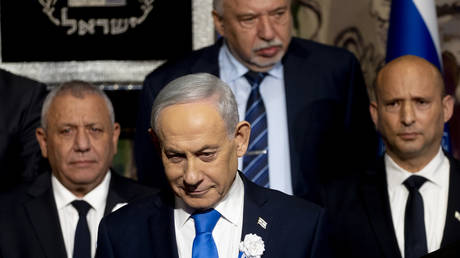
Benjamin Netanyahu does not survive by accident. He survives by exploiting every institutional fracture, playing factions against each other, and dragging out crises until his opponents stumble. Right now, Israel's longest-serving prime minister faces a familiar existential squeeze: a fractured parliamentary math problem, fierce disputes over military strikes on Iran, volatile West Bank security flare-ups, and a grinding corruption trial that suddenly shows signs of judicial shifting. Yet, writing him off is a rookie mistake.
The Coalition Deadlock And The Rotation Playbook
The numbers from the recent October elections didn't hand Netanyahu's bloc an outright majority, leaving him at the helm of a caretaker government while rivals scramble to build an alternative. When President Isaac Herzog initially tasked Yashar leader Gadi Eisenkot with assembling a cabinet, Netanyahu responded with characteristic tactical agility. He floated a power-sharing proposal involving a rotation of the premiership, offering Eisenkot the top job first while positioning Likud to re-enter the fold.
Why make such an offer? Because Netanyahu knows that keeping Likud inside a broad unity government prevents total exile. At the same time, he frames the alternative—a government reliant on Arab party support—as an unacceptable security risk.
His opponents aren't buying it easily. Factions within the anti-Netanyahu camp are deeply divided over whether to work with Arab lawmakers or partner with Likud. Yair Golan’s Democrats have pushed back hard against any deal involving Netanyahu's party, while Eisenkot navigates a fragile maze of negotiations with figures like Yisrael Beiteinu leader Avigdor Lieberman. While these factions argue over who gets to sit where, the clock ticks forward, and every week spent in caretaker status keeps Netanyahu in power.
The Iran Calculus And The Security Card
Foreign policy and regional brinkmanship remain the ultimate pressure valves in Israeli politics, and Netanyahu knows how to use them. Citing persistent intelligence warnings and concerns over Iran's nuclear program, he has repeatedly argued that a strong unity government is vital to confront external threats.
Opposition figures like Eisenkot and Lieberman have openly questioned the urgency of launching preemptive military strikes before a new permanent government is properly seated. Lieberman has gone so far as to label any unilateral strike order illegal during a caretaker phase.
Washington's complex dance with Tehran adds another layer of unpredictability. Reports of intelligence regarding security threats have complicated diplomatic bargaining, while US carrier strike groups maintain a heavy regional footprint. For Netanyahu, keeping the focus squarely on Iran deflects domestic outrage and reinforces the narrative that replacing seasoned leadership during a regional standoff is reckless.
West Bank Flashpoints And Internal Fault Lines
Domestic violence adds fuel to an already burning political fire. Recent nocturnal arson attacks by radical settlers in West Bank localities like Deir as-Sudan and Kafr Malik have intensified the toxic debate over law enforcement and political responsibility.
Eisenkot didn't mince words, publicly condemning the violence as Jewish terrorism and pointing the finger at National Security Minister Itamar Ben-Gvir and Finance Minister Bezalel Smotrich for fostering an environment of lawlessness. Ben-Gvir fired right back, accusing his critics of opportunism designed to court Arab lawmakers for coalition votes.
This domestic friction cuts straight to the core of Israel's coalition struggles. Every violent flare-up in the West Bank forces potential coalition partners to pick sides, deepening ideological divides and making a stable alternative government nearly impossible to stitch together.
The Legal Lifeline In The Courts
While the political theater plays out in the Knesset, a dramatic shift is quietly unfolding in the courtroom. Judges presiding over Netanyahu’s ongoing corruption trials recently suggested that prosecutors reconsider their stances, pointing toward potential openings in Case 4000 and Case 2000, while urging closure on Case 1000.
For an embattled leader fighting multiple legal fronts, time is the most valuable currency available. Prolonged coalition deadlocks buy months of breathing room. If the defense can use this political pause to chip away at the prosecution's strongest charges or secure a favorable settlement, Netanyahu achieves a dual victory: retaining political relevance while neutralizing his greatest legal vulnerabilities.
If Eisenkot somehow glues together a fragile majority without Likud, Netanyahu's run finally ends. But if coalition talks collapse over ultra-Orthodox draft laws, Arab party participation, or personal rivalries, the ultimate political survivor wins again. Watch the court filings and the Knesset arithmetic closely, because counting him out before the final gavel falls is always a mistake.


