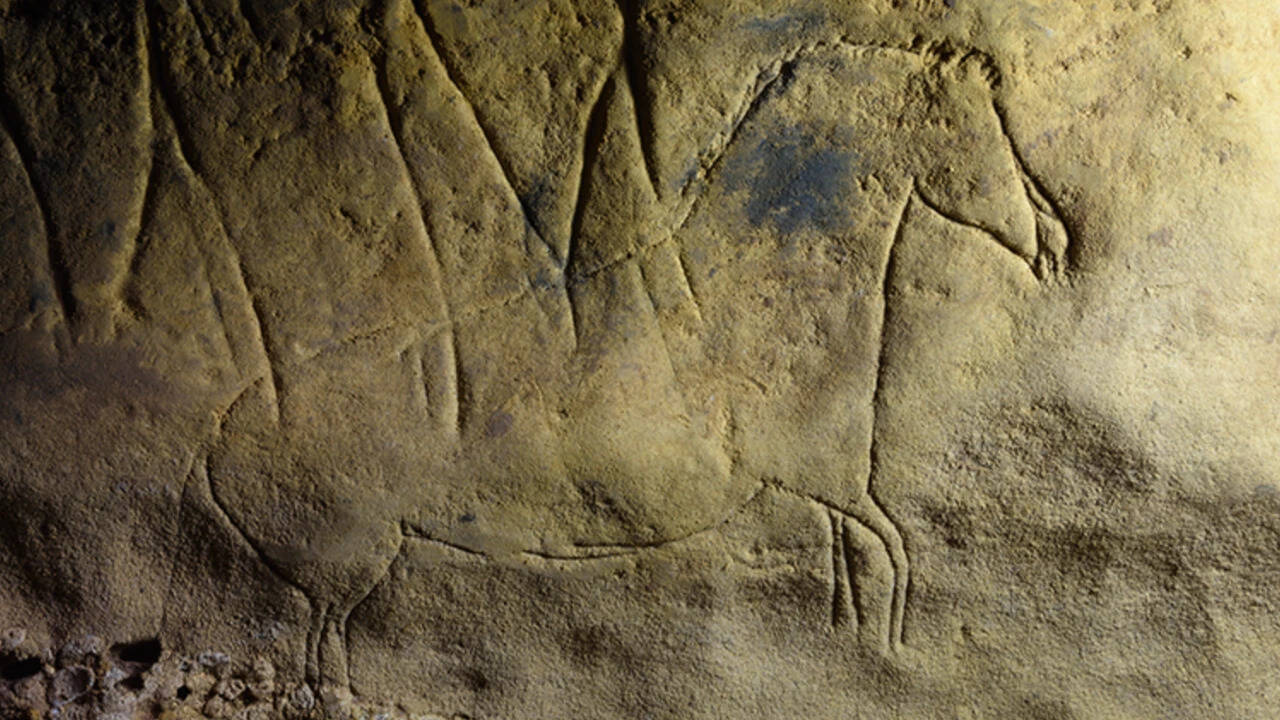
You can walk right past history and never even blink. That is basically what happened for over six decades inside a famous cave in Spain. Thousands of tourists, casual hikers, and local speleologists trudged through the subterranean passages of Catalonia's Cova de la Font Major. They flashed their lights, took photos, and left their own modern names scrawled on the stone.
Nobody saw the ancient ghosts watching them from the walls.
In late 2019, researchers Josep Maria Vergès Bosch and Míriam Salas-Altès from the Catalan Institute of Human Paleoecology and Social Evolution (IPHES-CERCA) took a closer look at a section called Gatoneres de Cal Palletes. What they found completely rewrites what we know about prehistoric life in Mediterranean Iberia. Published in Antiquity, their findings reveal a staggering 280 Palaeolithic motifs etched into the rock layers. It now stands as the third-largest known Ice Age art site on the Mediterranean coast of the Iberian Peninsula.
How Did Everyone Miss 280 Prehistoric Motifs?
People have used and visited Cova de la Font Major since at least the 12th century. By 1957, it became an established hotspot for public tours and speleology adventures. With hundreds of thousands of boots pacing through the tunnels over generations, how did 280 distinct engravings stay hidden in plain sight?
The answer comes down to rock texture and human blindness. Most visitors look where their headlamps point, staying focused on the main trail or modern graffiti. Furthermore, the cave's marl rock layers present an uneven, chaotic canvas. Earlier archaeologists assumed the rough surfaces were completely unsuitable for ancient artists. They figured prehistoric humans would stick to smoother limestone chambers found elsewhere in Europe.
They were wrong. When the research team examined unusual wall incisions that did not match modern vandalism, they realized these marks dated back tens of thousands of years. The ancient artists used the difficult rock face deliberately, carving deep lines and scraping surfaces to bring their vision to life.
Breaking Down the Artistry
This isn't just a few random scratches. The cataloged inventory at Cova de la Font Major contains immense detail and variety. Out of the 280 identified motifs, 55 are zoomorphic representations. That means they depict actual animals, including a striking bear engraving that anchors the collection.
To put that number in perspective, context matters. Roughly 75 percent of known Palaeolithic art sites along the Iberian Mediterranean coast hold fewer than five animal figures. More than 90 percent cap out at twenty. Finding 55 animal motifs in a single spot shatters regional averages.
The rest of the catalog consists of non-figurative designs, parallel lines, and complex geometric patterns. These abstract symbols challenge our assumptions about what early humans cared about. They weren't just sketching dinner targets; they were building an intricate visual language.
Shattering the Franco-Cantabrian Bias
For decades, mainstream archaeology suffered from a severe geographic bias. If you wanted to study Ice Age art in Europe, everyone pointed you north toward the Franco-Cantabrian region bridging France and northern Spain. That famous zone holds over half of all documented Upper Palaeolithic cave art on the continent.
Northeastern Spain, by contrast, was written off as an artistic wasteland. Before this discovery, researchers had only cataloged two meager Palaeolithic representations across the entire region of Catalonia. Scientists assumed early humans barely populated the dry Mediterranean coast during the Ice Age.
Cova de la Font Major proves that assumption was lazy.
The sheer density of engravings suggests a thriving, active human presence. More importantly, the stylistic choices don't match the northern Franco-Cantabrian mold. This points toward a distinct, localized artistic tradition unique to northeastern Iberia.
What This Means for Future Discoveries
When you peel back the layers of what we think we know about ancient history, gaps appear everywhere. Cova de la Font Major teaches us a humbling lesson. We haven't found everything out there. Much of it sits right under our noses, waiting for someone to ask better questions and look closer at the details.
If a heavily visited tourist cave can hide hundreds of Ice Age masterpieces for sixty years, what else are we walking past today? Check your local assumptions. The past is closer than you think.