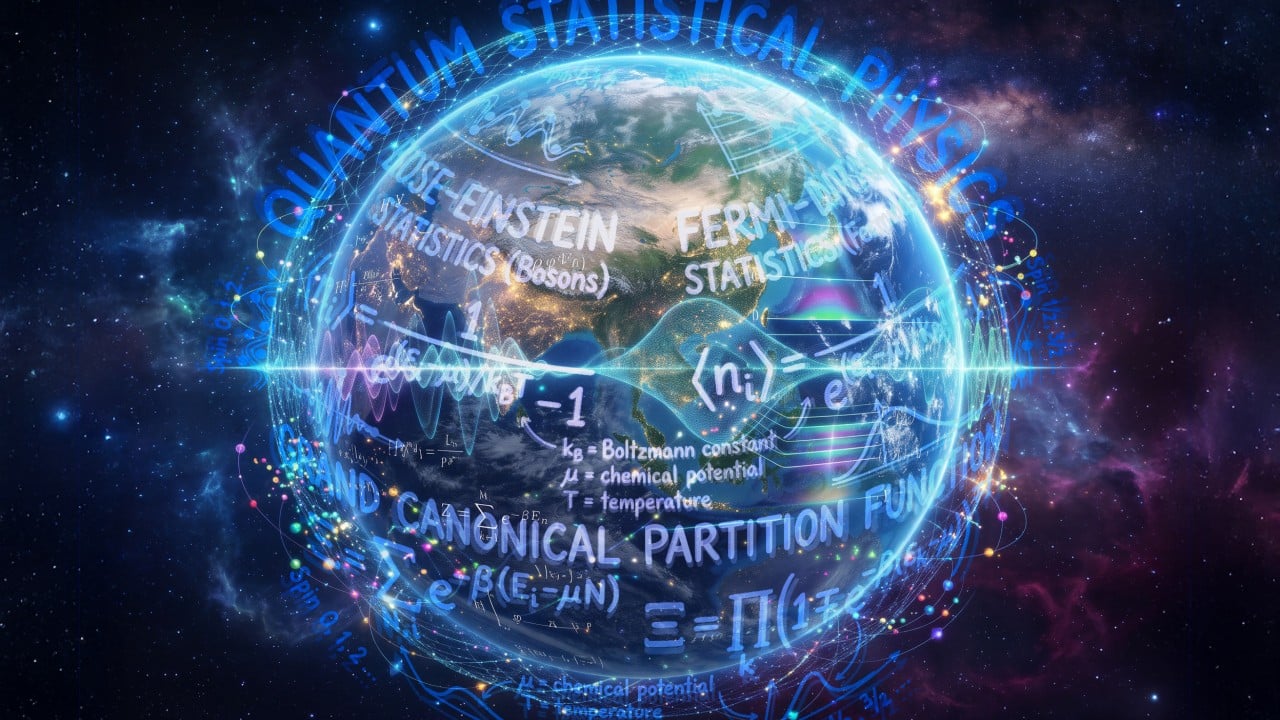
Physics education has a bad habit of stopping at four. You learn about gravity, electromagnetism, the strong nuclear force, and the weak nuclear force, and you're told that's the complete rulebook for the universe. It's a neat, tidy story that leaves out the strangest actor on the stage. Quantum statistics isn't a particle you can smash in a collider or a field you can map with a telescope. Yet, it dictates how matter behaves at the deepest levels, acting with the absolute authority of a fundamental law.
If you look at how modern physicists talk about nature, they keep running into a wall built by classical intuition. We think particles are like microscopic billiard balls, bouncing around independently according to their own internal rules. But once you drop down to the quantum scale, identity dissolves. Two identical particles aren't just similar—they become indistinguishable. You can't put a tiny painted number on an electron to track which way it goes. That simple, mind-bending fact changes everything.
The Rules That Direct the Microscopic World
To understand why quantum statistics packs the punch of a physical force, you have to look at how particles divide themselves into two distinct philosophical camps. You have bosons and fermions, and they treat personal space in radically different ways.
Fermions, which include electrons, protons, and neutrons, follow the Pauli exclusion principle. They are the ultimate introverts of the cosmos. No two identical fermions can occupy the exact same quantum state at the same time. This simple rule prevents matter from collapsing in on itself. It is the reason you don't fall right through your chair. When you sit down, the electrons in your body's atoms try to occupy the same space as the electrons in the chair's atoms. The exclusion principle steps in, creating a brutal quantum pressure that pushes back with immense force.
Bosons, on the other hand, are total extroverts. Particles like photons or gluons love company. They can pile on top of each other in the exact same quantum state, leading to collective behaviors like laser light or superfluids that flow without any friction whatsoever.
Beyond the Four Textbook Forces
When researchers talk about a "fifth force," they're usually hunting for new exotic particles or hidden dimensions that might explain dark matter. But quantum statistics achieves something arguably more profound without needing to invent a new boson. It imposes a statistical geometry on reality that creates macroscopic effects from microscopic rules.
Think about degeneracy pressure inside a white dwarf star. Gravity is desperately trying to crush the dead star into a single point, but degenerate electrons refuse to share space. The resulting outward push has nothing to do with electrostatic repulsion or thermal heat. It is pure quantum statistics holding up a massive star against the crushing weight of gravity. If you ignored quantum statistics, white dwarfs couldn't exist, and the late-stage evolution of the cosmos would look entirely different.
We see this same strange influence in condensed matter physics every single day. Superconductivity relies on electrons pairing up into bosons called Cooper pairs, bypassing the usual resistance of a crystal lattice. These aren't effects you can derive from Newton's laws or Maxwell's equations. They emerge entirely from the mathematics of how particle states combine and permute.
Why This Matters Now
We're currently racing to build functional quantum computers, and understanding these statistical boundaries isn't just academic theory anymore. Controlling qubits means managing whether you are dealing with fermionic or bosonic behavior. When engineers manipulate photons or superconducting circuits, they're actively engineering around the statistical laws that govern particle states.
Stop thinking of physics as just a collection of pushes and pulls. The invisible architecture of our universe is built on probability, identity, and the stubborn rules of quantum counting.
Take a closer look at how materials behave under extreme pressure or how ultra-cold atoms form Bose-Einstein condensates. That is where you see the real engine of the universe running.