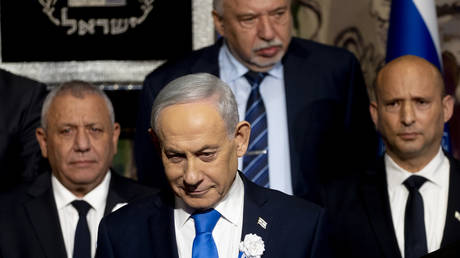
Israeli politics has a way of repeating itself until nobody believes the script anymore. Prime Minister Benjamin Netanyahu just renewed his call for Israeli government unity, framing it as an urgent necessity in the middle of ongoing regional crises. Opposition figure and former IDF Chief of Staff Gadi Eisenkot didn't buy it for a second, flatly dismissing the overture as political "tricks."
If you've followed coalition dynamics in Jerusalem over the past few years, Eisenkot's reaction makes complete sense. You don't need an insider's badge at the Knesset to see what's happening here. When Netanyahu talks about national unity, opposition leaders hear a survival strategy designed to shore up a fragile governing bloc rather than a genuine willingness to share power.
What Actually Happened Between Netanyahu and Eisenkot
Let's look at the immediate clash. Netanyahu publicly urged opposition figures to set aside political differences and join forces under a broad unity banner, arguing that external security threats demand an undivided front. On paper, that sounds reasonable. In wartime or periods of intense regional instability, democratic nations often form emergency governments.
Eisenkot's response cut right through the rhetoric. Having already served in an emergency war cabinet earlier in the conflict—and eventually walking away from it—Eisenkot dismissed Netanyahu's renewed pitch as tactical maneuvering. Calling it "tricks" isn't just a catchy soundbite for the evening news. It reflects deep-seated distrust built from firsthand experience inside Netanyahu's decision-making circle.
Why "Tricks" Is a Loaded Word in Israeli Politics
In Hebrew political discourse, accusing a prime minister of "tricks" (often shtikim or targilim) carries specific baggage. It suggests a leader is dangling a portfolio or a seat at the table purely to neutralize a rival, divide the opposition, or buy time before an election or a major coalition crisis.
Eisenkot knows the playbook intimately. When he and Benny Gantz joined the emergency government following the October 7, 2023 attacks, they believed their presence would steer military and diplomatic strategy toward long-term goals, including hostage releases and realistic post-war governance. Instead, they repeatedly found themselves sidelined when critical decisions collided with the demands of Netanyahu's far-right coalition partners.
The Structural Problem With Israeli Government Unity
Here is what most casual observers miss about calls for Israeli government unity. The obstacle isn't personal animosity between two stubborn men. It's the basic math of the Knesset and the ideological gulf separating Netanyahu's current partners from centrist opposition leaders.
Right now, Netanyahu's governing coalition relies heavily on ultra-Orthodox (Haredi) parties and religious nationalist factions led by figures like Bezalel Smotrich and Itamar Ben-Gvir. Those parties have red lines that directly clash with almost everything Gadi Eisenkot stands for:
- Military conscription: Centrist leaders demand broad, equitable draft laws requiring ultra-Orthodox men to serve in the IDF, especially after years of exhausting reserve duty for secular and national-religious Israelis. Netanyahu's Haredi allies threaten to topple the government the moment meaningful enforcement is proposed.
- Post-war diplomatic strategy: Eisenkot and other opposition figures have consistently pushed for pragmatic regional arrangements and clear political endgames in Gaza and Lebanon. Far-right ministers openly advocate for permanent military occupation and settlement expansion, rejecting compromises that Washington and regional Arab partners view as essential.
- State institutions and judicial independence: Before the war erupted, Netanyahu's coalition spent months trying to overhaul the judiciary, sparking massive nationwide protests. Opposition leaders view those efforts as an existential threat to Israeli democracy and refuse to prop up a government that hasn't formally abandoned them.
You can't bridge those gaps with a handshake and a press release. If Netanyahu brings Eisenkot into the room without dismantling his current coalition's core commitments, Eisenkot becomes window dressing. He takes shared blame for policies he opposes while holding zero veto power over the outcomes.
How Netanyahu Uses Unity Calls as Political Leverage
I've watched political leaders across democratic systems deploy the "unity" card, and Netanyahu is arguably the most skilled practitioner of the move in modern history. Even when an invitation is guaranteed to be rejected, issuing it serves several practical purposes for a sitting prime minister.
First, it shifts the blame. By publicly extending an olive branch, Netanyahu gets to tell voters that he tried to put the country first, while portraying Eisenkot and the opposition as petty politicians who prefer partisan warfare over national solidarity. In a polarized media environment, that framing sticks with undecided center-right voters.
Second, it tests the cohesion of the opposition bloc. Israel's opposition isn't a single unified party; it's a loose collection of centrists, left-wingers, and right-wing Netanyahu critics who agree on removing the prime minister but disagree on plenty else. Floating a unity offer forces opposition figures to publicly state their terms, exposing subtle differences in tone and ambition among them.
Third, it puts pressure on his own coalition partners. Whenever far-right ministers threaten to bolt over a cease-fire proposal or a budget dispute, Netanyahu can subtly remind them that he has alternatives—even if those alternatives are mostly theatrical.
Gadi Eisenkot’s Political Trajectory and Credibility
To understand why Eisenkot's pushback carries weight, you have to look at his standing with the Israeli public. Unlike career politicians who spent decades climbing party lists, Eisenkot spent nearly forty years in the Israel Defense Forces, serving as Chief of the General Staff from 2015 to 2019.
His credibility isn't theoretical. During the war, Eisenkot suffered devastating personal losses—including the death of his son, Gal, in combat in Gaza, as well as the deaths of two nephews. When he speaks about the human cost of military operations and the necessity of clear strategic objectives, Israelis listen differently than they do to standard partisan commentary.
Since leaving the war cabinet, Eisenkot has positioned himself as a sober, plain-spoken critic who refuses to play along with political theater. By labeling Netanyahu's renewed unity call as "tricks," he is signaling to voters that he won't repeat the mistake of lending legitimacy to a government whose core structure prevents decisive action.
What Opposition Leaders Actually Want Instead
If Eisenkot and other opposition leaders aren't interested in joining Netanyahu's existing coalition, what is their counter-offer? They've been remarkably consistent about this, even if it rarely gets framed cleanly in international headlines.
The opposition's version of "unity" starts with an agreed-upon election date. From their perspective, the current Knesset no longer reflects the public will, and true national healing requires going back to the voters. Until an election happens, centrist leaders have repeatedly offered a "safety net" from outside the government—meaning they would vote in the Knesset to protect the coalition from collapse if Netanyahu pursued major hostage deals or historic regional normalization agreements that his far-right ministers opposed.
Think about that distinction. An external safety net gives the prime minister all the legislative backing he needs to make tough, historic decisions for the country. What it doesn't give him is cover for routine governance, draft exemptions, or partisan budget allocations. Netanyahu's refusal to rely on an external safety net—and his insistence on formal unity talks instead—tells you everything about where his priorities lie.
Why International Observers Often Misread These Headlines
When news outlets like France 24 report on Netanyahu renewing unity calls and Eisenkot dismissing them, international readers sometimes view it through a Western parliamentary lens where "grand coalitions" are normal signs of maturity. Look at Germany, where rival center-right and center-left parties regularly govern together without drama.
Israel doesn't work like Berlin. Under Israel's proportional representation system with a low electoral threshold, small ideological parties hold disproportionate blackmail power over whoever sits in the prime minister's chair. A unity government in Jerusalem only works when the prime minister is genuinely willing to trade away ideological allies to build a centrist core.
We saw this happen briefly in 2021 when Naftali Bennett and Yair Lapid assembled an unusually broad coalition spanning right-wing, centrist, left-wing, and Arab Islamist parties. That experiment survived for roughly a year before collapsing under its own contradictions. When Netanyahu formed his current government afterward, he intentionally built a narrow, ideologically rigid bloc to avoid those internal compromises. Trying to graft Gadi Eisenkot onto that structure now is like trying to bolt a hybrid engine onto a vintage muscle car without changing the chassis.
What to Watch Next in Jerusalem
Don't expect Eisenkot's sharp dismissal to end the conversation. Netanyahu rarely drops a narrative once he thinks it resonates with his base, and regional developments will keep creating moments where calls for solidarity sound tempting on the surface.
If you want to cut through the noise and see whether any unity talk in Israel is real or just another round of political theater, watch three concrete indicators over the coming weeks:
- Coalition composition: Does Netanyahu signal any willingness to part ways with his most polarizing far-right ministers, or does he expect opposition figures to sit alongside them? If everyone stays in the room, nothing changes.
- Legislation on IDF conscription: Watch how the government handles ultra-Orthodox draft exemptions. Real unity requires real burden-sharing, and no centrist leader can survive politically if they rubber-stamp blanket exemptions during an ongoing security crisis.
- Clear strategic mandates: Any serious unity deal requires written, binding agreements on diplomatic endgames and hostage negotiations—not vague promises of "consultation" inside a powerless forum.
Until those conditions appear on the table, Eisenkot's assessment stands. Calling for unity while refusing to change the policies that divide the country isn't statesmanship—it's just politics as usual.