Walk past any hospital corridor, airport terminal, or city park and you'll spot thick-soled Hokas everywhere. People love the idea of stepping onto a plush cloud after a long day on concrete. Yet buying the wrong Hoka walking shoe is surprisingly easy when a brand throws terms like Active Foot Frame, H-Frame, and MetaRocker at you without explaining what actually happens to your foot inside the shoe.
Here's the short version before you scroll any further. If you want an everyday all-rounder that feels light and balanced, start with the Hoka Clifton 11. If your feet ache after hours on hard floors and you want maximum shock absorption, look at the Hoka Bondi 9. When your ankles roll inward and you need real structural guidance, compare the Hoka Arahi 9 against the wider, roomier Hoka Gaviota 6. And if you mainly commute, run errands, or want a lower-profile daily shoe with decent grip, the Hoka Transport 2 hits a sweet spot.
Cushioning Isn't the Same as Support
A lot of shoppers assume thicker foam equals better support. Honestly, that's backwards.
Support is about alignment, base width, and resistance to twisting or excessive ankle roll. Cushioning is about how much shock the foam absorbs before it reaches your joints. A super-tall, marshmallow-soft sole can actually feel wobbly if your ankle already tends to drift inward or if your balance isn't great on uneven pavement.
Hoka builds its shoes around a bucket-seat concept called the Active Foot Frame. Instead of perching your foot flat on top of a slab of foam, the midsole walls wrap slightly up around the sides of your foot. Deeper walls create more cradling; gentler walls feel freer. Pair that with a curved rocker geometry—which helps roll your stride forward from heel strike to toe-off—and walking feels less like slapping your foot down and more like rolling through a smooth arc.
Research backs up the mechanics behind rocker soles. A 2013 biomechanics study of 48 participants found that rocker-soled footwear reduced peak pressure under the central forefoot by up to 39% compared with standard flat footwear. Another study from 2025 looking at 29 women with heel pain reported a 15% reduction in peak heel pressure with a higher-drop shoe design compared with a lower-drop, different-outsole option. Numbers like that explain why people with tender heels or sore balls of the feet often notice relief quickly, even though individual response always varies.
Worth knowing: Podiatric organizations like the American Podiatric Medical Association grant a Seal of Acceptance to select models after reviewing them for foot health benefits, though the organization notes the seal is a recognition rather than a blanket medical prescription for every foot.
How the Core Hoka Walking Models Stack Up
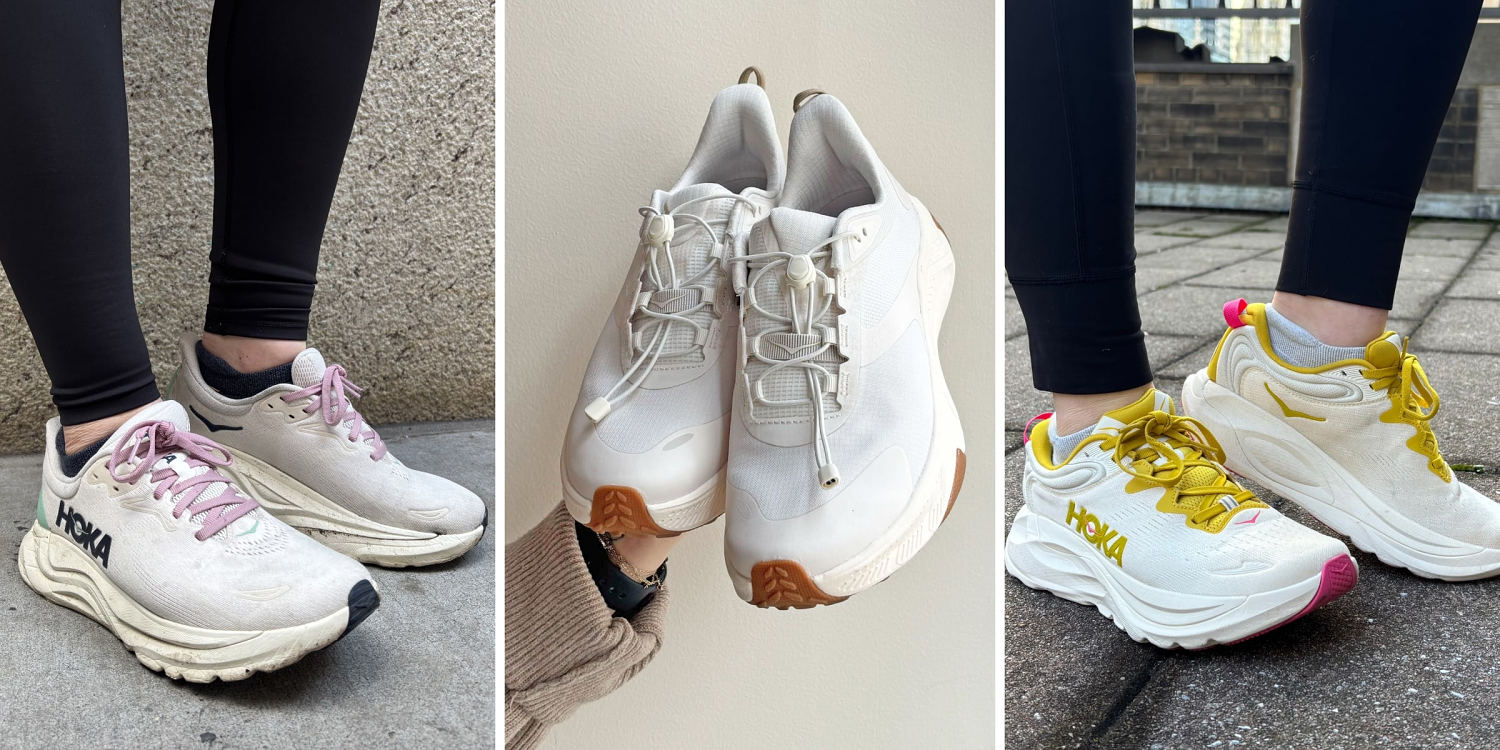
Testing Hoka walking shoes over weeks of errands, city sidewalks, and longer fitness walks reveals how differently five popular models behave once the novelty wears off.
Hoka Clifton 11 for everyday balance without bulk
The Clifton 11 is the default recommendation for a reason. It gives you a generous stack of foam with a lighter, more nimble feel than Hoka's heaviest cruisers, using an engineered mesh upper and an 8 mm heel-to-toe drop.
In real-world walking, it shines on five-mile neighborhood loops and travel days where you don't want a clunky shoe dragging behind you. Lab testing from RunRepeat shows high heel shock absorption paired with noticeable torsional flexibility, meaning the shoe bends and twists fairly easily rather than locking your foot into a rigid plank. That flexibility feels great for normal walking, though if your toebox runs wide or you have a prominent bunion, you may want to size up or pick a Wide option because Hoka's standard forefoot often tapers.
Hoka Bondi 9 for maximum shock absorption
If you stand on tile, concrete, or hospital floors all day and your heels feel bruised by 4 p.m., the Bondi 9 is built for that punishment. Hoka pushed the stack height even higher on the Bondi 9—around 42 mm for women and 43 mm for men with a 5 mm drop—and moved to a supercritical-foamed EVA setup.
Despite the towering look, independent lab measurements have noted that the Bondi 9 isn't necessarily mushy in a sloppy way; it combines a wide base with firmer-than-expected foam control, while still absorbing heavy impact. The trade-off is weight and bulk. You feel protected, not light on your feet.
Hoka Arahi 9 for nimble stability
Stability shoes used to feel like orthopedic bricks. The Arahi 9 aims to keep your foot centered and curb excess inward rolling (overpronation) while keeping weight down—around 8.2 oz in women's and 10 oz in men's—with an 8 mm drop.
It's a smart pick if you overpronate mildly to moderately and want something closer to a daily trainer than a heavy motion-control boot. Still, keep expectations grounded: a classic Cochrane review of military footwear trials found little evidence that prescribing shoes strictly by arch shape prevents injuries on its own. Use arch and pronation tendencies as a starting filter, then judge how your stride actually feels.
Hoka Gaviota 6 for structured support and roomier fit
When you want stronger stability features—including Hoka's H-Frame architecture—plus a bit more breathing room up front, the Gaviota 6 steps in. Specs list a 6 mm drop and heel stack heights around 37.9 mm for women and 39.3 mm for men, with weights right around 8.62 oz and 10.25 oz.
Independent gel-mold and caliper measurements from RunRepeat highlight a noticeably wider forefoot platform and roomier upper dimensions compared with several tighter Hoka lasts, making it a favorite for broader feet needing steady support. Airflow can feel warmer on hot days, so factor climate into your choice.
Hoka Transport 2 for errands, commuting, and daily wear
Not every walk is a fitness workout. Sometimes you're bouncing between coffee shops, train platforms, and grocery aisles, and a giant running shoe looks—and feels—like overkill.
The Transport 2 bridges everyday lifestyle wear and practical walking utility, coming in at roughly 9.7 oz for women and 11.3 oz for men with a 36.3 mm heel stack, 5 mm drop, water-repellent treated mesh, quick-pull laces (plus standard laces in the box), and grippy outsole lugs. It gives you a steadier, slightly more grounded street feel than maximum-stack trainers, though if you want heavy-duty trail protection or Gore-Tex waterproofing, Hoka sells dedicated variants for that too.
Mistakes People Make With Hoka Walking Shoes
Even great shoes disappoint when people fall into predictable traps.
- Treating foam as permanent. According to guidance from the American Academy of Orthopaedic Surgeons, EVA foam compresses and loses shock-absorbing resilience over time with repeated impact. Even if the upper mesh and rubber outsole still look spotless, the midsole can feel flat and tired well before the shoe looks "old".
- Ignoring toebox shape. People often see "Wide" on a size chart and assume every toe will have extra wiggle room. Several Hoka models still feature a tapered toe profile, so trying the shoe on later in the day—when feet naturally swell a bit—saves headaches later.
- Expecting a sneaker to cure sharp pain by itself. Supportive walking shoes can make long days more comfortable, especially if you have heel or forefoot soreness. If you have persistent foot, arch, or ankle pain, footwear works best alongside smart load management and professional care rather than acting as a standalone fix.
How to Pick the Right Pair Today
Narrow your choice down in three quick steps before spending money:
- Match the shoe to your main surface and pace: Pick the Clifton 11 for versatile daily walks and travel, Bondi 9 for maximum impact relief on hard surfaces, Arahi 9 or Gaviota 6 when you want added stability, and Transport 2 for casual errands and everyday commuting.
- Test fit late in the day: Walk around on a hard floor for at least ten minutes, paying attention to your heel lockdown, arch pressure, and whether your pinky toe or big toe feels pinched.
- Track your mileage and rotation: Rotate pairs if you walk long distances daily, and pay attention to subtle changes in foot or knee fatigue as a sign your midsole foam is packing out.
Hoka walking shoes review walks through real-world impressions and wear considerations so you can see how these cushioning and durability trade-offs play out in practice.