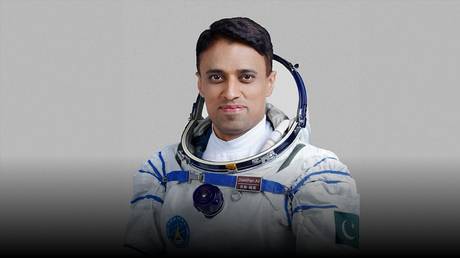
A Pakistan Air Force wing commander is about to step aboard China's Tiangong space station as its first foreign visitor. That headline sounds neat and tidy. Honestly, the real story is messier, faster, and way more strategic than a simple goodwill flight.
Muhammad Zeeshan Ali, age 40, is scheduled to lift off on the Shenzhou-24 mission aboard a Long March 2F rocket from the Jiuquan Satellite Launch Center on November 25, 2026, at 8:18 a.m. Beijing time. He will fly alongside Chinese crewmates Tang Hongbo and Wu Yi. His stay aboard Tiangong will be short—roughly five to ten days—before he rides back to Earth with departing crew members aboard Shenzhou-23.
Brief headlines often flatten a flight like this into pure diplomatic theater. Look closer and you see a calculated blueprint for non-Western human spaceflight, accelerated training timelines, and long-term lunar ambitions.
How a Pakistani Pilot Became Tiangong's First Foreign Crew Member
Speed defines this selection. Pakistan's Space and Upper Atmosphere Research Commission, SUPARCO, signed an astronaut cooperation agreement with the China Manned Space Agency in February 2025. In April 2026, Ali and fellow candidate Khurram Daud entered training in China. Seven months later, Ali got the nod for Shenzhou-24.
Seven months from training selection to launchpad is breakneck by traditional space agency standards. Most national astronaut corps spend years in baseline selection, technical qualification, and mission-specific sims before ever touching a flight manifest. Here, Ali trained as a payload specialist rather than a spacecraft pilot, focusing on science operations while experienced Chinese crewmates handle flight control and station systems.
And learning Mandarin wasn't optional. Station labels, procedures, and day-to-day crew coordination run in Chinese, and Ali entered training with virtually no foundation in the language. Centrifuge runs, emergency drills, survival training, and language immersion all had to click in less than a year.
One clarification matters right away. Some reports call Ali the first Pakistani in space. That's not quite right. Namira Salim flew on Virgin Galactic's Galactic 04 suborbital flight in October 2023. Ali's milestone is different: he is the first Pakistani citizen to fly on a Chinese space mission, the first foreign crew member to board Tiangong, and the first to reach orbital spaceflight under this program.
What Ali Will Actually Do in Orbit
A week in microgravity sounds brief if you expect a long-duration expedition. Yet short-stay payload specialists serve a very practical purpose on orbital stations.
Ali is tasked with four scientific projects selected from more than 300 proposals submitted for the mission, spanning biotechnology, materials science, and photosynthetic microorganisms. His job during those initial days is to set up and start the experiments, verify that hardware survived launch loads and vibration, and capture baseline microgravity data. Finishing the full scientific runs takes six to twelve months, which means the permanent Tiangong crew carries the baton long after Ali heads home.
That handover points to a bigger operational shift happening on the exact same flight. Shenzhou-23 commander Zhu Yangzhu, who launched in May 2026, is slated to remain aboard for another six months to complete China's first full-year stay in orbit. Long-duration human endurance data matters directly to lunar and deep-space planning, where crews face months of isolation, radiation exposure, and physiological wear.
Why Geopolitics and Orbital Access Collide Here
You can't separate this flight from how international space partnerships are dividing. For years, restrictions such as the U.S. Wolf Amendment have constrained bilateral NASA-China space agency cooperation, while China built Tiangong into a standalone three-module station completed in late 2022. Meanwhile, Pakistan has sought stronger external technical partners to scale its space capabilities.
As analysts quoted by Al Jazeera have noted, China was excluded from the International Space Station program, and Pakistan has also lacked astronaut flights on the ISS. Bringing a Pakistani payload specialist onto Tiangong turns a bilateral diplomatic relationship—marking 75 years of ties in 2026—into tangible orbital access.
Still, let's be realistic about what one short-duration seat proves. A single payload specialist flying for roughly a week demonstrates political alignment and basic operational integration. It does not automatically mean foreign partner modules, independent international crew rotations, or deep joint hardware manufacturing at scale. Spaceflight diplomacy moves in incremental steps, and hype often runs ahead of engineering reality.
Looking Past Shenzhou-24 Toward the Moon
The more consequential question isn't what happens on day three of Ali's flight. It's what comes next.
China and Pakistan already have robotic lunar history together. Pakistan's iCube-Qamar cubesat, developed at the Institute of Space Technology, flew to lunar orbit aboard China's Chang'e-6 mission in 2024. Looking ahead, SUPARCO has pointed to ongoing work with China on a lunar mission tentatively targeted around 2028, including a SUPARCO-developed rover slated for Chang'e-8.
If Shenzhou-24 works as intended, it gives Islamabad something harder to measure than a photo op: hands-on crewed flight experience, ground-control coordination lessons, and scientific payloads that can feed back into domestic research, including medical and materials applications.
Practical Ways to Track and Evaluate This Milestone
If you're following this mission—whether for aerospace news, policy analysis, or STEM education—don't stop at the first-foreigner headline. Here's how to track what actually matters over the coming months:
- Watch the launch and docking sequence: Track the Long March 2F liftoff scheduled for November 25, 2026 (8:18 a.m. Beijing time) and check updates on Shenzhou-24's rapid autonomous rendezvous and docking with the Tianhe core module.
- Verify the crew swap and return leg: Follow official announcements from the China Manned Space Agency and SUPARCO to confirm Ali's return aboard Shenzhou-23 alongside departing crew members, while Zhu Yangzhu remains for the extended stay.
- Follow the six-to-twelve-month science readout: Keep an eye on experiment outcomes in biotechnology, materials, and photosynthetic microorganisms rather than treating the launch week as the end of the science.
- Separate diplomatic statements from hardware milestones: Track concrete follow-through on joint payloads and lunar cooperation—such as Chang'e-8 rover progress—to see how this flight shapes future missions.


