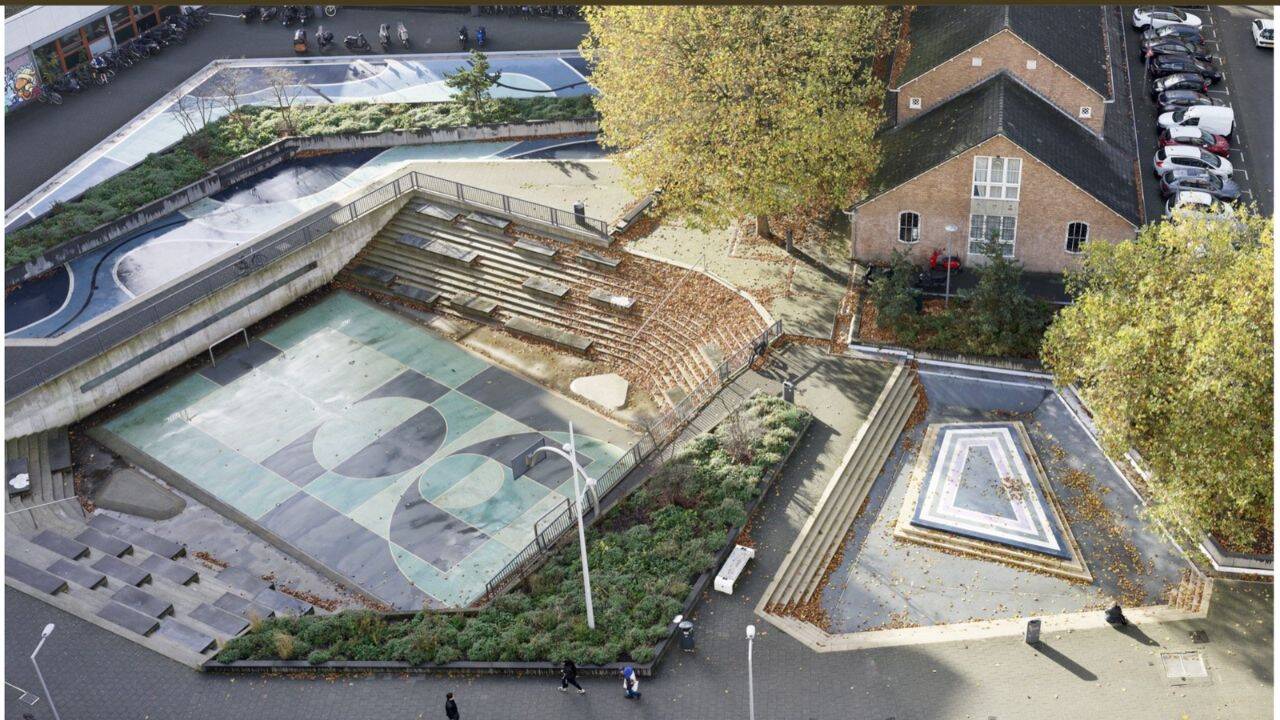
Most cities build flood infrastructure underground and forget it exists until the pipes back up into someone's basement. Rotterdam did the exact opposite. At Benthemplein, when the sky opens up, a neighborhood hangout turns into a temporary rainwater reservoir. When the clouds clear, those same sunken basins become basketball courts, volleyball spots, skating ledges, and amphitheater steps.
I've spent plenty of time looking at municipal drainage projects that sound brilliant in a slide deck and turn into dead zones on the ground. A concrete detention pit behind a chain-link fence doesn't get used on a sunny Tuesday. Benthemplein works because it treats water as a seasonal guest rather than an emergency. It sits right between the dense Agniesebuurt neighborhood and central Rotterdam, surrounded by a long 20th-century building block designed by Hugh Maaskant that houses schools, offices, a gym, and a youth theater, plus a 19th-century church. Before the redesign, it was a dull, underused expanse with a line of trees and not much reason to linger.
How a Rotterdam Water Square Actually Works
To understand Rotterdam water squares, you have to stop thinking of stormwater as waste that needs to vanish down a pipe immediately. In a city sitting largely below sea level with a combined sewer system, sudden cloudbursts overwhelm underground conduits fast. Conventional deep concrete tanks under streets can cost a fortune and give residents zero daily benefit.
Designed by De Urbanisten and opened on December 4, 2013, Waterplein Benthemplein uses three distinct basins at different depths. Two shallower blue-toned basins catch runoff from the square itself during ordinary rain. A third, deeper central basin stays dry most of the time and only fills when rain persists and volumes climb, pulling water from a wider catchment area through visible stainless-steel gutters, a water wall, and a rain well that channels roof water from an adjacent building.
The timing matters just as much as the capacity—roughly 1,700 to 1,800 cubic meters (about 1.8 million liters) across the plaza's layout. Water in the shallow basins filters into the subsoil to support nearby greenery and groundwater, while water in the deeper basin drains back to Rotterdam's open-water system within a maximum of 36 hours. That 36-hour cap isn't arbitrary. Leaving standing urban runoff sitting around for days invites algae, odor, and public health headaches. Getting it moving again quickly keeps the plaza clean and ready for play.
The smartest trick at Benthemplein isn't the concrete. It's making the plumbing visible—stainless-steel gutters for water channels, blue surfaces where water collects—so neighbors see how their street handles a storm instead of treating rain like a hidden utility problem.
Why Courts and Skate Lines Beat Hidden Tanks
Let's be honest: a giant hole in the ground with a sign saying "Flood Retention Basin" isn't going to draw teenagers after school. Benthemplein flipped that script by designing the basins for dry-weather life first. The deep central pit doubles as a court for basketball, football, and volleyball, framed by stepped seating where friends can sit and watch.
Meanwhile, the shallower areas give skaters, wheel sports, and casual hangouts room to move without crowding a pickup game. According to PublicSpace, the stainless-steel gutters aren't delicate little trim pieces either—they're built tough and oversized so skateboarders can ride along them. Patches of tall grasses, flowers, and existing trees break up the hard surfaces and soften the microclimate on warm days.
Community workshops played a real role here too, not just as a box-ticking exercise. Students and teachers from Zadkine College and the Graphic Lyceum, church members, gym-goers, youth theater folks, and local residents spent months hashing out what they wanted. Young people pushed for active space to play and be seen; older neighbors and quieter visitors wanted greener pockets and places to sit. That tension is pretty common in city parks, and you can see how the layout tries to keep loud courts and calmer edges from stepping on each other's toes.
The Trade-Offs Nobody Mentions in Hype Threads
Whenever a project goes viral on social media, people treat it like a magic blueprint any city can drop onto any corner. Doesn't work that way.
First, cost and site conditions are real constraints. Benthemplein came in around €4 million to €4.5 million, with funding tied to climate and water programs like the Rotterdam Climate Initiative, water board support, and innovation subsidies. Building a large, deep basin required piling work and careful engineering in dense urban ground. Smaller neighborhood squares like Bellamy Square in Spangen (with around 250 cubic meters of storage) or Kleinpolder Square in Overschie show that you can scale the idea down or tuck storage underground where space or budget is tight, sometimes even placing sculptures on raised plinths so water doesn't damage them.
Second, multi-use spaces require ongoing care. You can't install stainless-steel channels, painted basins, and stepped concrete seating and walk away for five years. Leaves, trash, and wear from sports and skates need regular maintenance, and a court that just had standing water needs to dry and clear before normal games pick back up. As TERRA50 notes in its case study of the project, performance depends on catchment area, soil and subsurface conditions, and dedicated upkeep budgets.
There's also a practical expectation check for anyone visiting or planning around a sunken plaza. If a heavy downpour hits, your pickup basketball game isn't happening in the deep basin right away—you're waiting for the water to recede and the surface to dry out. For a neighborhood that deals with intense rain, trading an occasional rained-out court for less street flooding is a pretty fair bargain, though it's worth knowing how the space behaves across seasons.
Practical Next Steps for Planners, Advocates, and Visitors
If you're looking at Rotterdam's approach because you care about urban design, neighborhood parks, or climate adaptation in your own city, start with practical moves rather than grand slogans.
- Map your local pinch points first. Look at where water actually pools during heavy rain and which nearby streets or schoolyards already lack safe, welcoming public space. A water square only solves a problem if it sits where runoff can reach it and people actually walk by.
- Pair drainage budgets with park budgets. One reason Benthemplein happened is that water management and public realm goals were tackled together rather than split into two disconnected spreadsheets. If you're talking to local officials, ask how flood mitigation funds and park recreation funds can overlap.
- Host messy, honest community workshops early. Bring in the people who will really use the space—students, skaters, athletes, parents, and older neighbors—before drawings are locked in. Ask what feels missing in the neighborhood right now, not just how they feel about drainage pipes.
- Visit or study both dry and wet conditions. If you visit Rotterdam or review project documentation from groups like Climate Adaptation Platform Netherlands, look at how drainage timing, surface materials, and planting hold up over time rather than judging a space by a single sunny photo.