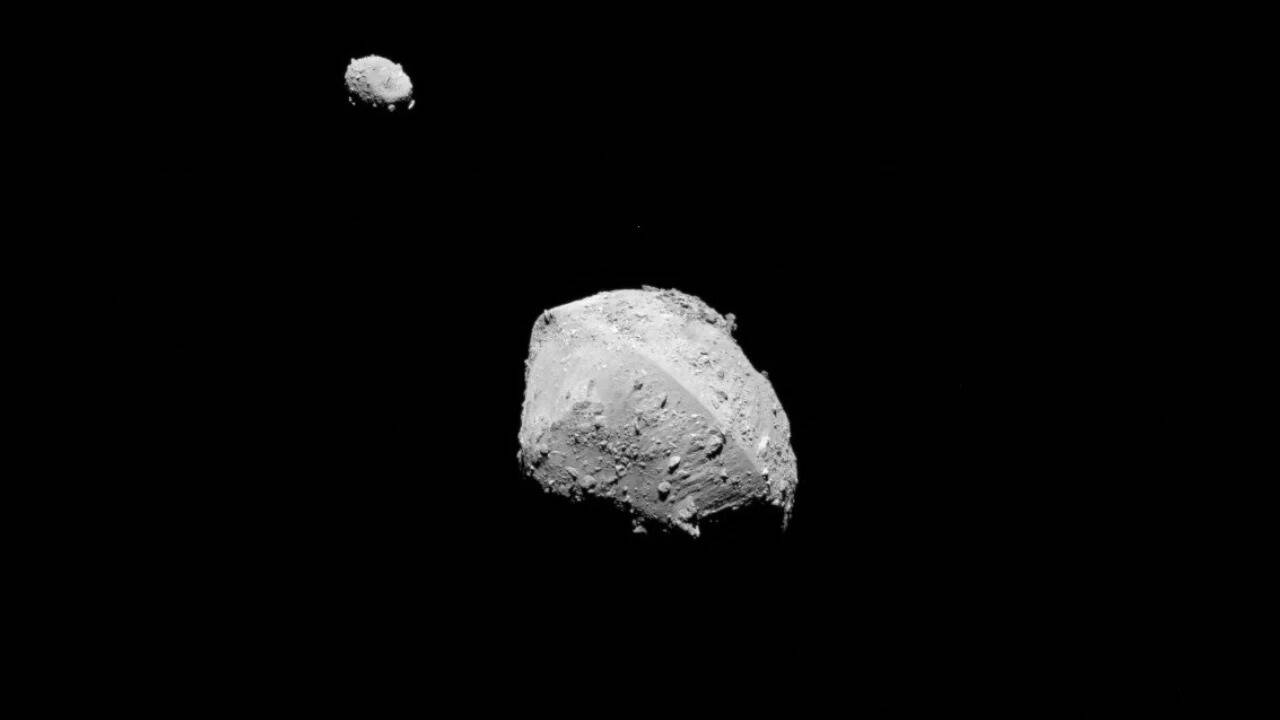
Scientists spent four years arguing over whether NASA's asteroid crash test punched a clean crater into Dimorphos, reshaped the whole moonlet, or left barely a dent. Now the first close-up images from the European Space Agency's Hera spacecraft are in, and the answer turns out to be all three at once.
Honestly, the photos look wild. When NASA's Double Asteroid Redirection Test, better known as DART, slammed into the 151-meter moonlet Dimorphos on September 26, 2022, at roughly 14,000 miles per hour (about 22,530 km/h), it didn't just knock Dimorphos into a tighter, 33-minute-shorter orbit around its 730-meter companion Didymos. Hera's Asteroid Framing Camera captured the struck face flattened into a stadium-sized crater spanning nearly the entire width of the body, complete with odd internal features like an elongated, cigar-shaped structure near the center.
That single detail flips a lot of early assumptions on their head. Before Hera arrived at the binary system in November 2026 after launching in October 2024, computer models had a hard time agreeing on what actually happens when a roughly half-tonne probe hits a loose, rubble-pile space rock. Some simulations even predicted there wouldn't be a distinct crater left behind at all.
Why The Crater Changes Planetary Defense Math
Knocking an asteroid off course sounds simple on paper. You throw a heavy object at high speed, transfer momentum, and watch the trajectory bend.
In reality, kinetic impact is messy. A big chunk of the push comes from recoil when thousands of tons of rock and dust blast backward off the surface, acting like a jet of ejecta. How much material blasts off, at what angle, and at what speed depends on whether the target is solid bedrock or a loosely bound pile of boulders held together by tiny amounts of gravity.
Without seeing the aftermath up close, mission planners had to guess at key pieces of the puzzle. DART proved that deflection works, beating NASA's pre-test benchmark of a 73-second orbit shift by shortening Dimorphos's loop around Didymos by about 33 minutes. Later orbital tracking even showed a tiny shift of around 0.15 seconds in the pair's orbit around the Sun. Yet Earth-based telescopes couldn't weigh Dimorphos directly or inspect the scar left on its surface.
Now Hera is surveying the system from roughly 25 to 30 kilometers away, giving researchers a real crash-scene investigation rather than a guess. As Hera principal investigator Patrick Michel has noted, getting "all three" outcomes—a massive crater, shape change, and a chaotic tumble—shows how sensitive a small body's response is to the exact physics of the collision.
Surprises Hiding Around Didymos And Dimorphos
The stadium-sized crater isn't the only thing catching mission scientists off guard. Look closely at what Hera's cameras and thermal-infrared instruments have been picking up, and a much stranger picture emerges:
- Wild tumbling: Rather than settling cleanly into its adjusted orbit, Dimorphos has been left tumbling chaotically as it circles Didymos.
- A swarm of orbiting boulders: Hera has spotted hundreds of boulders, just a few meters across, circling in the system—a reminder that debris from a deflection strike doesn't just vanish into deep space.
- Untouched territory: Despite the dramatic damage on the hit face and the new wobble in its motion, other parts of Dimorphos and the larger Didymos still look largely familiar compared with earlier observations.
- Fresh interior clues: Blasting out a crater that wide may have exposed fresher material beneath Dimorphos's weathered outer layer, giving researchers a rare look at what sits underneath.
That swarm of boulders matters practically, not just scientifically. Hera has to navigate safely around them as it edges closer and prepares to deploy two shoebox-sized CubeSats in early 2027 to probe the asteroids' interiors with radar and study surface composition. Any future planetary defense mission will have to account for post-impact debris clouds and altered spin states, especially if a follow-up reconnaissance probe ever visits the target.
What People Get Wrong About Asteroid Deflection
Whenever headlines mention a "stadium-sized crater" or "tumbling" space rocks, a few myths start making the rounds. Let's clear them up straight away.
First, neither Didymos nor Dimorphos was ever a threat to Earth, and DART could not have nudged them onto a collision course with us. Testing a real hazard would be reckless; testing on a safe binary pair roughly 193.5 million kilometers away let engineers practice autonomous targeting and measure orbital timing safely.
Second, a kinetic impactor isn't a magic button that works identically on every asteroid. A monolithic metal-rich rock behaves differently from a porous rubble pile. If you ever face an incoming asteroid with years of warning, you need accurate estimates of mass, internal structure, and momentum transfer—not just a rule of thumb borrowed from a single test.
Third, even if a crater looks dramatic in a photo, crater size alone doesn't tell the whole story. What matters for saving a city or a continent is the net change in velocity over time, multiplied across millions of kilometers of travel before the asteroid reaches Earth.
Practical Next Steps For Following The Mission
If you want to track how this planetary defense science evolves without getting lost in hype, start with the primary sources rather than second-hand summaries:
- Check official updates from the European Space Agency Hera mission for raw instrument releases, orbital milestones, and CubeSat deployment news.
- Compare pre-impact views from NASA's DART mission with post-impact imagery to see how lighting angles and camera resolution affect what looks like a crater versus a shadow.
- Watch for upcoming radar and mass measurements from Hera and its CubeSats, because turning a one-time test into a dependable shield depends on knowing what's hidden inside the rock.