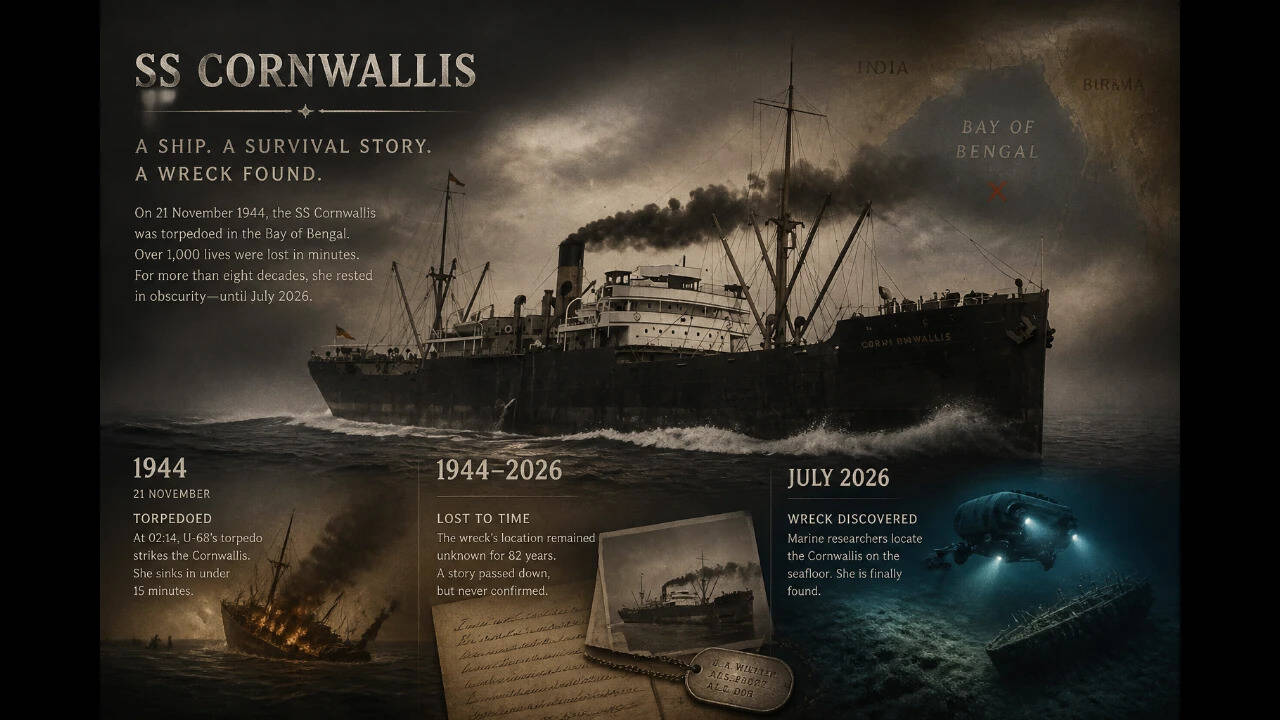
For more than eighty years, the final resting place of the SS Cornwallis remained an open ghost story in the freezing waters off the Maine coast. Sunk by a German U-boat in December 1944, the Canadian steamship took 43 lives down with it into the dark, vanishing so completely that its exact underwater location became one of New England's most enduring maritime mysteries.
That seven-year search ended when a dedicated crew of technical divers from the Nomad Exploration Team pinpointed the massive wreck sitting nearly 400 feet below the Atlantic surface. It is a brutal dive in punishing conditions, but the discovery finally offers historical closure to dozens of families across Canada and the United States.
The Strange Backstory of the SS Cornwallis
Most people don't realize that the sinking of the Cornwallis was part of a bizarre, high-stakes chapter of World War II intelligence operations on American soil. Built in Vancouver in 1921 as the Canadian Transporter, the 5,458-ton merchant vessel had already cheated death once. In September 1942, a German submarine struck the ship while it was anchored in Barbados. Crews managed to refloat and repair her, returning the steamship back to active merchant duty.
By November 1944, the ship was loaded down with bags of sugar and barrels of molasses, chugging northward from Barbados toward Saint John, New Brunswick. There were 48 people aboard, including seven armed guards.
Unbeknownst to the crew, the German submarine responsible for their fate—the U-1230, commanded by Hans Hilbig—had just completed a clandestine mission right on the American mainland. Days earlier, the U-boat surfaced near Hancock, Maine, dropping off two Nazi spies: Erich Gimpel and William Curtis Colepaugh. Their mission was to gather intelligence on American industrial and atomic capabilities.
After dropping the saboteurs off, the U-1230 patrolled the shipping lanes, tracked the Cornwallis, and fired a single torpedo into its forward cargo hold on December 3, 1944. The ship went down by the bow in under ten minutes. Only five people survived, rescued eventually by local fishing boats after floating on life rafts.
Seven Years of Grid Searches and Side-Scan Sonar
Finding a 400-foot-long steel hulk in the open ocean isn't like looking for a needle in a haystack—it's like looking for a microscopic splinter in a dark room. The Nomad Exploration Team, seasoned New England technical divers who previously located the USS Eagle 56, started hunting for the Cornwallis in 2019.
They deployed side-scan sonar across roughly 50 square miles of treacherous North Atlantic waters. The environment offered every obstacle imaginable: brutal water temperatures, ferocious currents, high tides, and minimal visibility.
On July 11, 2026, during what felt like a fruitless sweep on the very edge of their designated search grid, diver Bob Foster noticed a sharp anomaly pop up on the sonar screen:
"We were all giving up on this particular area... and just as we were going to turn around, I happened to see something that was clearly man-made on the screen coming up. So that was it."
Subsequent technical dives down to the 120-metre mark confirmed the structure matched original blueprints and historical dimensions. At 400 feet down, the cold water preserves the wreck as a stark, haunting time capsule from the closing months of the war.
Why This Discovery Matters Today
Shipwreck hunting isn't just about finding old steel. For the families of the 43 sailors who died—many of them hailing from Nova Scotia and New Brunswick—the discovery transforms an abstract historical tragedy into a localized reality.
The divers plan to work on recovering specific artifacts to share with descendant families, offering closure for generations who grew up knowing only that their ancestors vanished somewhere off the New England coast. Meanwhile, the Nomad Exploration Team has already set its sights on mapping out other missing wartime giants resting quietly on the ocean floor.