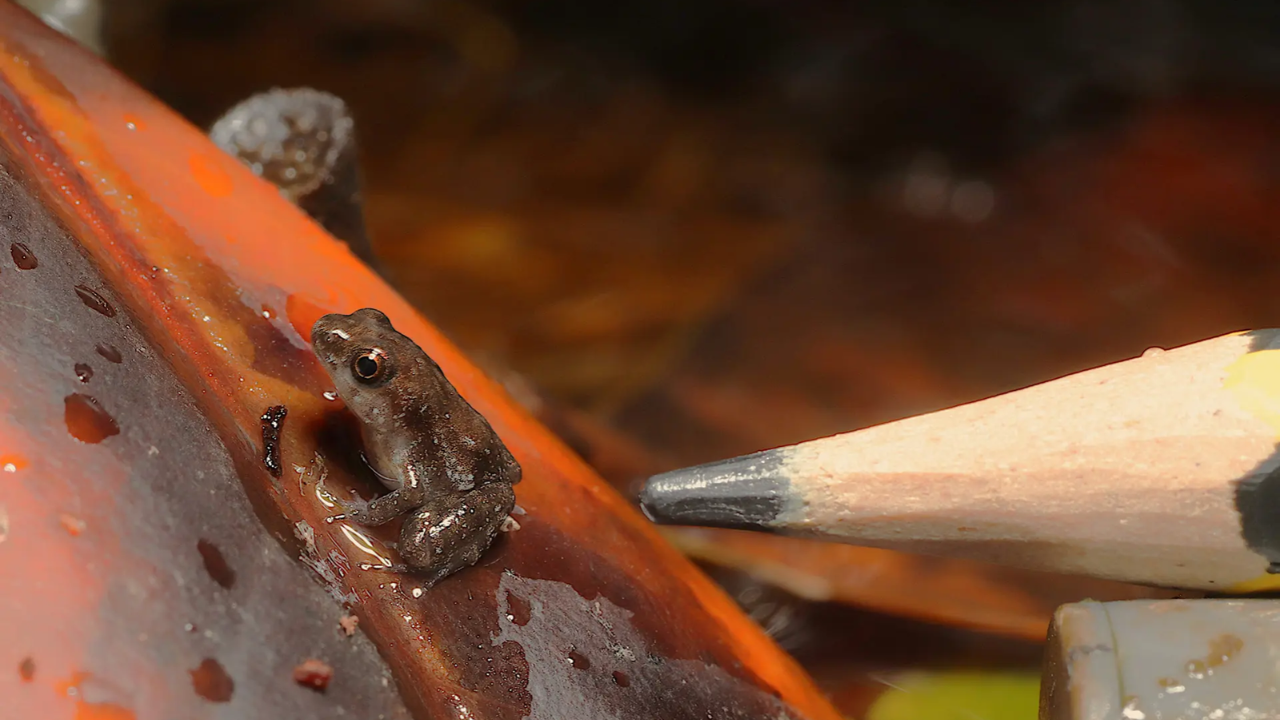
Fifteen tiny frogs no bigger than the tip of a pencil just proved that a newly named amphibian doesn't have to vanish before we even learn how to keep it alive.
At London Zoo, keepers recently bred Afia Birago's puddle frogs (Phrynobatrachus afiabirago) under human care for the first time anywhere in the world. These froglets start out around 5 millimeters long, while full-grown adults weigh less than 1.75 grams. Honestly, blink and you'll miss one on a damp leaf. Yet those 15 froglets carry real weight for saving tiny Ghanaian frogs from extinction.
Most quick news reports stop at the cute headline: London Zoo bred 15 tiny frogs from Ghana. That's a neat hook, sure. It misses the real story. These frogs were only described as a new species to science eight years ago, and they survive in just two perennial pools inside Ghana's Atewa Hills Forest Reserve. They exist nowhere else on Earth. And their forest home is getting hammered by mining.
Why Tiny Ghanaian Frogs Matter Beyond a Zoo Milestone
When people hear about rare froglets in London, they often ask why a tiny amphibian from West Africa deserves emergency care when bigger, flashier animals get all the headlines. That reaction is common, and it's backward.
Amphibians sit on a razor's edge. Their thin, permeable skin absorbs moisture and oxygen, which also makes them quick casualties when water quality drops, forests get cleared, or microclimates dry out. If a forest's damp pools turn muddy or disappear, frogs usually go first.
With Afia Birago's puddle frog, the stakes feel even sharper because scientists barely had time to study them in the wild. Described just eight years ago and restricted to two perennial pools in the Atewa Hills Forest Reserve, the species has no backup range. According to reporting from London Zoo and Discover Wildlife, an emergency action plan took shape in September 2025 after 20 Critically Endangered adults were moved to London Zoo in coordination with Ghanaian partners.
What makes this work different from old-school trophy breeding is why the frogs went to London in the first place. Local partners in Ghana faced hurdles sourcing specialist equipment locally and had limited hands-on amphibian husbandry experience for this specific species. Bringing 20 adults to London let ZSL's amphibian team figure out basic survival rules—what the frogs eat, how humidity affects them, and how to trigger breeding—so those lessons could be shared back with teams in Ghana.
The Real Threat in the Atewa Hills
Mining is tearing up the exact forest environment these frogs depend on. Reporting on the conservation effort highlights illegal small-scale gold mining, known locally as galamsey, alongside broader mining pressure on the Atewa Hills Forest Reserve, which chews up forest cover, digs pits, and fouls water sources.
You can't just patch a torn-up rainforest microclimate with a shovel. Once shade trees fall and water gets silted or polluted, temperature and humidity swings spike fast. For a frog that weighs under 1.75 grams as an adult, a dried-out puddle isn't an inconvenience. It's a dead end.
What Keepers Actually Had to Figure Out in London
Breeding a brand-new species in captivity sounds tidy on paper. In practice, it's trial, error, and extreme care.
When the 20 adults arrived in London in 2025, keepers didn't have a neat instruction manual for Phrynobatrachus afiabirago. They had to reverse-engineer what the frogs needed. Feeding thousands of tiny prey items like springtails, dialing in humidity, and paying attention to rain cues helped crack the breeding puzzle.
Then comes the hardest part of small-amphibian care: handling animals that measure about 5 millimeters. A clumsy move or dry fingertip can injure a fragile froglet before it even gets a fair shot at growing up. Even experienced keepers treat tiny amphibians like spun glass.
A Name That Means Something Personal
Part of what sticks with me about this story isn't the lab work—it's the personal history behind the frog's name. Ghanaian conservationist Caleb Ofori-Boateng, who works with Herp Conservation Ghana and serves as a ZSL EDGE Regional Project Manager, helped describe the species to science and named it after his mother, Afia Birago.
Naming a species after a parent is one thing. Watching that species get pushed to the brink right after being named is another. As Ofori-Boateng noted in zoo announcements, his mother's name will be tied to a species conservationists worked to save rather than one they lost.
Why Breeding in London Is Only Half the Job
Let's be honest about zoo breeding programs. A handful of froglets in London doesn't magically heal a damaged forest in Ghana.
If conservation stops at keeping a small group alive in the UK, we've built a museum piece, not a wild recovery. The real test happens back in West Africa. Before the adults moved to London in 2025, ZSL amphibian keeper Unnar Aevarsson traveled to Ghana to help establish a conservation breeding facility in Kumasi, described by the zoo as the first dedicated to amphibian conservation in West Africa, and to gather field data on the frogs' natural habitat.
Now the protocols worked out in London are being passed along to colleagues at the CSIR-Forestry Research Institute of Ghana's Kumasi breeding centre. At the same time, ZSL EDGE Fellow Anthony Churcher with Herp Conservation Ghana is looking into potential habitat on private land around the Atewa Hills Forest Reserve that could someday support releases of frogs bred in Ghana.
What Could Go Wrong Next
I'm excited about the 15 froglets, truly. Still, I don't want anyone pretending the hard part is over.
First, scaling up from 15 newborns to a self-sustaining population takes time, steady funding, and reliable equipment. Second, reintroducing frogs into the wild fails if the surrounding landscape is still being degraded or fragmented. Habitat on private land near Atewa could help, yet safe, clean water and intact forest cover remain non-negotiable. Third, data on tiny, newly described amphibians is still limited, so keepers and field biologists have to keep adjusting as they learn.
What This Means for Wildlife Conservation Right Now
This partnership shows how international wildlife protection works when it's done right. London Zoo brought deep amphibian care experience and specialized setups; Ghanaian partners—including Herp Conservation Ghana and the CSIR-Forestry Research Institute of Ghana—brought local leadership, field knowledge, and long-term roots in the region.
For anyone watching global conservation, it's a reminder that saving biodiversity isn't only about giant pandas or elephants. Often it's about a 5-millimeter froglet in a damp tank, backed by local scientists who refuse to let a newly discovered species disappear without a fight.
Practical Next Steps If You Want to Help
- Support local and global amphibian work directly: Look up the Zoological Society of London and Herp Conservation Ghana to see how donations fund field research, breeding centers, and habitat protection rather than generic overhead.
- Follow Atewa Hills forest protection efforts: Track updates on the Atewa Hills Forest Reserve and forest conservation in Ghana so you understand how mining and land use affect watershed health for both wildlife and nearby communities.
- Visit and ask informed questions: If you head to London Zoo's The Secret Life of Reptiles and Amphibians habitat, look closely at the microhabitat setups and ask keepers how lessons from London are transferring to the breeding center in Kumasi.
- Share accurate conservation context: When posts or videos pop up about tiny frogs, share the bigger picture—habitat protection and local capacity matter just as much as first-time births in a zoo.