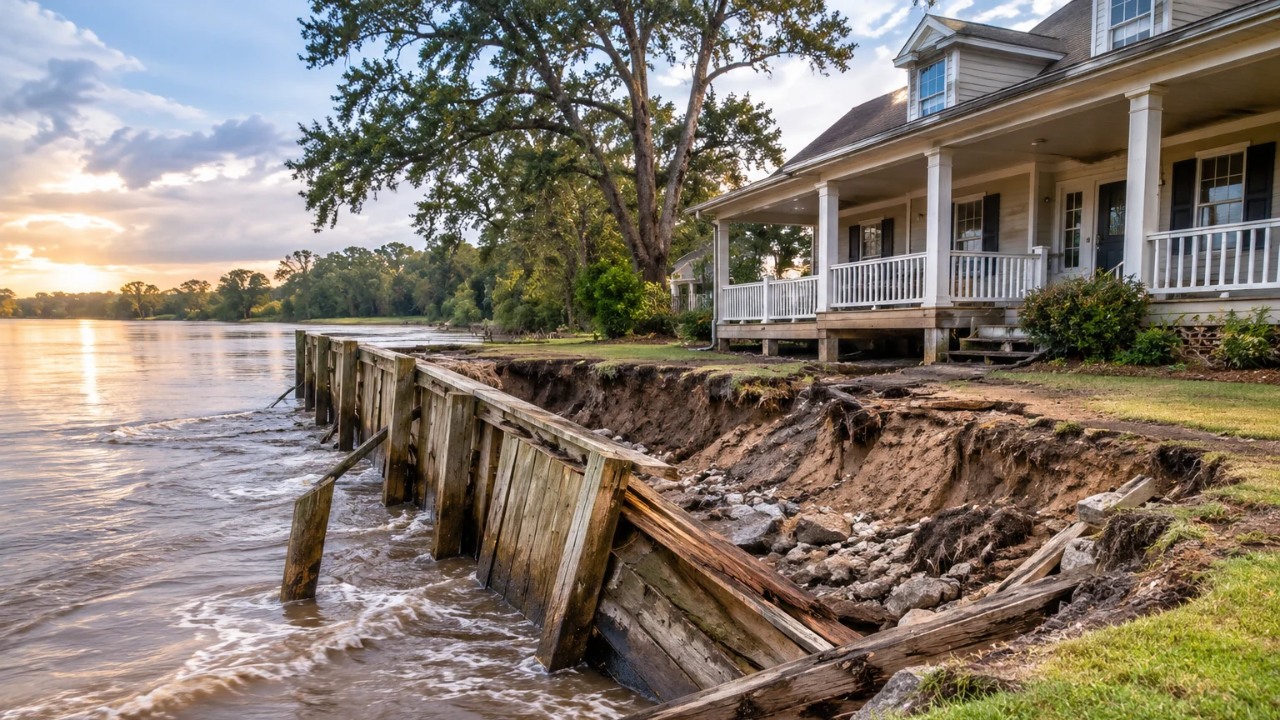
When you drop $32,500 on a protective wooden bulkhead to save your riverfront house from erosion, you expect the contractor to know what they're doing. Elizabeth Molbert learned that lesson the hard way along the Calcasieu River in Louisiana.
After spending thousands on a barrier meant to shield her $109,000 property, a 2017 flood tore the structure apart. Worse, the shoddy bulkhead had been bolted directly to a structural house piling, dragging her entire home out of place when it collapsed.
Most people would throw their hands up and accept financial ruin. Molbert went to court instead. In a major ruling from the Louisiana Court of Appeal, Third Circuit (Elizabeth D. Molbert v. Kenko Bulkhead & Marine Services, LLC), she secured nearly $450,000 after judges threw out an unfair blame assignment and held the negligent builders fully accountable.
The High Cost of Cutting Corners on Marine Construction
Riverfront property owners face brutal natural forces every single day. Moving water eats away at banks, threatening foundations and turning dream homes into safety hazards. That is why hiring licensed, competent marine contractors isn't just a suggestion—it's survival.
Molbert originally bought her property in 2009. Seeking professional help against creeping erosion, she contracted Kenko Bulkhead & Marine Services to build a 130-foot wooden barrier completed in June 2016. Less than a year later, high water exposed massive engineering failures.
Expert testimony in the lawsuit revealed that the structure lacked proper soil compaction, adequate height, and crucial rock protection. To make matters worse, the builders tied a temporary stabilization beam directly to the home's support pilings. When the river pushed against the weak bulkhead, it yanked the house right along with it.
You shouldn't have to carry an engineering degree just to vet someone you hired off the street. Yet, court records showed the company operators assured Molbert they were fully qualified despite lacking the proper state licenses for the job.
Fighting Insurance Exclusions and Unfair Blame
When disaster strikes, insurance battles are practically guaranteed. Molbert filed under her Liberty Mutual flood policy, receiving a $165,000 payout after appraisals topped out. To fix the mess, she had to shell out $167,058.59 for an engineered steel replacement bulkhead and an eye-watering $266,372.75 just to repair her shifted house.
She sued Kenko, its owners, and its insurer, Travelers Property Casualty Company of America. At the initial jury trial in September 2024, the legal system threw a bizarre curveball: the jury slapped Molbert with 25% of the fault for the disaster, arguing she should have somehow known to remove the stabilization beam attached to her house.
The appeals court rightly shredded that logic. Judges pointed out that homeowners hire professionals precisely because they lack specialized marine engineering knowledge. Expecting a homeowner to spot structural hazards created by licensed pros makes zero sense. The court stripped away her 25% share of the blame entirely.
Navigating Complex Contractor Insurance Loopholes
Insurance companies will try almost anything to dodge payouts. Travelers argued that a breach-of-contract exclusion let them off the hook since the dispute stemmed from a construction agreement.
The appellate court disagreed because Kenko built the bulkhead without required state licenses, rendering the contract an absolute nullity under Louisiana law.
While the policy didn't cover the cost of replacing the defective wooden bulkhead itself—falling under standard work-product exclusions—it did cover the severe damage done to Molbert's house under the completed-operations provision. The court also bumped her mental anguish compensation up to $15,000, acknowledging that draining retirement accounts and taking on extra jobs just to fix someone else's botched work takes a brutal psychological toll.
In the end, Molbert's total award settled at $448,431.34, covering home repairs, the new steel barrier, and mental damages, with the defendants forced to shoulder all expert and court costs.
What Homeowners Can Learn From This Legal Battle
If you own property near water, this case offers a harsh wake-up call about contractor vetting and construction oversight.
- Verify licenses independently: Never take a contractor's word for it. Check state licensing boards yourself before signing any paperwork or handing over cash.
- Inspect attachment points: Ensure marine barriers are independent structures. Tying bulkheads directly to house pilings is a massive red flag that can weaponize a failing wall against your home's foundation.
- Document everything: Keeping detailed records of communications, insurance payouts, and repair bills is the only way to survive a multi-year courtroom battle.
Protecting your investment means refusing to let negligent builders off the hook when things go sideways.



