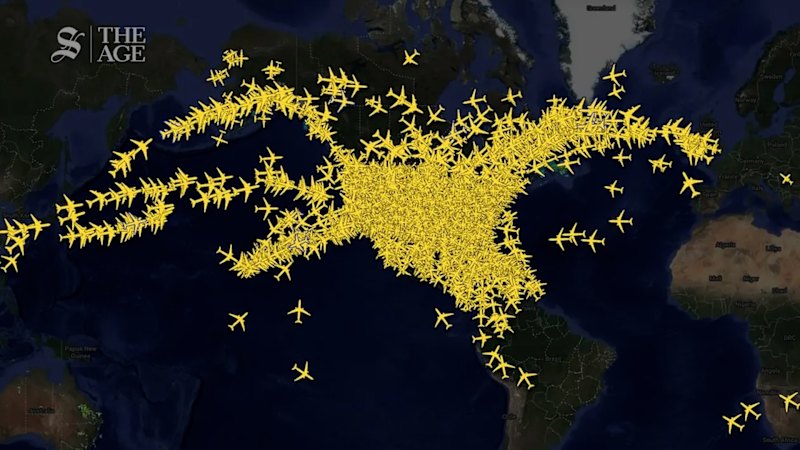
Air travel in the United States ground to an absolute halt when the Federal Aviation Administration issued a rare nationwide ground stop. Thousands of passengers found themselves stranded at departure gates from New York to Los Angeles. If you were tracking the skies, you watched in real-time as millions of dollars in economic activity froze because a critical communication system simply choked.
This incident marks only the third time in modern U.S. history that a nationwide ground stop has been ordered across the entire country, putting it in the same historic category as the September 11 attacks and a 2023 FAA system outage.
What Actually Caused the Shutdown
The chaos started when a severe telecommunication problem hit regional Air Route Traffic Control Centers. These hubs direct planes navigating the skies between airports. When the radios and data links started failing, air traffic controllers lost their reliable lines of sight and sound to airborne aircraft.
Transportation Secretary Sean Duffy and Homeland Security Secretary Markwayne Mullin addressed reporters as the crisis unfolded. Officials pointed out that new FAA equipment and modern technology updates appeared to overwhelm older, legacy infrastructure. Switches and routers became completely overloaded with data, outputting inconsistent information to controllers.
Planes already airborne were safely guided down, but every single departure was locked in place. Flight tracking services reported that more than 11,000 flights were ultimately delayed or canceled. Amtrak reported a massive surge in web traffic as stranded flyers desperately scrambled for alternative ways home.
Dispelling the Cyberattack Panic
Whenever a modern infrastructure failure of this scale happens, the immediate fear is malicious interference. Security officials moved quickly to shut down those rumors.
Mullin made it clear during White House briefings that there was zero indication of a nefarious cyberattack. President Donald Trump echoed those sentiments, noting that the outage did not appear tied to foreign actors or artificial intelligence anomalies.
Instead of a high-tech sabotage plot, the reality is much more boring and far more frustrating. Aging public sector tech collided with data overloads. When high-volume digital environments push outdated switches past their breaking point, systems fail. It is a structural vulnerability rather than an enemy action.
The Broader Vulnerability of Modern Infrastructure
We rely heavily on hyper-connected systems that lack adequate redundancy. When every regional control center depends on centralized routing nodes, a single bottleneck brings down the entire network.
Airlines and aviation authorities now face intense pressure to modernize. Critics are calling this shutdown an overdue wake-up call. Patching legacy software and hoping for the best is no longer a viable strategy for a multi-trillion-dollar global transportation network.
Passengers experienced firsthand how fast modern mobility can revert to the stone age. If you travel frequently, incidents like this serve as a stark reminder to build flexibility into your travel itineraries. Always download offline maps, keep flexible booking options handy, and expect cascading delays that stretch well past the initial fix.
The FAA successfully lifted the ground stop after roughly four hours and twenty-five minutes, allowing departures to slowly resume. Clearing the backlog of canceled and delayed flights took days, rippling across international connections and stranding crews out of position. The planes are back in the air, but the structural flaws in the network remain to be fixed.



