A black hole weighing 360 million suns had no business existing that early. Yet there it is in the data, shining as the oldest known quasar from a time when the universe was less than five percent of its current age.
Published in Astronomy & Astrophysics by a team led by Julien Wolf of the European Southern Observatory, the discovery centers on an object formally designated J1504+6252 and nicknamed Dún Aonghasa. Its light left the source roughly 13.1 billion years ago, about 630 million years after the Big Bang. That pushes the confirmed quasar frontier back by roughly 40 million years past the record Euclid set in July 2026, making it the biggest leap in nearly a decade.
Honestly, most headline summaries treat a distance record like a sports trophy. A bigger number on the board, a quick pat on the back for space telescopes, and everyone moves on. That misses the real tension here. Dún Aonghasa isn't just far away; it's a timing headache for standard astrophysics.
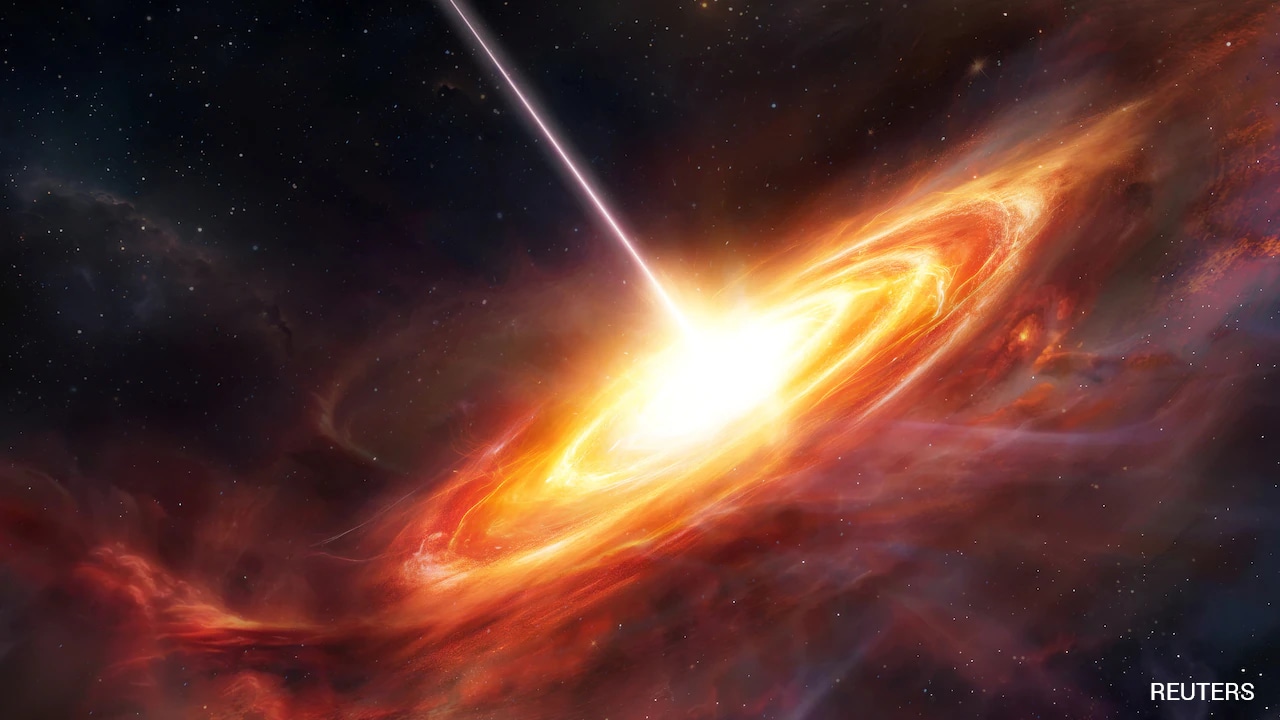
Looking at that bright swirling disk around a supermassive black hole helps explain why astronomers spot these beacons across billions of light-years. When gas and dust spiral inward toward the event horizon, friction heats the material to extreme temperatures, letting the galactic core outshine the rest of its host galaxy many times over.
How a Slow Feeder Got So Huge So Fast
Here is the twist that makes Dún Aonghasa so tricky to explain. Observations indicate this black hole was pulling in matter at a relatively slow clip when we see it.
Wait a second. If it isn't gulping material frantically right now, how did it reach roughly 360 million solar masses—about 90 times the mass of the supermassive black hole at the heart of our Milky Way—within 630 million years of the Big Bang?
Astronomers have wrestled with two main competing stories for early supermassive black holes. One starts small with the remnant of a first-generation star and assumes rapid, sustained feeding. The other starts big through direct collapse, where a massive cloud of primordial gas stays warm enough to resist breaking up into lots of small stars and instead channels mass toward a single heavy seed that collapses straight into a hefty black hole.
Dún Aonghasa tilts the scale toward heavier initial seeds or earlier growth bursts. If a black hole isn't feeding rapidly at the epoch observed, starting from a tiny stellar corpse leaves very little wiggle room on the cosmic clock. Direct collapse—or at least a much headier start than textbook models once assumed—suddenly looks far more plausible.
Still, let's be candid about the limits of what we know. We're looking at a single snapshot from 13.1 billion years ago, not a time-lapse movie of how this exact black hole assembled its mass. Quasar growth can be episodic, and measuring exact accretion rates and masses across vast cosmic distances always carries observational uncertainties. Calling direct collapse "proven" would go past the evidence; calling it strongly supported by a tight timeline is much closer to the mark.
Redshift 8.13 and Why Light Stretches Redder
If you're wondering how astronomers know Dún Aonghasa predates every other confirmed quasar, the answer comes down to redshift. As the universe expands over billions of years, space stretches the light traveling through it. Shorter, bluer wavelengths get stretched toward longer, redder ones, including infrared light.
Dún Aonghasa clocks in at a redshift of z = 8.13. It's the first confirmed quasar past a redshift of 8, and it beats the previous mark by about 40 million years in cosmic time.
That stretching is exactly why space telescopes tuned for infrared and wide-sky surveys are indispensable here. Ground-based telescopes deal with Earth's atmosphere, which absorbs or blurs plenty of infrared light and limits wide-area hunting. Orbiting observatories can scan huge swaths of sky cleanly and hand off top candidates to heavy-hitting follow-up instruments.
Why the Oldest Known Quasar Needed a Relay Team of Telescopes
Finding a record-breaking quasar doesn't happen in one lucky click. It takes a relay across observatories, each doing a job the others can't.
First, the European Space Agency's Euclid mission spotted the candidate inside its wide-survey data, sifting through millions of cosmic objects to flag rare needles in a giant haystack. In roughly 18 months of observations, Euclid has already turned up 31 quasars—including 12 beyond redshift 7—showing just how productive wide-field surveys from space can be.
Then came the verification leg. Observations from the W.M. Keck Observatory and the Hubble Space Telescope offered early clues, followed by the Large Binocular Telescope and finally the James Webb Space Telescope (JWST). JWST's infrared muscle pinned down the redshift at z = 8.13 and measured the black hole's mass at roughly 360 million times that of the sun.
That multi-telescope handoff matters because early cosmic dawn is crowded with lookalikes. Dusty star-forming galaxies or foreground objects can mimic distant red sources at a glance. Without high-sensitivity spectroscopy and sharp follow-up data, a flashy candidate could easily turn out to be a false alarm.
Cosmic Dawn Wasn't Empty Dark Space
People sometimes picture the early universe as a completely blank void until stars suddenly switched on like lightbulbs in a dark room. That isn't quite right.
After the Big Bang cooled enough for atoms to form, space filled with a neutral fog of hydrogen gas. Early stars and galaxies slowly pumped out energetic radiation that ionized—or burned through—that fog during the epoch of reionization, gradually making the universe transparent to ultraviolet light.
Dún Aonghasa sits right in the thick of that transition. Watching a massive black hole and its host galaxy take shape while the cosmic fog was still clearing gives astronomers a window into how early structure and radiation interacted. Co-author Silvia Belladitta, affiliated with the Max Planck Institute for Astronomy and INAF Bologna, noted that while this is the farthest quasar seen so far, theoretical models suggest even earlier quasars could exist from roughly 270 million to 470 million years after the Big Bang.
Common Mix-Ups Around Quasars and Distance Records
A few misconceptions pop up every time a distance record hits the news, so it helps to clear them up before reading further:
- A quasar isn't a separate type of star. It's the blazingly bright active core of a galaxy powered by matter falling toward a supermassive black hole.
- Farthest doesn't mean "latest news" in cosmic time. Because light takes billions of years to reach us, looking farther out means looking further back in time. When we see Dún Aonghasa, we're seeing how it looked 13.1 billion years ago, not how it looks today.
- One record doesn't close the book on cosmic dawn. Earlier candidates or theoretical predictions keep pushing expectations, and follow-up observations routinely refine or challenge initial interpretations of extreme high-redshift objects.
Practical Ways to Follow Early-Universe Discoveries
You don't need an observatory or a physics degree to track this beat smartly as Euclid and JWST keep releasing data:
- Check the redshift number (z) first. When a headline claims a record-breaking quasar or galaxy, look for the redshift value and whether it has been spectroscopically confirmed rather than estimated from broadband colors alone.
- Read the ESA and telescope science releases alongside news briefs. Agencies like the European Space Agency and research hubs like the Max Planck Institute for Astronomy lay out which instruments confirmed a finding and where the uncertainties sit.
- Separate "candidate" from "confirmed." Early-universe astronomy moves fast, and initial detections often get sharpened—or revised—once follow-up spectra arrive.