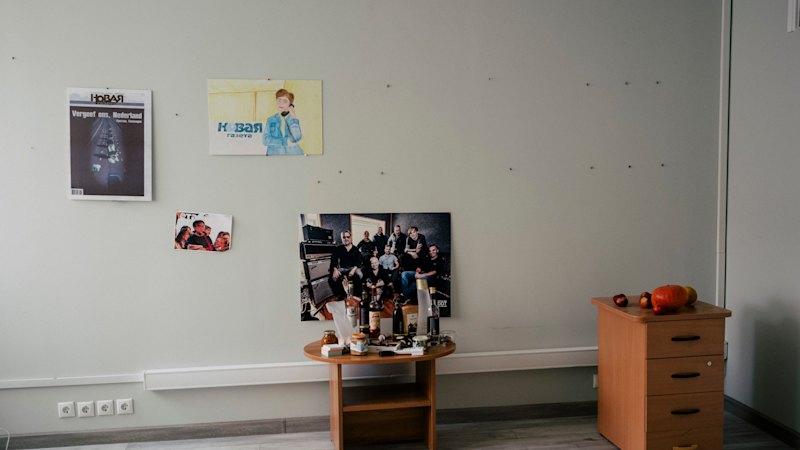
Boxes taped shut, desks stripped bare, and portraits of fallen journalists taken down from the walls. That was the scene inside the Moscow newsroom of Novaya Gazeta as Russia’s last major independent newspaper finally locked its doors for good after more than three decades of defiant reporting.
For over thirty years, this publication stood as a rare bastion of critical journalism in a country where speaking truth to power carries an extraordinary price. Six of its journalists were murdered over the years, including world-renowned investigative reporter Anna Politkovskaya. Yet, the newsroom kept publishing, surviving regime shifts, economic crises, and mounting authoritarian pressure.
Now, the story is over. The paper's closure isn't just a sad footnote for the journalism industry; it's a stark marker of how thoroughly the Kremlin has snuffed out independent domestic civil society.
The Anatomy of a Slow Death
You don't shut down a legendary media institution overnight. It's a grinding, systematic process of attrition. When the full-scale conflict in Ukraine broke out, the pressure on Novaya Gazeta shifted from dangerous to completely intolerable.
The state didn't just shut them down with a single decree at the start. Instead, authorities deployed a web of restrictive legislation:
- Labeling the outlet and its staff as "foreign agents," a designation designed to ostracize and choke off operations.
- Blocking online access to their articles across Russia.
- Seizing printing presses and criminalizing independent crowdfunding or reader donations.
- Arresting staff members on trumped-up charges and raiding homes.
By the time editor-in-chief Sergei Sokolov and his team announced the final closure, they weren't operating in a normal news environment. They were trapped inside what staff members accurately called a "kill zone".
Nobel Peace Prize laureate Dmitry Muratov, who co-founded the paper and led it through its darkest chapters, put it bluntly when addressing the crowd outside their historic headquarters. He noted that they didn't naturally die out—they were killed alongside the remnants of constitutional protections for free speech.
What the Closure Changes on the Ground
When foreign observers look at Russian media, they often miss the psychological impact of losing an in-country voice. Plenty of exiled Russian media outlets operate from Berlin, Riga, or Vilnius. But Novaya Gazeta chose a different path. They stayed. They tried to report from within, navigating impossible censorship laws to document the human cost of the war, the plight of political prisoners, and domestic corruption.
Staying meant making painful compromises. They had to weigh every word to avoid immediate liquidation, operating within suffocating legal boundaries just to keep printing a shred of independent reality.
Critics sometimes questioned those compromises. But for millions of Russians who felt entirely isolated, reading Novaya Gazeta meant knowing they weren't alone in their dissent. With the physical office now empty and a plaque reading "Here lived Novaya Gazeta" nailed to the wall, that internal anchor is gone.
The Broader Reality for Global Press Freedom
The demise of Russia's oldest independent paper sends an unmistakable signal to journalists everywhere. Authoritarian regimes have mastered the playbook for crushing dissent without needing to stage dramatic nighttime raids on day one. They use financial strangulation, bureaucratic harassment, legal terror, and the branding of truth-tellers as national security threats.
When Dmitry Muratov stepped out of the building for the final time, he made it clear that expecting salvation from political figures is a fool's errand. He urged people to rely on each other instead.
The journalists are packing up their gear, but they insist their trade isn't dead because they simply don't know how to do anything else. Even so, the blackout inside Russia is now nearly absolute, leaving a vast nation isolated in an echo chamber of state propaganda.



