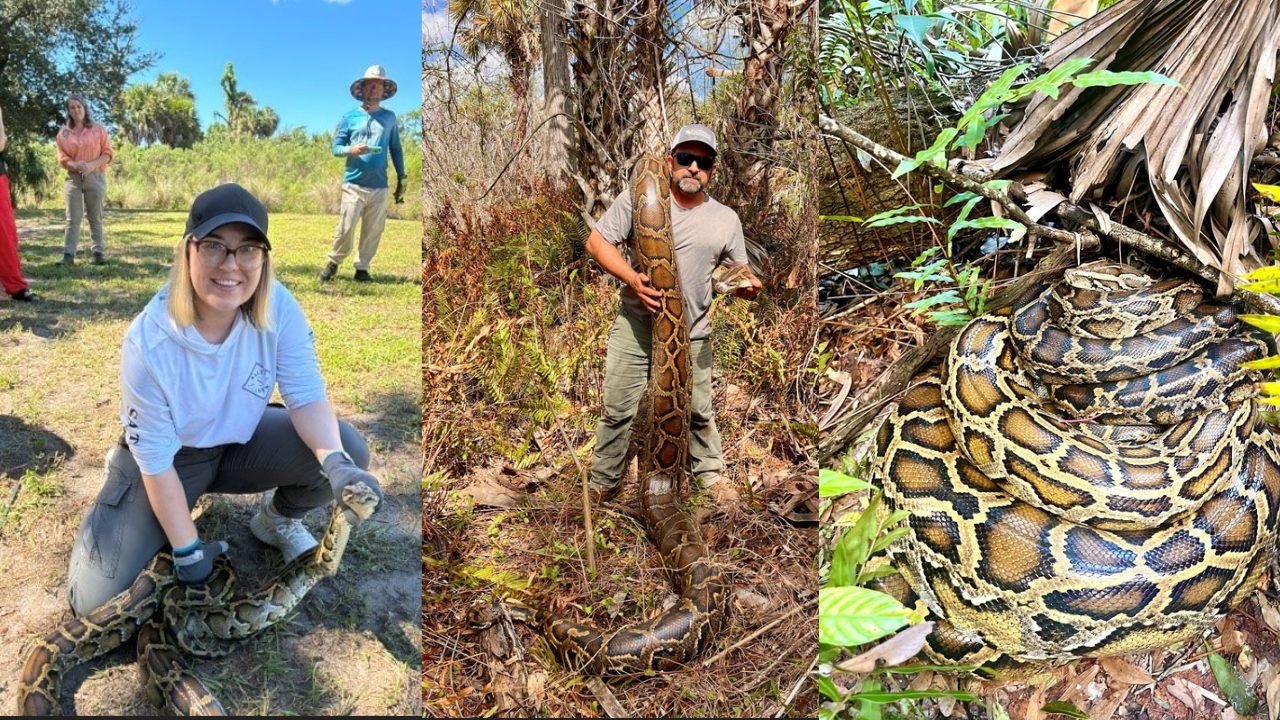
Using 40 radio-tagged male Burmese pythons as scout snakes, wildlife biologist Ian Bartoszek and the Conservancy of Southwest Florida pulled a record 8,080 pounds of invasive pythons out of the landscape during the November 2025 to April 2026 breeding season. Honestly, if you try to fight an ambush predator in dense mangrove swamps and flooded marshes by just walking around with a flashlight, you're going to lose. Most of the biggest snakes stay hidden in places trucks can't reach and human eyes barely scan. Turning the males' own mating instincts against them changes the math.
Between November 2025 and April 2026, Bartoszek's team and volunteers removed 177 invasive Burmese pythons plus 4,100 eggs from roughly 200 square miles in Southwest Florida. That's over four tons of snake in a single season—a record by weight since the Conservancy's research and removal program began in 2013. The captured females averaged 95 pounds and carried an average of 70 eggs each, with the largest female hitting 153 pounds and stretching 17 feet long. Since 2013, the program has logged more than 1,750 pythons weighing over 53,000 pounds, alongside 25 collaborative scientific papers with partners like the U.S. Geological Survey, the University of Florida, Rookery Bay National Estuarine Research Reserve, and the South Florida Water Management District.
Why Walking Blind Doesn't Cut It in the Swamp
People hear "record python haul" and picture a line of hunters marching down a levee bagging snakes left and right. That's not how suppression actually works when you're dealing with adult females tucked deep into inaccessible wetlands.
Burmese pythons are masters of camouflage and cover. They slip into subterranean refuges, dense mangroves, and deep water where spotters on roads never see them. Even during major public events like the 2026 Florida Python Challenge—where 907 participants removed 280 snakes over 10 days—broad sweeps tend to catch what's visible near edges rather than the heavy breeding stock sitting in the interior.
Here's why scout snakes matter so much. Male pythons spend the breeding season—running roughly from December into April, peaking around February—actively searching for mates. When biologists catch adult males, surgically implant radio transmitters, and release them back where they were found, those males become moving beacons. Trackers follow the radio signals on foot or by boat, and when a tagged male links up with a large female or a breeding aggregation, the team has a shot at removing heavy reproducers before they lay eggs.
Wait—let's be clear about what that 8,080-pound record actually means. A massive weight total in a single season isn't proof the invasive population is already wiped out. Sometimes high biomass reflects better detection in targeted zones, year-to-year shifts in where snakes aggregate, or deeper access into breeding pockets. Bartoszek has pointed out that long-term pressure appears to be suppressing local reproduction, with teams seeing fewer reproductive females and smaller individuals in areas under sustained management, yet he also notes the goal is for removal numbers to eventually trend down as local pressure bites. Anyone treating one four-ton season as a "mission accomplished" banner is ignoring how vast South Florida really is.
How Scout Snakes Changed the Reproductive Math
If you want to shrink a python population, weight alone isn't the whole story. A 15-pound snake and a 120-pound gravid female don't have the same ecological impact.
One big female can carry dozens of eggs—averaging around 70 among the females removed in the 2025–2026 season, while the Florida Fish and Wildlife Conservation Commission notes females can lay from 50 to more than 100 eggs in a clutch. By tracking males to females before egg-laying, the Conservancy of Southwest Florida didn't just pull 177 adults out of the system. Removing those females and recovering 4,100 eggs cut off thousands of potential hatchlings before they ever dispersed into marshes, canals, and upland edges.
Still, biology keeps throwing curveballs. Research published in recent years by Bartoszek and collaborators has shown that Burmese pythons exhibit multiple paternity, meaning a single clutch can have more than one father. That complicates simple genetic or population assumptions. Juvenile pythons also move differently depending on habitat—canals and levees act as corridors, while dense urban development can act as a barrier or edge zone.
And the prey picture is brutal. Roughly a quarter of the females removed during the 2025–2026 season contained remains of white-tailed deer. White-tailed deer are a core prey species for endangered Florida panthers. When pythons eat deer, wading birds, marsh rabbits, raccoons, and bobcats, they're competing directly with native predators and stripping out the mid-sized mammals that kept the Everglades food web functioning. In areas where pythons have been established longest—since the species was first documented in Everglades National Park back in 1979—native mammal declines have been staggering, with researchers widely citing drops of around 90% or more in some key species.
The Bigger Map Is Still Expanding
Even as Southwest Florida logs record removals in Collier County, the broader invasion hasn't stood still. In October 2026, the University of Florida's Institute of Food and Agricultural Sciences (UF/IFAS) reported an established Burmese python population in Charlotte County, with authorities suspecting past escapes or releases from captivity.
That detail highlights a mistake a lot of people make when reading about Everglades wildlife news. They think pythons are neatly contained inside a single park boundary. They aren't. Water corridors, canal networks, seasonal weather, and human releases keep pushing the front lines.
At the same time, we should stay honest about what's still unknown. Scientists have learned an enormous amount from necropsies—measuring growth rates, gut contents, hormone levels, mercury loads, and viruses—yet estimating exact total python numbers across hundreds of square miles of swamp remains difficult because detection rates are naturally low. Nobody credible claims there's a silver bullet like a quick biological control that won't harm native reptiles. Sustained, science-backed removal, habitat restoration, and public vigilance remain the real work.
Practical Next Steps If You Care About Stopping Invasive Pythons
You don't need a radio receiver or a swamp buggy to help slow down invasive snakes in Florida, and if you're outside Florida, you can still support solid conservation science.
- Report sightings immediately in Florida. If you spot a Burmese python—or another non-native reptile—in Florida, log it through the FWC IveGot1 reporting system or call the FWC invasive species hotline instead of relying on social media posts. Accurate location data helps wildlife teams track spread into newer counties like Charlotte.
- Never release exotic pets into the wild. It sounds obvious, yet escaped or dumped constrictors and exotic reptiles keep seeding new problems. If you ever can't care for a non-native reptile, look into authorized amnesty programs, rescue networks, or rehoming options rather than turning it loose in a canal or park.
- Know the rules before joining hunt efforts. Enthusiasts love the idea of hunting pythons, and state challenges draw big crowds, but wandering onto private land, restricted refuges, or sensitive nesting areas without authorization creates safety and legal trouble. Stick to approved public lands, follow FWC regulations, and learn proper humane handling and identification first so you don't harm native snakes like harmless rat snakes, racers, or water snakes.
- Back long-term field science, not just viral headlines. Big removal totals grab attention for a week, but the real progress comes from multi-year tracking, necropsy data, and wetland restoration. Supporting organizations like the Conservancy of Southwest Florida or collaborating research institutions funds the unglamorous daily telemetry and lab work that informs land managers year after year.
The swamp doesn't give up its secrets easily. Tracking 40 tagged males through mud, heat, and thick brush won't erase an entire invasive species overnight, yet every breeding female intercepted before laying eggs is a real dent in the next generation.