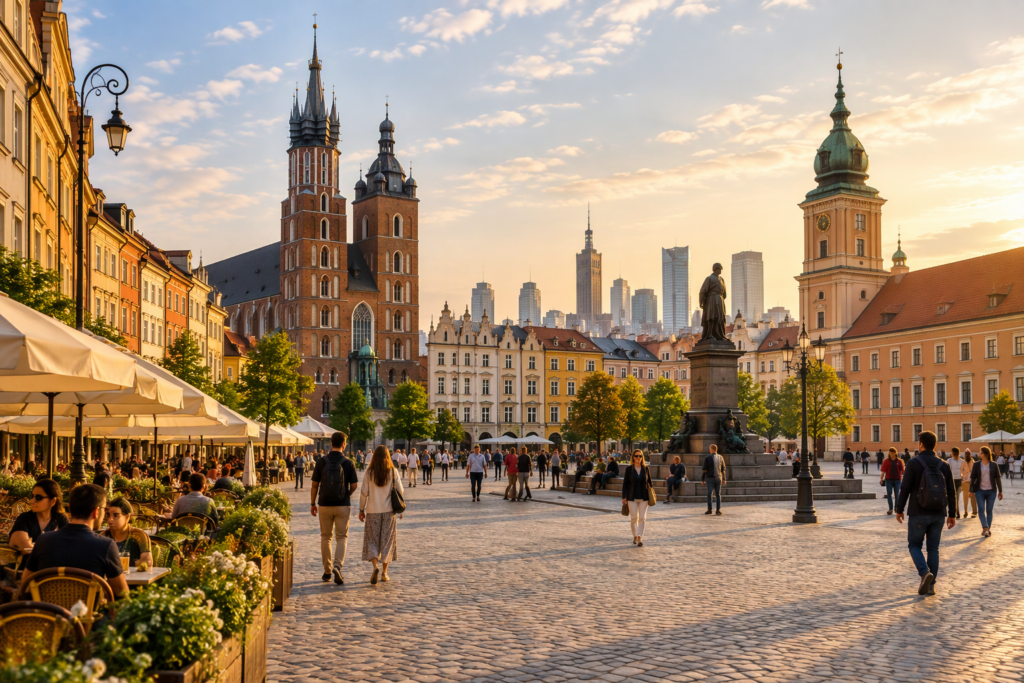
Political gridlock usually defines Warsaw. But tragedy has a way of stripping away institutional posturing. Thousands of mourners recently flooded Krakow's Main Market Square for a solemn March of Silence, and standing right beside each other in the crowd were Prime Minister Donald Tusk and President Karol Nawrocki.
If you've followed Polish politics over the last few years, you know these two figures are locked in a perpetual power struggle over judicial reforms, executive authority, and the direction of the state. They rarely agree on anything. Yet, as Poland wrapped up its second day of national mourning, party lines vanished. They walked together to honor six innocent lives cut short by a horrific mass shooting that completely shattered the historic city's peace.
Understanding the Krakow Tragedy
The violence unfolded on a Saturday afternoon in one of Europe's most picturesque tourist destinations. A 24-year-old gunman opened fire in the heart of Krakow's historic center, killing six people—including Polish citizens, a British national, and an Austrian visitor—and wounding 15 others.
The attack ended when two police officers, Artur Morański and Jakub Kulik, confronted and shot the gunman, who later died in the hospital. Those officers acted with swift bravery, absorbing gunfire to protect civilians. When Morański woke from a grueling 12-hour surgery for lung and arm wounds, his very first words to officials weren't about his own pain. He asked, "Is Kuba alive?"
The shockwaves of the event extended beyond Krakow. Investigators later linked the suspect to a multi-site tragedy that included family murders elsewhere in the country. While officials probed potential radical ideologies and far-right influences behind the rampage, the immediate reality for Poland was an unfamiliar and terrifying brush with mass gun violence. St. Mary's Basilica even suspended its iconic hourly trumpet call for 12 hours—something that hadn't happened since 1939.
Setting Aside Polarized Politics
When a nation faces collective trauma, leadership is tested on tone and unity. Tusk and Nawrocki choosing to walk side-by-side wasn't just a photo opportunity; it was a psychological necessity for a deeply polarized country.
For months, the media cycle has been dominated by institutional showdowns, police deployments near courts, and fierce ideological battles. Citizens are exhausted by perpetual hostility at the top. By answering Krakow Mayor Łukasz Gibała's call for a unified public demonstration, Tusk and Nawrocki signaled that national security and human grief transcend partisan warfare.
Tusk posted a direct message to the public urging collective solidarity, while Nawrocki's office honored the responding officers with state recognition. Cardinal Grzegorz Ryś, the metropolitan archbishop of Krakow, also joined the march, uniting secular political power and religious leadership in a rare moment of shared sorrow.
What Happens Next for Public Safety
The shooting has forced an urgent reckoning across Poland regarding gun accessibility, extremist radicalization, and urban security. Major cities have ramped up police patrols, and intelligence services are aggressively tracking potential digital footprints left by the assailant.
Security experts point out that preventing copycat incidents requires a delicate balance between open public spaces and modern threat monitoring. Poland has largely avoided the scale of mass shootings seen elsewhere in the West, making this event a profound wake-up call for law enforcement agencies.
Political unity rarely outlasts the funeral processions. Once the days of national mourning end, the bitter constitutional and legislative battles in Warsaw will inevitably resume. But for one somber evening in Krakow's medieval square, politicians remembered that the people they govern need them to stand together when the worst happens.



