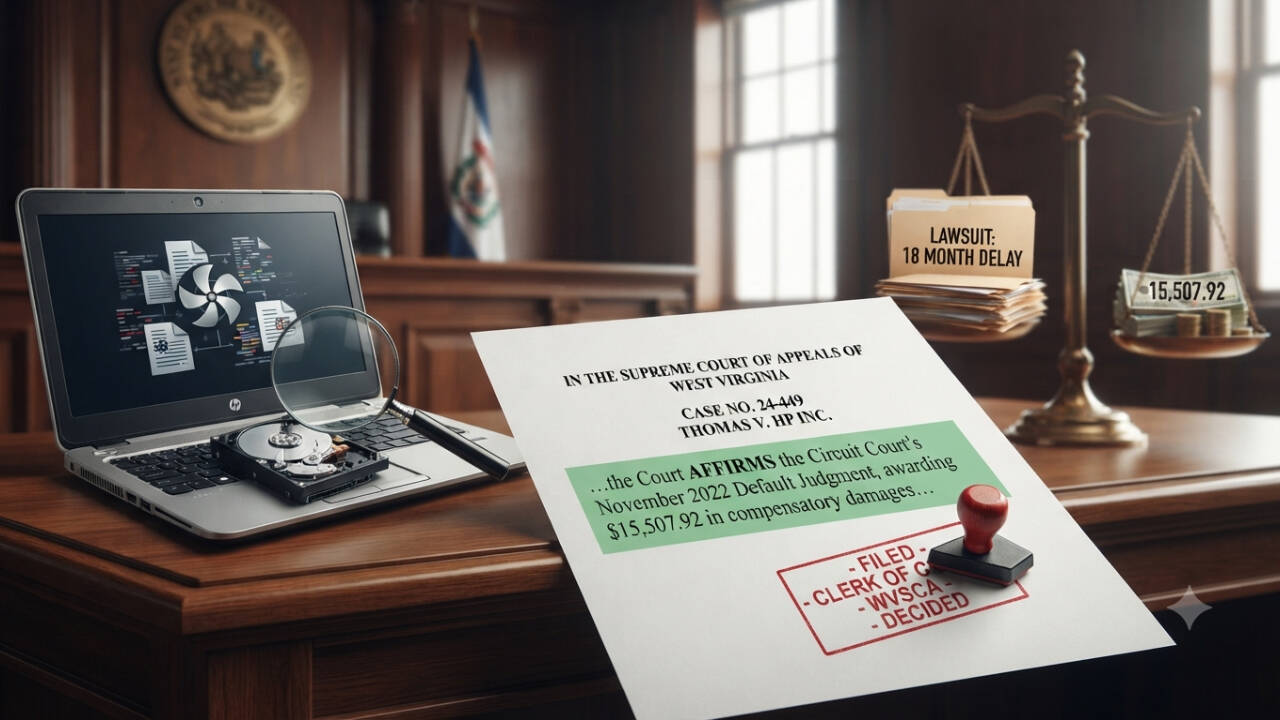
Imagine spending over fifteen hundred dollars on a brand-new laptop, adding a three-year extended warranty, and expecting peace of mind. Now picture that computer dying, getting a warranty replacement, and watching that replacement machine fail six months later while wiping out every single personal file you own. That nightmare scenario happened to West Virginia resident Ms. Thomas back in 2019. But what started as a frustrating hardware failure morphed into a multi-year legal battle that recently reached the Supreme Court of Appeals of West Virginia, teaching corporate legal teams an expensive lesson about ignoring court documents.
HP Inc. probably thought the initial civil complaint filed against them would just float away. They missed responding to the lawsuit for a full eighteen months. When a major corporation ignores a legal filing for a year and a half, courts don't hand out polite reminders. They hand out default judgments.
The Anatomy of a Corporate Blunder
Corporations deal with thousands of claims every month, yet dropping the ball for eighteen months takes a special kind of administrative chaos. HP blamed the radio silence on an internal misrouting error. They claimed the paperwork accidentally went to an employee who was out on medical leave.
Courts hear excuses every single day. An internal routing mistake doesn't cut it when you're facing a formal court summons. Because HP ghosted the legal process for a year and a half, a circuit court entered an amended default judgment in November 2022. The price tag for ignoring the bench? Exactly $15,507.92 in compensatory damages. That figure covered the defective laptop, a replacement unit, disputed Instant Ink subscription charges, and the sheer inconvenience caused to the consumer. The judgment also stacked on $20,000 in punitive damages alongside $9,130.33 in legal fees and attorney costs.
When HP finally woke up and realized what happened, they panicked. Their legal team tried to set the judgment aside, arguing that the lower court lacked jurisdiction and that internal administrative mix-ups qualified as excusable neglect. Both the circuit court and the intermediate appellate court slammed the door in their face.
The Supreme Court Weighs In
The case eventually landed on the docket of the Supreme Court of Appeals of West Virginia. The state's highest court didn't have much patience for corporate appeals built on self-inflicted administrative incompetence.
The justices affirmed the core decision, leaving the $15,507.92 compensatory award and attorney fees completely intact. The court noted that the consumer had clearly stated enough financial loss in her initial complaint to justify the lower court's jurisdiction. More importantly, misrouting legal documents to an absent employee fails to meet the legal definition of good cause needed to reopen an old liability ruling. You can't just ignore a lawsuit for eighteen months and expect the judiciary to hit a reset button just because your HR department dropped the ball.
While the compensatory payout survived, the punitive damages portion of the ruling sparked sharp debate among the justices. Under West Virginia civil procedure rules governing default judgments, courts generally cannot award relief that exceeds what the plaintiff originally asked for in their complaint. One dissenting justice pointed out that Ms. Thomas never explicitly requested punitive damages or laid out facts warranting them in her original filing. That dissenting voice highlighted the strict procedural guardrails designed to protect defendants, even those who fail to show up. Yet, because HP botched their initial appellate briefings on that specific point, the broader default judgment largely stood.
What This Means for Consumers and Tech Giants
This case highlights two starkly different realities in the modern tech and legal ecosystem. For everyday consumers, warranties often feel like empty promises wrapped in fine print. When a machine dies and takes irreplaceable family photos, tax documents, or work projects down with it, the emotional toll is real. Winning financial compensation through the courts is rare, tedious, and exhausting.
For enterprise tech companies, this ruling serves as a brutal reminder about compliance and internal tracking. Customer service chatbots and automated warranty loops often frustrate buyers until they have no choice but to escalate matters to the courts. When a formal legal complaint lands on a corporate desk, treating it like junk mail or letting it sit on a desk for eighteen months invites catastrophe.
If you're dealing with hardware failure and corporate stonewalling, document everything. Keep receipts, save service logs, and don't assume big brands are untouchable. Accountability still exists, even if it takes a trip to the state supreme court to prove it.