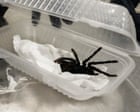
Customs checkpoints rarely produce moments quite as bizarre as the one officials faced at Lima's Jorge Chávez international airport. Three travelers thought they could board a flight to Germany with three suitcases packed tight with living cargo. They were wrong. Customs agents noticed suspicious movement inside the baggage during a routine scan.
When officers opened the bags, they didn't find counterfeit designer goods or hidden cash. They found more than 3,000 live tarantulas stuffed inside dirty socks.
Wildlife trafficking sounds like a quiet, invisible black market. In reality, it's a massive, highly organized global enterprise. Interpol estimates the illegal wildlife trade generates roughly $20 billion annually worldwide. This recent bust in Peru exposes the sheer scale of the exotic pet trade and the lengths smugglers go to bypass international borders.
The Anatomy of a Million Dollar Spider Heist
The numbers behind this operation are staggering. According to Peruvian wildlife authorities from the National Forestry and Wildlife Service (SERFOR), a single tarantula can command around €500 on the European market. Multiply that by 3,000 specimens, and you are looking at a potential street value of roughly €1.5 million from a single shipment. More insights regarding the matter are explored by USA.gov.
The smugglers didn't just grab a few large spiders from a single backyard. The seized arachnids ranged from tiny hatchlings and eggs to full-grown adults, collected across several distinct regions of Peru. Packing thousands of venomous and fragile creatures into dirty socks serves a dual purpose for poachers. It dampens movement, limits visibility during casual inspections, and provides a crude, makeshift container that occupies minimal space inside luggage.
The suspects—two German nationals and one Polish citizen—were immediately detained by police specialized in environmental crimes. They now face severe criminal proceedings. But catching three couriers at an airport terminal only scratches the surface of a much larger supply chain.
Why the Exotic Pet Trade Craves Peruvian Wildlife
South America boasts some of the most biodiverse ecosystems on earth, making it a primary target for poachers looking to supply international collectors in Europe, Asia, and North America. Rare arachnids, colorful poison dart frogs, and exotic birds are routinely poached from their natural habitats to satisfy high-end demand in the pet trade.
Buyers often assume captive-bred animals are too expensive or difficult to find, fueling an underground appetite for wild-caught species. Collectors pay top dollar for unique colors, rare defensive behaviors, or large sizes.
Unfortunately, this demand comes with a devastating ecological cost. Poaching removes reproductive adults and fragile hatchlings directly from local populations, accelerating biodiversity loss in regions that are already vulnerable to habitat destruction and climate shifts. When thousands of spiders are ripped from the wild at once, local food webs and insect control dynamics take an immediate hit.
How Authorities Are Fighting Back Against Wildlife Trafficking
Stopping wildlife smuggling requires more than just sharp-eyed customs agents noticing a bag wriggling on an airport X-ray belt. It demands cross-border intelligence sharing and specialized enforcement units.
Environmental crime divisions are training airport personnel to spot behavioral cues from couriers and recognize the physical signatures of biological smuggling. Smugglers frequently use convoluted flight paths, changing airlines and layover cities multiple times to mask the origin of their cargo.
The confiscated tarantulas face a complex rehabilitation and repatriation process. Reintroducing wild-caught animals back into their exact native micro-habitats is notoriously difficult, and many seized creatures require specialized care in rescue sanctuaries before authorities can determine their next steps.
The next time you hear about a bizarre border seizure, remember that it's usually just a small window into a multi-billion-dollar criminal network. Protecting global biodiversity means cracking down hard on the supply chains that turn living creatures into cargo.



