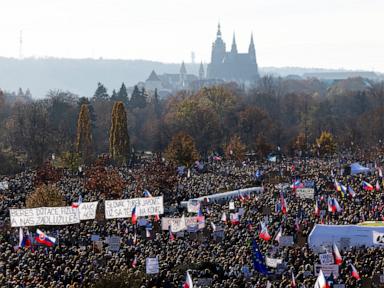
Hundreds of thousands of people packed Prague’s historic Letná park, chanting slogans and wearing paper hats shaped like a beloved local animated character. They weren't celebrating a sports victory or a national holiday. They were there to stop their own government from gutting public broadcasting.
When Prime Minister Andrej Babiš’s coalition rammed a controversial public media funding bill through parliament at 4:36 in the morning, they probably thought the public wouldn't notice or care enough to fight back. They were wrong. The protest movement that followed turned into a massive rejection of state-controlled media encroachment, echoing historical fights for democracy.
What the Proposed Overhaul Actually Changes
For years, Czech Television (ČT) and Czech Radio (ČRo) have operated on a traditional funding model. Households and businesses paid regular license fees, which created a financial firewall between the broadcasters and whichever politicians happened to be holding power at the moment.
The government’s new plan abolishes those independent household fees entirely. Instead, public broadcasting would be funded directly out of the state budget.
On paper, politicians claim this saves citizens money and brings administrative efficiency. In practice, the transition slashes initial funding by roughly 15 percent. For anyone who understands how government budgeting works, this isn't an efficiency measure—it’s a leash.
When a broadcaster depends on annual line items approved by the ruling party, editorial independence vanishes. If a news anchor investigates government corruption, the ruling coalition can simply threaten to slash the budget next year. That's not a hypothetical risk. It’s a playbook used across the region by populist leaders who want uncritical coverage.
The 4:36 AM Wake-Up Call for Democracy
The backlash didn't start in a vacuum. Back in October, the ruling coalition pulled a fast one in the lower house of parliament. They abruptly cut short opposition speaking times and forced an overnight vote, pushing the bill through its first reading at 4:36 a.m.
That specific time stamp—4:36—became an instant rallying cry. Protesters adopted it as a symbol of legislative stealth and bad-faith governance.
Mikuláš Minář, head of the civil society group Million Moments for Democracy, which organized the massive Prague rallies, put it bluntly to the crowds: "We are here to stand up against the rule by force in the style of 4:36."
The outrage quickly spilled out of parliament and into everyday life. Czech public media workers staged a dramatic one-day strike, broadcasting only emergency audio and looped music while leaving newsrooms empty. University students marched, labor unions mobilized, and hundreds of prominent Czech athletes signed public letters demanding the government scrap the legislation. International journalism watchdogs, including Reporters Without Borders and the European Federation of Journalists, warned that the funding shift opens the door straight to political coercion.
Why This Fight Matters Beyond Czech Borders
You might wonder why citizens care so deeply about a television and radio funding structure. The answer comes down to trust. In an era where disinformation spreads instantly online, independent public media acts as a crucial check on state power.
Babiš has a long, documented history of attacking mainstream media, and his coalition includes far-right and Eurosceptic factions. For many Czechs, dismantling independent broadcasting looks less like a budget cut and more like a calculated step toward illiberal democracy, mirroring tactics seen in neighboring Hungary.
European Union officials have already taken notice, noting that national legislation must guarantee sustainable, transparent funding criteria to protect the rule of law.
The bill hasn't officially become law yet—it still has to navigate committees and face potential friction in the Senate and from President Petr Pavel. But the government is pushing hard, betting that public exhaustion will eventually set in.
If the crowds in Letná park proved anything, it’s that Czech society isn't willing to give up its free press without a brutal fight.



