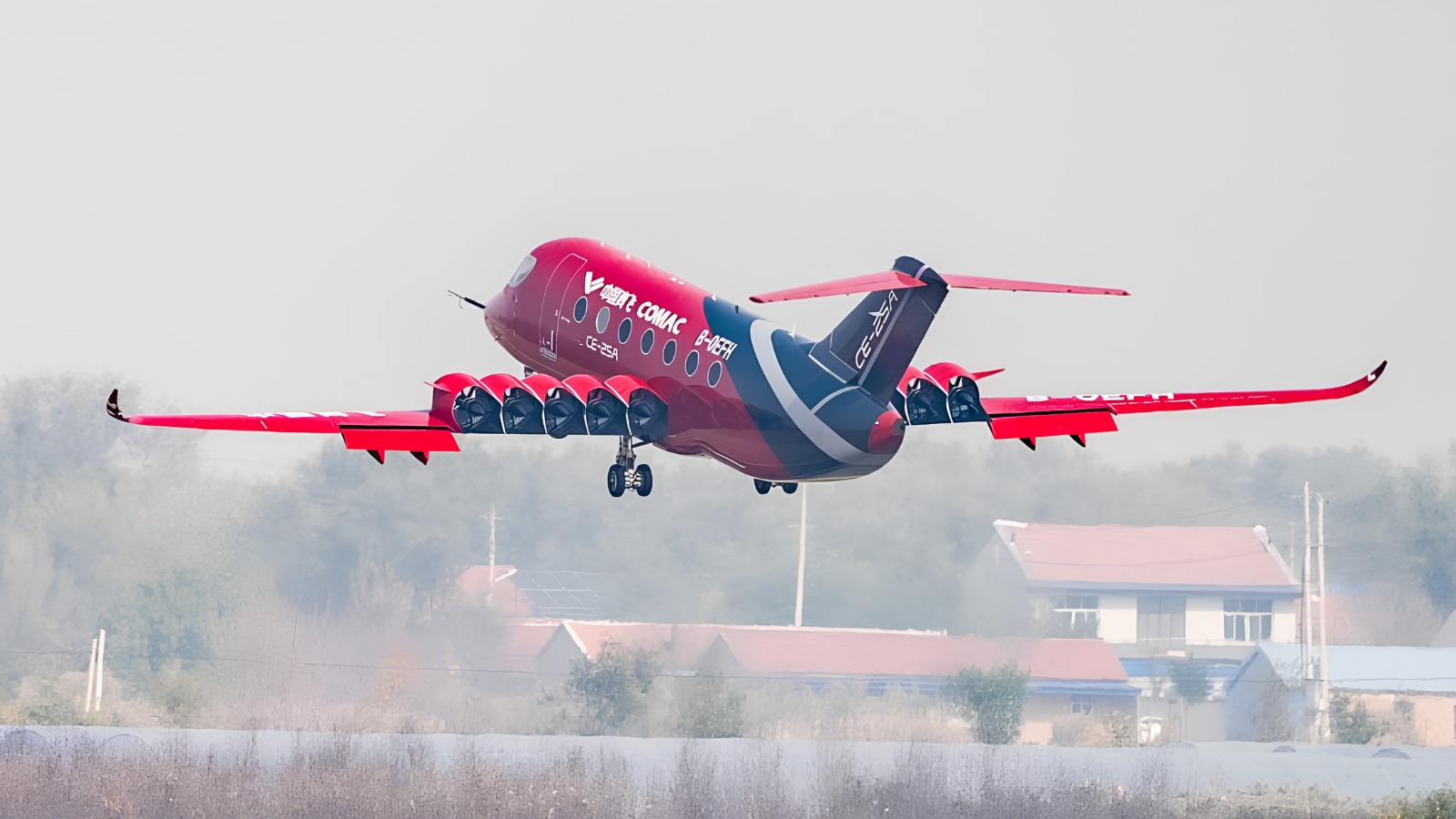
Electric aviation has spent years trapped in a cycle of slick CGI promotional videos and battery-weight excuses. Every few months, a startup promises zero-emission regional hops, only to quietly pivot or stall when physics catches up. But state-backed aviation in China just forced a reality check. The COMAC CE-25A—a 10-tonne, 19-seat electric commercial aircraft—completed its first crewed intelligent flight in Binzhou, Shandong Province.
It carried two pilots and a flight-test engineer for a 57-minute test window, logging over 16 minutes of active airborne time. While headlines love to throw around the 300 km/h cruising speed and 400 km range specs, the real story isn't about breaking speed records. It's about whether heavy battery-electric commercial flight can escape the drawing board and actually clear regulatory hurdles.
Inside the Specs of the CE-25A
Let's look at what COMAC built. The CE-25A is a 10-tonne class commuter aircraft designed explicitly for short regional hops. It seats 19 passengers, putting it directly in the territory of legacy turboprops like the Beechcraft 1900, though with an entirely different propulsion architecture.
Instead of burning jet fuel, it relies on heavy energy storage developed in partnership with CATL, utilizing an array of distributed electric ducted fans mounted across the wing structure. During its recent test, the aircraft cruised at an altitude of roughly 2,400 meters.
Before this crewed milestone, the airframe quietly went through 19 uncrewed autonomous flight validations starting back in February. That methodical, unglamorous testing phase is precisely why this project demands attention. COMAC isn't just rendering concepts; they are building physical hardware, flying it, and officially entering the type-certification pipeline with the Civil Aviation Administration of China (CAAC).
The Brutal Physics Problem Everyone Ignores
If you want to understand why commercial electric aviation is so brutally difficult, look at a simple law of physics: fuel burns off, making traditional airplanes lighter as they fly. Batteries don't. A lithium-based power pack weighs the exact same whether it's fully charged at takeoff or completely dead on landing.
To match the energy density of standard aviation kerosene, you need massive weight allocations dedicated entirely to batteries. That penalty severely limits payload and distance. A 400-kilometer range sounds impressive until you subtract mandatory regulatory safety reserves. Once you factor in alternate airport reserves and hold times, your actual usable point-to-point distance shrinks significantly.
This is why western competitors like Heart Aerospace have leaned heavily into hybrid-electric designs for their larger regional concepts. By keeping a backup fuel generator on board, they hedge against the harsh weight limits of current battery technology. COMAC and CATL, by contrast, are pushing a purely electric heavy airframe, betting that rapid advancements in battery density and fast-charging infrastructure will close the gap.
Why Regional Commuter Routes Are the Only Viable Target
Nobody is flying an electric 19-seater across oceans, and expecting transcontinental electric travel anytime soon is a waste of time. But that misses the point of what short-haul aviation is supposed to do.
Think about regional geography where high-speed rail lines face geographical barriers, or island chains where short hops consume disproportionate amounts of jet fuel relative to takeoff cycles. A 19-seat configuration targeting short intercity legs serves a very specific niche.
Furthermore, electric propulsion brings a massive operational advantage that airports and nearby communities care about deeply: noise reduction. Jet turbines scream during takeoff and landing, restricting urban proximity. Electric ducted fans operate at a fraction of that acoustic footprint, which could eventually allow smaller commuter strips to operate closer to city centers without triggering endless noise complaints.
The Road Ahead for Commercial Certification
Acceptance of a type-certificate application by the CAAC is a major administrative milestone, but let's be realistic—it is not the same thing as commercial approval.
Getting a stamp of approval to carry fare-paying passengers under rigorous transport-category airworthiness standards (such as China's CCAR-25 equivalent framework) requires proving fault tolerance, thermal runaway containment, and propulsion redundancy over thousands of flight hours. Battery safety at a 10-tonne scale is an entirely unchartered beast for commercial regulators.
The CE-25A has proven it can leave the ground safely with a crew on board. Turning that expensive prototype into a reliable, economically viable commercial fleet is an entirely different battle. Expect years of grueling flight tests, iterative battery swaps, and structural refinements before a paying passenger ever boards one for a scheduled ticket. Watch how the certification process handles battery degradation and thermal management over the next twenty-four months; that will tell you whether electric commercial aviation is finally turning a corner or just entering another expensive experimental phase.