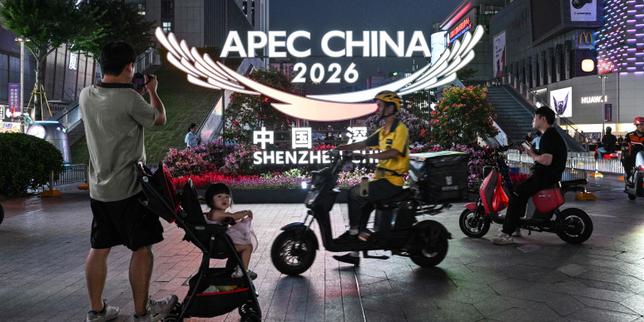
Most Western capitals still operate under a comfortable illusion. When economic growth stumbles, property markets wobble, and demographic curves point downward, conventional political logic assumes a rising power will turn inward to fix its domestic plumbing. Beijing is doing the exact opposite.
Despite severe internal headwinds, China's leadership is actively accelerating its push to restructure global governance and push Western institutions to the margins. This isn't just diplomatic theater. It's a calculated, long-term campaign to build an alternative international architecture where rules are written in Beijing rather than Washington, London, or Brussels. If you think economic sluggishness will slow down China's geopolitical ambitions, you're missing the entire point of how the ruling party views national survival.
The Domestic Trap Versus Foreign Ambition
Look at the headlines on any given morning. Real estate defaults, local government debt mountains, youth unemployment spikes. Analysts in European and American think tanks look at these figures and conclude that Beijing has too much on its plate to care about international norm-setting. That assumption is dangerously flawed.
In the political calculus of the Chinese Communist Party, economic difficulties don't necessitate a retreat from the world stage. They demand a redoubling of effort. When domestic growth models hit a wall, external expansion and diplomatic redirection become tools of domestic legitimation. By spearheading alternative multilateral forums and presenting China as the stable anchor of the Global South, Beijing shores up its narrative of inevitability at home.
Domestic strain and foreign ambition aren't competing priorities. They feed each other. When growth slows down at home, securing raw material supply chains across Africa and Latin America becomes even more urgent. Securing long-term trade agreements outside Western currency zones isn't a luxury project. It's economic insurance.
Redesigning International Standards From the Inside
For decades, Western policymakers believed that integrating China into global organizations like the World Trade Organization would automatically liberalize its political system. That was wishful thinking. Beijing didn't westernize. Instead, it learned how to game the system from within, and now it's building entirely new systems.
Take technological standardization. While Western media focuses on tariffs and export controls, Chinese engineers and diplomats have quietly dominated specialized United Nations agencies, including the International Telecommunication Union. By securing leadership posts in technical committees, Beijing shapes global standards for 5G, artificial intelligence governance, and smart city infrastructure.
These aren't neutral technical specifications. They bake authoritarian surveillance capabilities and state-controlled data management right into the global digital plumbing. When developing nations adopt these standardized packages, they buy into an ecosystem designed by Beijing. Western protests arrive too late because the technical ground was already won years prior in closed-door committee rooms.
The Expansion of Parallel Multilateralism
Western diplomats love their acronyms and legacy institutions. G7, NATO, the IMF, the World Bank. For generations, these clubs held a monopoly on global economic and security management. That monopoly is gone.
Beijing has spent the past decade constructing an alternate universe of international organizations. The Shanghai Cooperation Organisation handles security coordination across Eurasia. The BRICS bloc, recently expanded to include major energy producers and regional heavyweights, acts as an economic counterweight to the G7.
These forums share a common objective. They offer developing nations financial backing and diplomatic support without the pesky human rights conditions or fiscal austerity demands attached to Western loans. You need a deep-water port or a high-speed rail network? Beijing writes the check. You don't have to promise democratic reforms or anti-corruption crackdowns.
This transactional diplomacy resonates powerfully across the Global South. Many nations remember decades of Western paternalism and conditional aid. China's non-interference mantra sounds refreshing to governments tired of being lectured on governance standards while struggling with basic infrastructure deficits.
The Security Dimension Beyond Economic Aid
Trade and infrastructure were only phase one. Beijing has moved firmly into the security arena through initiatives that explicitly challenge the post-World War II security architecture.
The Global Security Initiative, launched alongside companion development and civilization frameworks, rejects the concept of universal values promoted by Western democracies. Instead, it champions absolute state sovereignty and non-interference, code language that protects authoritarian regimes from external criticism.
Joint military exercises with Russia, Iran, and various African states signal a growing readiness to project power far beyond China's immediate neighborhood. While Beijing avoids direct military entanglements wherever possible, it steadily builds operational partnerships that bypass American security alliances in the Indo-Pacific and beyond.
By framing Western security alliances as destabilizing remnants of a bygone Cold War era, Chinese state media successfully shifts the blame for regional tensions onto Washington and its partners.
Where Beijing Hits Resistance
Yet, this grand design isn't foolproof. Overreach carries real costs. The Belt and Road Initiative has faced severe scaling back and restructuring as recipient countries struggle with debt repayment and projects turn into white elephants.
Many developing nations want Chinese cash, but they don't want to become economic vassals. Pushback is growing in places like Southeast Asia, Latin America, and parts of Africa where local populations resent unfair labor practices, environmental degradation, and opaque loan terms.
Furthermore, the tightening grip of the party-state under Xi Jinping drives away foreign direct investment and spooks private entrepreneurs. Brain drain is real. Innovation thrives on openness, and an increasingly ideological domestic environment stifles the kind of freethinking research that powered China's tech boom in the 2010s.
Middle powers like India, Japan, and European nations are waking up to the reality of systemic rivalry. Supply chain diversification, de-risking strategies, and restrictions on critical technology transfers are starting to bite. Beijing faces a tougher, more coordinated pushback in high-tech sectors than it anticipated a few years ago.
The Strategic Reality for Western Diplomacy
Ignoring these trends or dismissing them as temporary blips is no longer an option for policymakers in Western capitals. Complacency is the greatest vulnerability.
Meeting this challenge requires more than defensive tariffs and export bans. Western nations must offer compelling, well-funded alternatives for global infrastructure and digital connectivity. Empty rhetoric about rules-based order falls flat when developing countries face immediate financing shortages.
The global governance architecture is splitting down the middle. One side clings to legacy institutions paralyzed by polarization and historical privilege. The other builds agile, revisionist networks designed to bypass Western sanctions, currency dominance, and normative pressure.
Beijing has made its intentions clear. The restructuring of the global order isn't a future scenario to debate in academic journals. It's happening right now, project by project, standard by standard, vote by vote in international bodies. Pretending otherwise guarantees a future where Western rules apply only to the West.