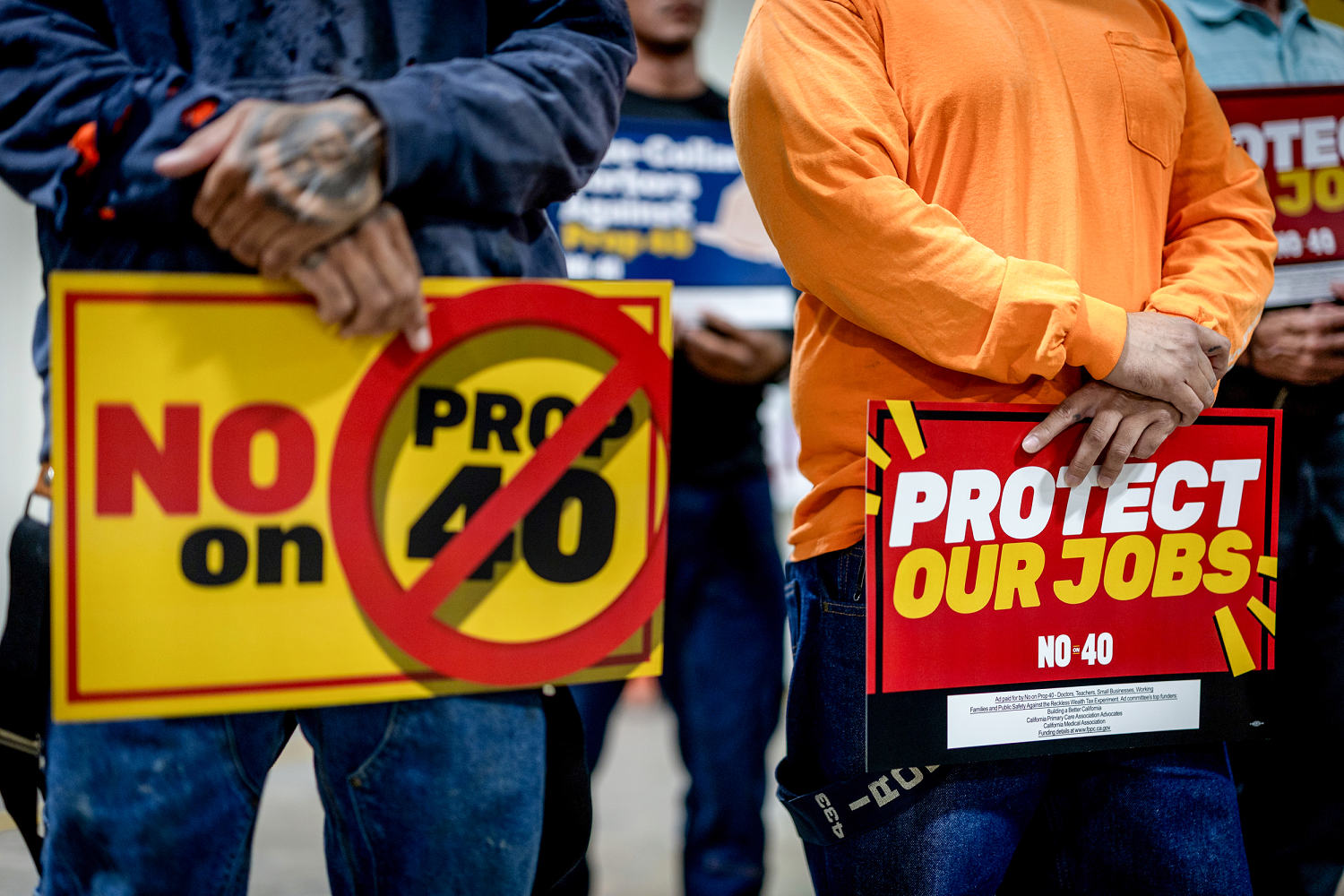
California just killed the most ambitious wealth tax in American history. Voters rejected Proposition 40 by a margin of 52.8% to 47.2%, handing a stinging defeat to progressive organizers and labor unions who spent months trying to convince the state's electorate to tax its richest residents.
If you only read the headlines, it's easy to chalk this up to Silicon Valley money buying an election. That's part of it, sure. Opponents outspent supporters by massive margins—250 to 1 in late October alone, according to ad-tracking firm AdImpact.
But money doesn't explain everything. Not even close.
What actually sank California's billionaire tax was a mix of terrible timing, a deeply flawed one-time design, and an unlikely alliance of teachers, doctors, and moderate Democrats who wanted nothing to do with it. Honestly, if you want to understand where the Democratic Party is heading before the 2028 presidential race, you need to look closely at why Prop 40 fell apart.
What Proposition 40 Actually Proposed
Let's clear up the math first. Proposition 40 wasn't an ongoing income tax. It was a one-time, 5% wealth tax targeting California residents—individuals, married couples, or trusts—with a net worth exceeding $1 billion. For households sitting between $1 billion and $1.1 billion, the rate phased in gradually.
The proposal, sponsored by the labor union SEIU United Healthcare Workers West, aimed to raise tens of billions of dollars. Ninety percent of that money was earmarked for state-funded healthcare programs, with the remaining 10% going toward food assistance and K-14 public education.
Sounds straightforward, right? Tax roughly 250 ultra-wealthy households and plug the holes left by federal budget cuts.
Here's where it got messy. To calculate net worth, the measure would have counted publicly traded stocks at their December 31, 2026 market value, private business interests, sole proprietorships, and even Roth IRAs valued over $10 million. It also applied retroactively based on residency as of January 1, 2026.
You don't have to be a tax attorney to see the logistical nightmare there. Valuing private, illiquid startups on a single calendar day is hard enough. Trying to enforce a retroactive residency rule on people who can afford fleets of lawyers and private jets? That's a whole different ballgame.
The Strange Coalition That Killed the Measure
Most people assume a wealth tax dies because billionaires run scary TV ads. And yes, Google co-founder Sergey Brin and other tech titans poured millions into the opposition. According to Ballotpedia, opposition committees raised over $140.5 million compared to roughly $33.2 million for supporters. It became the most expensive ballot measure fight in California history.
Still, money alone doesn't get the California Teachers Association, the California Medical Association, and Planned Parenthood to all line up against a healthcare and education tax.
Wait—why would teachers and doctors oppose a tax meant to fund schools and healthcare?
Because of how Prop 40 was written. The measure explicitly exempted its revenue from California's constitutional spending requirements, including Proposition 98, which normally guarantees around 40% of General Fund revenues go to schools and community colleges. Critics argued that creating a separate, one-time reserve fund outside the normal budget process risked destabilizing long-term state finances.
Even the League of Women Voters of California—hardly a front group for Silicon Valley—refused to endorse it. They took a neutral stance, warning that the one-time structure conflicted with sound public finance principles and risked long-term revenue loss.
Outgoing Gov. Gavin Newsom and gubernatorial candidate Xavier Becerra both came out against it, warning it would trigger an exodus of high-income earners. Meanwhile, many progressives weren't thrilled either, arguing that a one-time levy wasn't real structural reform. When you lose the moderates, the institutional unions, and half your own base, you're not going to win a statewide vote.
Did Billionaires Actually Leave California
You've probably heard the threat a thousand times. "Tax the rich, and they'll just pack up and move to Texas or Florida." Usually, it's mostly bluster.
This time, some of them actually did it.
Before the residency deadline, at least seven of California's estimated 214 billionaires reportedly left the state, including PayPal co-founder Peter Thiel, former Uber CEO Travis Kalanick, and Google co-founders Larry Page and Sergey Brin. In June 2026, former U.S. ambassador Meg Whitman and her husband sold off multiple California properties, including a $17.9 million fly-fishing ranch, amid fears the tax would pass.
Does seven billionaires leaving crash California's economy? No. But California's state budget relies heavily on capital gains and income taxes from its wealthiest residents. Even the California Budget & Policy Center noted in its analysis that while Prop 40 could raise tens of billions in the short term, it could also lead to ongoing income tax revenue losses if billionaires relocated to avoid it.
Voters heard that message loud and clear. In a state already dealing with high living costs and budget anxiety, the fear of shrinking the long-term tax base hit a nerve.
The Poison Pill Strategy Worked
If you want to see how ruthless California ballot politics has become, look at Propositions 41 and 42.
Opponents didn't just campaign against Prop 40. They funded two competing ballot measures designed as legal traps. Under California law, if competing measures pass, the one with more votes wins. Supporters of Prop 40 called Props 41 and 42 "poison pills" because if either received just one more "yes" vote than Prop 40, it would nullify the billionaire tax entirely—even if Prop 40 passed.
It's a brilliant, cynical tactic. Voters get confused by three overlapping tax measures on the same ballot, and the opposition splits the narrative. By the time November 3 arrived, the "No on 40" campaign had successfully framed the measure as a messy, risky gamble rather than a simple fix for healthcare funding.
What This Means for Democrats Heading Into 2028
Sen. Bernie Sanders and Rep. Ro Khanna campaigned hard for Prop 40, pitching it as a blueprint for the rest of the country. Economists who helped draft it argued that a win in California would kickstart a national movement to tax ultra-high-net-worth individuals.
Instead, it exposed a massive fault line inside the Democratic Party right before the 2028 presidential primary.
On one side, you have the populist wing pushing aggressive wealth taxes to counter federal cuts and extreme inequality. On the other, you have pragmatic governors and institutional allies who know that taxing unrealized gains at the state level is a legal and economic minefield.
If a 5% one-time wealth tax can't pass in deep-blue California—a state where billionaires are practically a punching bag—it's going to be a tough sell anywhere else.
What You Should Watch Next
If you're following tax policy or California politics, don't assume the wealth tax debate is dead. It's just shifting venues.
- Watch the 2027 legislative session in Sacramento. Unions like SEIU-UHW aren't going away, and they'll likely push for targeted corporate or capital gains adjustments that don't rely on a messy ballot initiative.
- Track the residency audits. The California Franchise Tax Board is notorious for aggressively auditing high-net-worth individuals who claim they moved out of state. Expect legal battles over those high-profile 2026 departures.
- Pay attention to federal tax talks. The failure of Prop 40 proves that state-by-state wealth taxes are too easy to dodge. Any serious attempt to tax billionaire net worth will have to happen at the federal level, where you can't just move to Austin to escape the bill.



