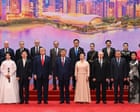
Diplomacy is rarely clean. Sometimes, it forces leaders into rooms they’d rather avoid, standing next to figures they’ve heavily condemned. Australian Prime Minister Anthony Albanese found himself right in that exact crossfire at the Asia-Pacific Economic Cooperation summit in Shenzhen, China.
When Albanese stepped up for the leaders' group photo alongside Vladimir Putin, Donald Trump, and Xi Jinping, he walked straight into a political firestorm. Pro-Ukraine groups in Australia had spent days urging him to boycott any frame featuring the Russian president. They argued that sharing a stage normalizes a regime responsible for ongoing aggression. Albanese didn't flinch. He weighed the optics, looked at the diplomatic rulebook, and decided to show up anyway.
The Realpolitik of Summit Hosting
Why did Albanese take the shot? The answer comes down to host-country protocol and the stark reality of multilateral summits. When a powerhouse nation like China rolls out the red carpet for a massive regional gathering, skipping core events isn't just a snub against a pariah state; it is a direct insult to the host.
Before the event kicked off, Albanese made his stance blunt. He stated he would respect the wishes of China as the summit host. That meant participating in the traditional family photo and attending the official banquets.
Deputy Prime Minister Richard Marles backed up the move immediately, pointing out that engaging within the structured confines of Apec is fundamentally different from rolling out a red carpet bilaterally. You go to these summits because global trade, regional security, and the sheer weight of major power friction require a seat at the table. If you boycott every room containing a war criminal, you end up talking to empty chairs.
The Divergence Between Canberra and Europe
Australia's approach stands in sharp contrast to the high-stakes friction coming out of Europe. While European leaders like Emmanuel Macron have railed against any hint of an unjust peace or forced compromise in Ukraine, Canberra has walked a more pragmatic tightrope.
Back in October, Australian Foreign Minister Penny Wong famously refused a photo op with Russian Foreign Minister Sergei Lavrov at a different ministerial setting. Critics pointed to that moment as proof that boycotts are possible. But Shenzhen is a different beast entirely. With Donald Trump, Xi Jinping, and Vladimir Putin all converging under one roof for high-stakes trilateral movements, Australia needed to project stability and regional presence, especially alongside close partners like Canada's Mark Carney.
Albanese even praised Xi Jinping's deep engagement and extensive knowledge of Australia during the trip. It's a calculated dance. Australia wants trade stability with Beijing while maintaining a hardline stance on national security and alliances like the Quad.
The Cost of Opting Out
What happens if a middle-power leader refuses the photo? You score a brief domestic headline for moral clarity, but you lose immediate diplomatic leverage. International forums run on physical presence. By standing in the frame, Albanese preserved his ability to advocate for broader regional interests without getting bogged down by an empty-chair protest that Beijing would view as a diplomatic tantrum.
Critics will keep calling it a compromise of values. Realists will call it basic statecraft. At the end of the day, prime ministers aren't sent abroad to curate pristine photo albums. They're sent to manage messy realities where bad actors share the same global stage, whether anyone likes it or not.



