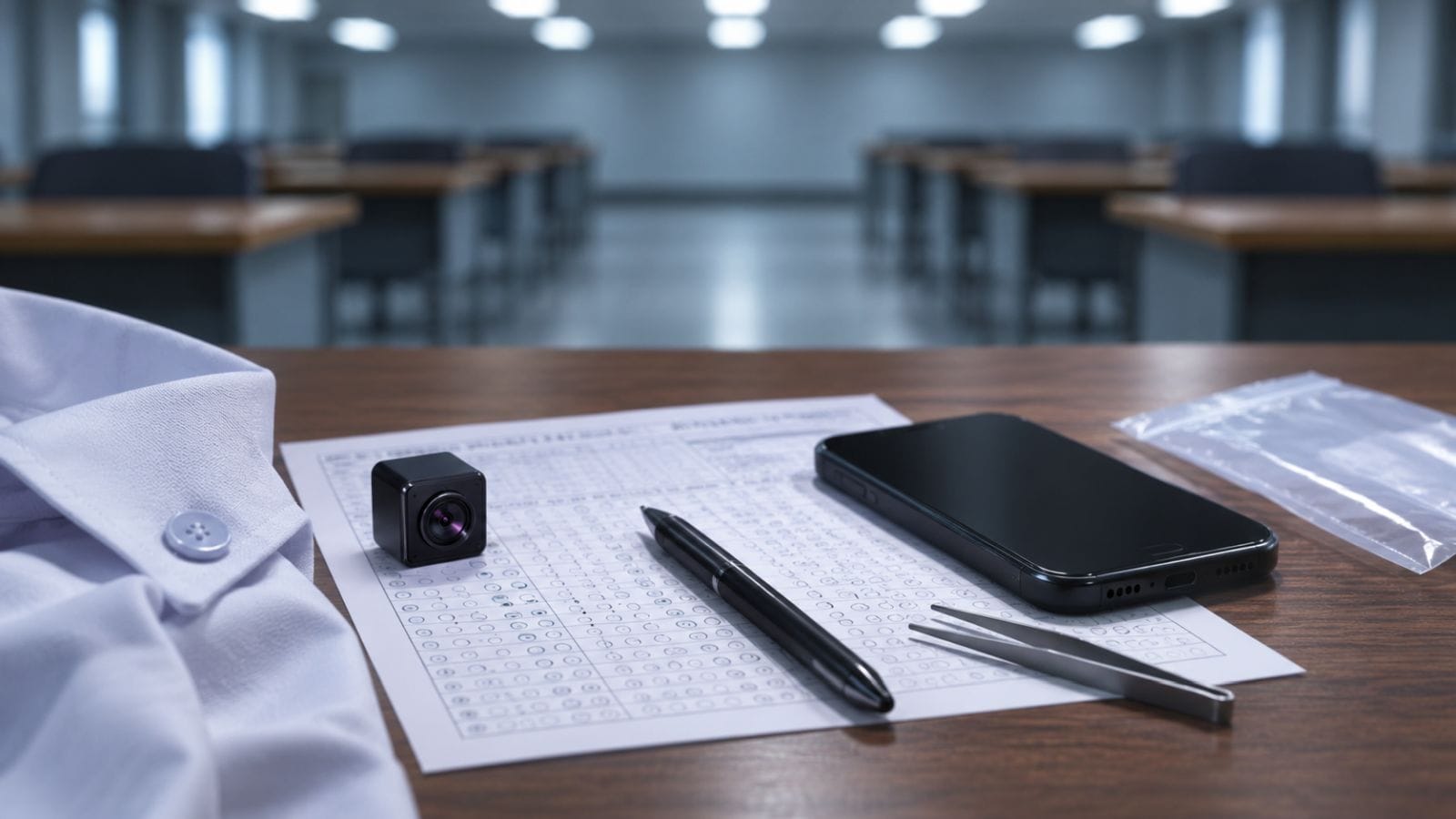
Imagine sitting down for the most consequential eight hours of your young life, and a proctor reaches toward your chest with a sticker because your shirt button looks slightly suspicious. That isn't a dystopian thriller plot. It became real life for more than 550,000 candidates sitting for South Korea's Suneung college entrance exam in November 2026.
A single confession flipped the country's high-stakes testing culture upside down. Just days before the Suneung, 34-year-old test-taker Han Won-seok—who had posted eye-popping scores on South Korea's national certified tax accountant exam, including answering 159 out of 160 questions right in the first round—admitted in a video that he used a miniature camera, a smartphone, and generative AI to beat the system. Suddenly, every thick eyeglass frame, sleeve cuff, and clothing button looked like a potential spy rig.
Honest students paid the price in sheer stress. When officials scramble days before an exam to slap stickers over buttons and inspect eyeglasses, anxiety spikes for teenagers who already carry enough pressure on their shoulders.
http://googleusercontent.com/lmdx_content/CUztqCjesdvsRoxAELfUjIkzwpwqDixaYzoBPdIUJpZaROklmDsRWkDOPOBgwTobKqJvMFvkQzhnGmDcnSxKSydznMcDdHcwgqJKPVvkeAzhrBdLoUUeWXRESWNfHdCpIEpdJLSzPEFCeHhNIvnO73884 As discussed in latest reports by The Washington Post, the effects are worth noting.
What Triggered the Suneung Crackdown
The panic didn't start inside a high school exam hall. It started with a professional licensing test whose results looked too good to be true.
In the first round of the certified tax accountant exam in April 2026, the overall test-taker average in tax law was roughly 30.18 out of 100. Han racked up 397.5 out of 400 points. Later, in July's second round, he scored 663 out of 800. Veteran observers and online sleuths started questioning how someone could pull off numbers like that through solo cramming alone.
On November 15, 2026, Han came forward in a video posted on his attorney's YouTube channel. He said he used a hidden miniature camera to photograph exam questions, fed them to generative AI, and checked answers on a smartphone—explaining that financial pressure after leaving a corporate job and fear of letting down his parents pushed him to cheat. Local outlets and wire services, including The Korea Herald and The Guardian, covered how fast the confession reverberated through Seoul.
Even before Han's admission, AI wearables were already making exam boards nervous. Education authorities had banned smart glasses from exams in July 2026, and a handful of smart-glasses cheating cases had surfaced at university tests in Seoul in October. Meanwhile, illicit ads on Telegram were openly pitching button cameras, camera glasses, and miniature earpieces to test-takers looking for a shortcut.
How Exam Halls Changed Overnight
Two days after Han's confession, the government rolled out an emergency security playbook for the November 19 Suneung across roughly 1,312 test centers. You can tell how rattled officials were by how physical and sweeping the rules became:
- Extra staffing: Around 8,400 additional supervisors were added to roughly 75,000 proctors nationwide, splitting duties between smart-device checks and hallway supervision.
- Eyeglass inspections: Test-takers wearing glasses had to remove them and place them on their desks before testing periods so proctors could inspect them for smart hardware.
- Button stickers and clothing checks: Invigilators placed stickers over shirt buttons to block hidden pinhole cameras and checked collars, sleeves, and watches.
- Network limits: Public Wi-Fi within 100 meters of test sites was shut off for 24 hours starting Wednesday evening, alongside tighter device rules and post-exam investigations.
- Harsher penalties: Officials moved to push the exam ban for cheaters from one year up to 10 years, alongside criminal complaints and voided scores.
Let's be honest—putting stickers on buttons is a classic whack-a-mole move. It solves yesterday's threat picture, or at least tries to look decisive fast. Yet a determined cheater with a tiny camera, a hidden display, or a cellular link isn't stopped just because a proctor puts a sticker on a plastic button.
There's also a practical flaw with last-minute enforcement. Teachers and unions raised fair questions about recruiting thousands of extra staff right before exam day and expecting them to spot micro-electronics in seconds. When rules are announced days ahead, normal students start wondering whether wearing thick frames, a patterned shirt, or normal-looking buttons will waste precious calm before the bell rings.
Angles Most Coverage Misses
Most headlines treat this purely as a gadget-versus-proctor story. That misses two deeper realities that shape why South Korea reacted so intensely.
First, the Suneung isn't just another test. In South Korea, university placement heavily influences career paths, social networks, and family expectations. That's why planes pause during listening sections and police help latecomers reach test sites. When people believe a high-stakes exam is rigged by hidden tech, public trust in meritocracy takes a hit—which is why the Ministry of Education warned that unfairness could trigger wider social strain.
Second, old-school paper exams were built for a pre-AI world. As The Korea Herald noted in its reporting on the scandal, educators who helped shape the Suneung in 1993 have long pointed out that a single written test only captures a narrow slice of real ability—and generative AI makes pure recall and formulaic problem-solving even easier to externalize. Meanwhile, accounting bodies began looking at practical, non-AI assessments during training to verify whether newly qualified professionals actually have the skills they claim.
Some officials even floated big-picture ideas, like debating whether smart-device makers should be pushed to add visible or audible indicators when devices are active. Good luck getting universal hardware rules like that passed overnight across global manufacturers. Realistically, exam security is going to stay an arms race between stealthier hardware and stricter physical controls, paired with statistical anomaly checks on impossible score jumps.
What You Can Do Before High-Stakes Exams
If you're taking a major proctored exam—or helping a student prepare for one—don't treat security rules as an afterthought on test morning. A little planning saves real mental energy.
- Read the exact dress and item rules days early. Check what's banned, what stays outside the room, and whether glasses or watches get inspected. Simple, plain clothing without bulky hardware or questionable accessories reduces friction at the door.
- Keep your setup boring and unmistakable. Wear standard, low-profile eyeglasses if you need them, skip flashy gadgets, and leave anything electronic locked away well before arrival. You don't want to spend five minutes explaining a harmless item while your heart is racing.
- Build calm routines for inspection delays. Extra checks and crowd control can slow down morning entry. Arrive early, keep breathing steady, and remind yourself that a proctor checking your glasses or buttons is checking the room—not accusing you personally.
- Never gamble your record on a shortcut. A banned device or cheating accusation can wreck years of work through voided scores, multi-year bans, or criminal trouble. Honest preparation is slower and harder, sure, but it's the only path you actually own.



