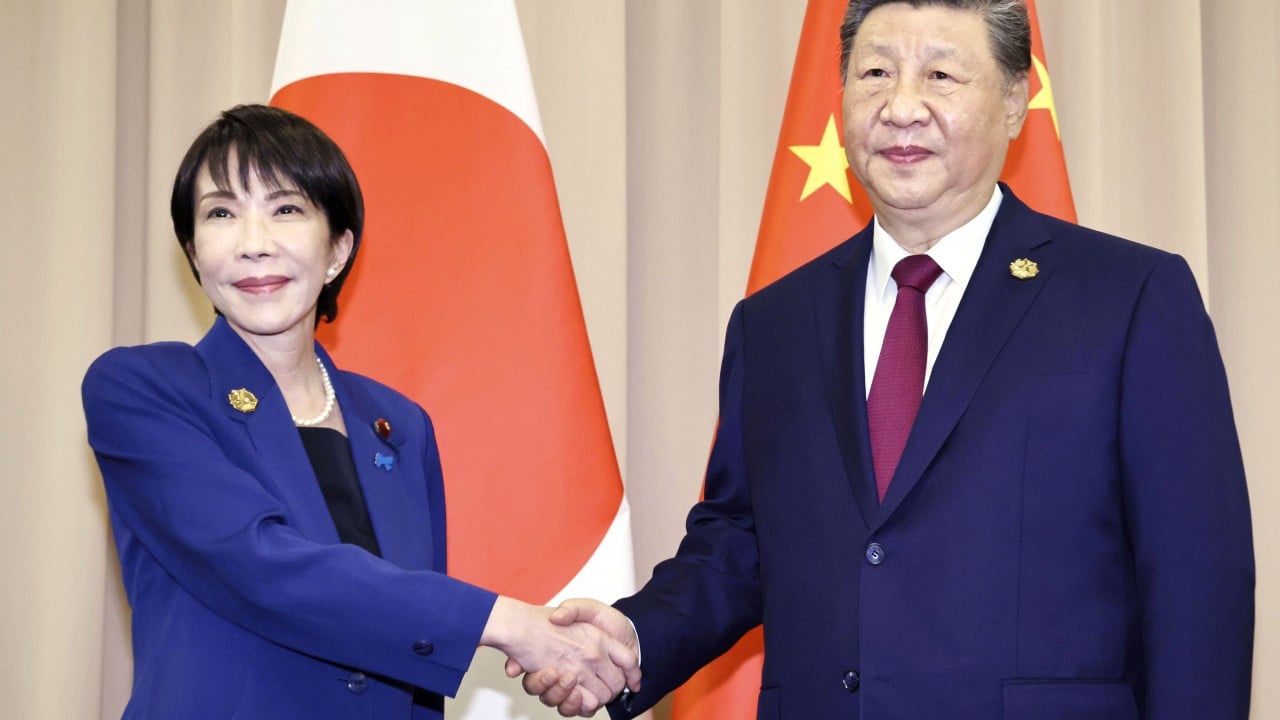
History rarely repeats itself quite the way optimists hope. Back in 2014, when Beijing hosted the APEC summit, Chinese President Xi Jinping and then-Japanese Prime Minister Shinzo Abe managed to orchestrate a frosty yet functional diplomatic reset. That famous, stone-faced handshake became the blueprint for managing deep bilateral friction. People look at today's regional tensions and assume a repeat performance is just around the corner.
They are completely missing the point.
The current standoff between Beijing and Tokyo under Prime Minister Sanae Takaichi is fundamentally different from the territorial and historical spats of a decade ago. If you are waiting for a sudden handshake at the Apec summit to wipe the slate clean, you are misreading the entire geopolitical playbook of both nations.
The Taiwan Red Line Changes Everything
In 2014, the friction stemmed from historical grievances, wartime memory, and competing claims over uninhabited islands. Toxic? Absolutely. But those issues allowed for a certain amount of diplomatic ambiguity and compartmentalization. Trade could keep humming while politicians bickered over shrines and rocks.
Today's crisis is entirely different. The core dispute revolves around Takaichi's explicit stance on a Taiwan contingency. When she stated in parliament that a Chinese move against Taiwan could constitute a survival-threatening situation for Japan—thereby triggering collective self-defense—she crossed a line that Beijing treats as non-negotiable.
China doesn't view this as standard political posturing. Beijing views it as direct interference in its most sensitive territorial core interest. Because of this, Beijing's demand isn't just for Tokyo to tone down the rhetoric; they've demanded a formal retraction. And Takaichi, backed by a powerful conservative political base, has refused to back down. You cannot manufacture a diplomatic thaw when the baseline condition from Beijing is an apology that Tokyo refuses to give.
Political Incentives Have Shifted in Tokyo
Look closely at how Japanese leadership handles pressure today compared to 2014. Shinzo Abe was a nationalist, but he was also pragmatic enough to realize that a complete economic freeze with China hurt Japan's corporate interests. He invested heavily behind the scenes to find a diplomatic off-ramp.
Takaichi operates in a different political reality. Her hardline stance against Beijing plays remarkably well with domestic voters who are increasingly anxious about Chinese maritime expansion and economic coercion. Getting snubbed or treated coldly by Beijing on an international stage isn't necessarily a political death sentence for her back home. In fact, standing up to China can be spun as proof of strength to her nationalist supporters.
When a leader's domestic survival relies on looking tough against a foreign rival, the incentives for compromise evaporate. Why cave to Beijing's demands when standing your ground secures your political base?
The Missing Middle Ground in Modern Japanese Politics
Back in 2014, Japan's ruling Liberal Democratic Party (LDP) maintained internal factions that specialized in keeping backchannels open with Beijing. There were seasoned politicians who viewed China relations as too important to fail, acting as shock absorbers when state-to-state ties hit rock bottom.
Those moderate voices have largely been marginalized or replaced. The political gravity in Tokyo has shifted firmly toward a strategy of collective resilience, decoupling critical supply chains, and building a network of security partnerships like the Quad alongside the United States. Japan is actively fortifying its southwestern islands and ramping up defense spending. Tokyo is preparing for long-term strategic competition, not a quick diplomatic reset.
Beijing recognizes this shift. Chinese state media and officials see Japan's current strategy not as an isolated policy quirk, but as part of a wider US-backed containment architecture. From Beijing's perspective, offering a soft diplomatic landing to Takaichi without a fundamental shift in her Taiwan policy would look like weakness.
What Actually Happens Next
Expect friction rather than fireworks. While business lobbies on both sides are desperately trying to keep supply chains for rare earths and manufacturing components stable, the political tracks are locked in separate directions.
Stop expecting a replay of 2014. The structural foundations of the relationship have eroded, the stakes involving Taiwan are infinitely higher than historical island disputes, and neither capital has an internal political incentive to blink first. The sooner businesses and analysts accept that this cold peace is the new baseline for East Asia, the better prepared they will be for the economic and security shocks ahead.