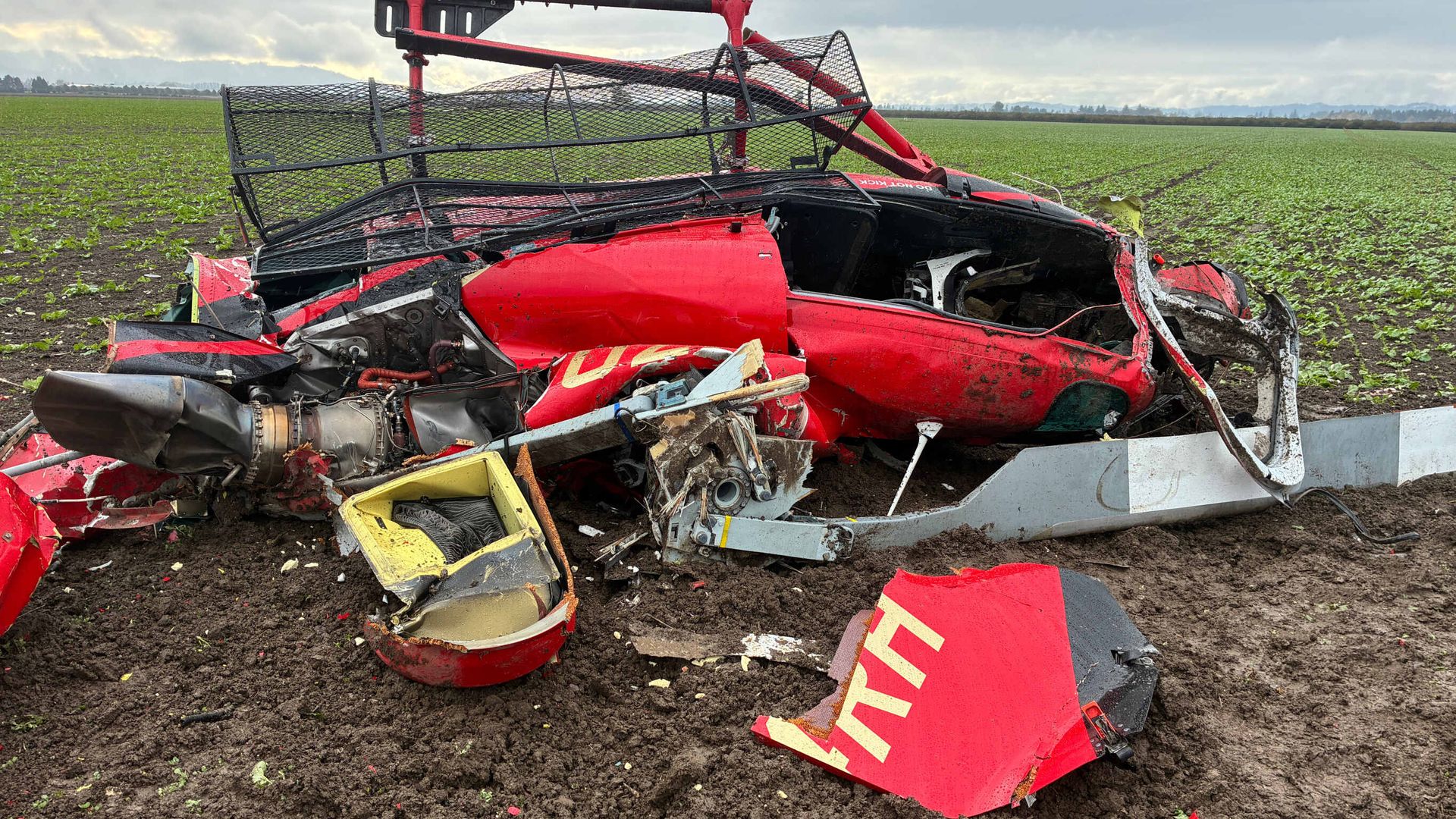
Two helicopters collided in mid-air near McMinnville, Oregon, claiming three lives, including a flight student from the United Kingdom. The disaster unfolded on a Thursday afternoon near McMinnville Municipal Airport, leaving behind tangled wreckage in a farm field and triggering a multi-agency federal investigation.
Local law enforcement and aviation authorities rushed to the scene following witness reports of the crash at approximately 2:10 p.m. local time. The impact zone, situated near the intersection of the Southeast Amity-Dayton Highway (Highway 233) and Southeast Cruickshank Road, quickly became the focal point of an emergency response involving the Yamhill County Sheriff’s Office, Oregon State Police, and local fire departments.
The Aircraft and the Victims Involved
The collision involved two distinct aircraft: a 1995 Robinson R22 and a 2018 Airbus AS350B3. Two people were aboard the Robinson helicopter, while a single pilot operated the Airbus.
The Yamhill County Sheriff’s Office identified the occupants of the Robinson R22 as 22-year-old flight instructor Maddie Aasbo of Texas and the unnamed student pilot from the UK. The sole occupant of the Airbus AS350B3 was 38-year-old Tyler Delane Sturdevant of Newberg, Oregon. All three individuals were pronounced dead at the scene.
The Robinson helicopter was associated with Jerry Trimble Helicopters, a prominent flight training school based at the McMinnville airport. The training institution released a statement expressing profound grief over the incident and confirming its full cooperation with safety inspectors.
Why Mid-Air Collisions Happen Near Regional Airports
Aviation safety experts point out that airspace surrounding regional airports and flight training hubs carries unique hazards. Training aircraft often operate in designated practice areas or local patterns, where student pilots build hours under instruction. While airports like McMinnville maintain steady traffic, the dense concentration of smaller, highly maneuverable craft increases spatial awareness demands.
Flight instruction inherently involves high-workload environments. Instructors must constantly monitor external traffic while managing student inputs inside a confined cockpit. When multiple aircraft converge on shared corridors or approach vectors near municipal fields, the margin for error shrinks dramatically.
The Ongoing Investigation
Responsibility for dissecting the tragedy now rests with federal authorities. Investigators from the National Transportation Safety Board (NTSB) have taken the lead, backed by the Federal Aviation Administration (FAA). Teams are examining radar data, maintenance records, and witness accounts to piece together the final moments before the impact.
At the same time, local authorities are coordinating international notifications. Because the deceased student pilot hailed from Britain, the Yamhill County Sheriff's Office has worked alongside the FBI and the British consulate to ensure proper next-of-kin protocols before releasing identifying details to the public.
Road closures remained in place along Highway 233 while technical crews cleared the debris field and documented the wreckage. While the airport itself stayed operational, the local community and the wider aviation training sector are left confronting the stark dangers inherent in learning to fly.



