For years, military planners operated under a comfortable assumption. Fixed overseas bases with robust perimeter walls and layered missile defense batteries were thought to be secure enough to project power anywhere on earth. That calculation just broke.
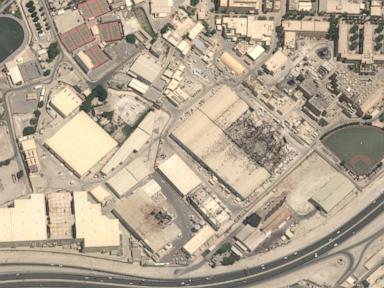
Recent satellite imagery and regional operational assessments tell a much darker story about how modern regional conflicts are actually fought. When Iranian missiles and drones rained down across more than two dozen sites in the Middle East, it wasn't a random barrage. It was a calculated, sequential dismantling of American military architecture.
If you want to understand why traditional projection models are failing, you have to look past official press releases and examine the sequencing of the strikes.
Blindfolding the Giant First
You don't punch a heavyweight without first knocking out his vision. Tehran's strategy followed a ruthless, logical sequence that analysts are only now fully piecing together.
The first wave of munitions didn't target sleeping quarters or mess halls. They went straight for the eyes and ears of the defense network. Early-warning radar systems, command nodes, and tracking installations absorbed the initial brunt of the kinetic onslaught.
Consider the sheer scale of the hardware involved. Defense contractor data shows that specialized early-warning radars—units so scarce that the United States possesses only a handful globally, with individual price tags hovering around half a billion dollars—were directly hit or catastrophically damaged in locations like Jordan and Qatar.
Once those tracking grids were fractured or blinded, the air defense umbrella lost its coordination. That opened the door for everything else.
The Strike on Infrastructure and Aircraft
With the warning systems neutralized or severely degraded, subsequent waves shifted focus toward active hardware and logistical shelters.
Between April and June, coordinated strikes impacted dozens of distinct locations, destroying or heavily damaging hundreds of individual structures. We aren't just talking about cosmetic scorch marks on concrete barriers. Satellite data evaluated by independent investigators highlights direct hits on:
- Aircraft hangars housing multi-million dollar tactical assets
- Fuel storage and logistics depots
- Tactical communications infrastructure
- Permanent and semi-permanent troop housing facilities
Congressional reports and defense tracking groups note that multiple American aircraft stationed in the region suffered varying degrees of structural damage before assets could be relocated out of immediate harm's way. Kuwaiti installations, given their proximity, took some of the heaviest structural hits during the height of the exchanges.
Why the Pentagon Kept Quiet
Official statements from United States Central Command and Pentagon spokespeople have consistently maintained a posture of operational security, emphasizing that forces remain well-protected and fully capable. Figures like Pentagon spokesman Sean Parnell have publicly insisted that service members have everything required to maintain mission success.
Yet, the deliberate delay in releasing clear satellite imagery and the tight lid on casualty or equipment tallies point to a deeper anxiety. When billions of dollars in infrastructure are compromised, transparency usually takes a backseat to strategic containment. Observers note that administrative measures were quietly implemented to slow down outside verification, leaving independent analysts to rely on commercial orbital imagery to piece together the toll.
The End of Fixed Base Dominance
The core takeaway from these developments goes far beyond a single exchange of fire. Military analysts, including experts from research organizations like the RAND Corporation, argue that this campaign signals a permanent shift in how great powers must view force projection.
Relying on massive, permanent land bases packed with fixed assets is becoming a liability rather than an advantage. When cheap, mass-produced drone technology and precision ballistic missiles can systematically blind and dismantle multi-billion-dollar defensive shields, the math changes completely.
Future operational planning will have to prioritize mobility, dispersion, and rapid reconstitution over concrete runways and static command hubs. If you're still betting on permanent regional outposts to keep the peace, the satellite data proves the game has already changed.
Iran DESTROYS Over 200 US Targets, Satellite Images ...
This video is relevant because it analyzes satellite imagery detailing the scale of damage sustained by U.S. military bases during the regional conflict.



