Eleven years is a long time in the news cycle. It is barely a blink when you are missing your mother.
When a white supremacist walked into a Wednesday night Bible study at Mother Emanuel African Methodist Episcopal Church in Charleston, South Carolina on June 17, 2015, and murdered nine Black worshippers, the nation reacted with immediate, roaring shock. Politicians gave speeches. Flags came down. Pundits debated gun control and racial hatred for a few grueling weeks. Then the news vans packed up. The cameras left.
The people who lost their parents, children, and siblings stayed behind in the quiet devastation.
That silence is precisely why the newly opened Emanuel Nine Memorial matters so profoundly. Backed by twenty-five million dollars in fundraising and designed by Michael Arad—the architect behind the National September 11 Memorial in New York—this permanent site finally stands beside the historic church. For Chris Singleton, who was only eighteen when his mother, Reverend Sharonda Coleman-Singleton, was murdered, the dedication offers something he has never had. A physical place to visit. Because his mother's ashes were scattered in the ocean in Jamaica, he didn't have a traditional gravesite. Now, he has a quiet corner of downtown Charleston where he can sit, breathe, and remember.
Eleven Years and Twenty Five Million Dollars Later
Building a monument of this magnitude takes staggering effort. The Mother Emanuel Memorial Foundation was established back in 2017 specifically to shepherd the project from concept to reality. Raising twenty-five million dollars is no small feat, especially when donor fatigue and shifting economic realities constantly threaten nonprofit fundraising campaigns.
Donations poured in from everyday individuals, private foundations, major corporations, and public coffers, including contributions from the city of Charleston and the state of South Carolina. But the foundation's board made a critical financial decision that deserves more attention than it usually gets. Out of that twenty-five million dollar total, approximately five million dollars has been tucked away into a permanent maintenance endowment.
That detail is genius. Too often, public monuments open to great fanfare only to fall into disrepair a decade later because the host institution cannot afford upkeep. By securing an endowment upfront, the organizers ensured that this Charleston memorial will not become a financial anchor weighing down the Mother Emanuel congregation. It protects the space for generations to come, sparing the church from bearing the ongoing economic cost of honoring a national tragedy.
Architecture Rooted in Human Dignity
Monuments run the risk of feeling sterile. Architects sometimes lean too heavily into brutalism or cold abstract geometry when trying to express grief, leaving visitors feeling alienated rather than comforted. Michael Arad avoided that trap entirely.
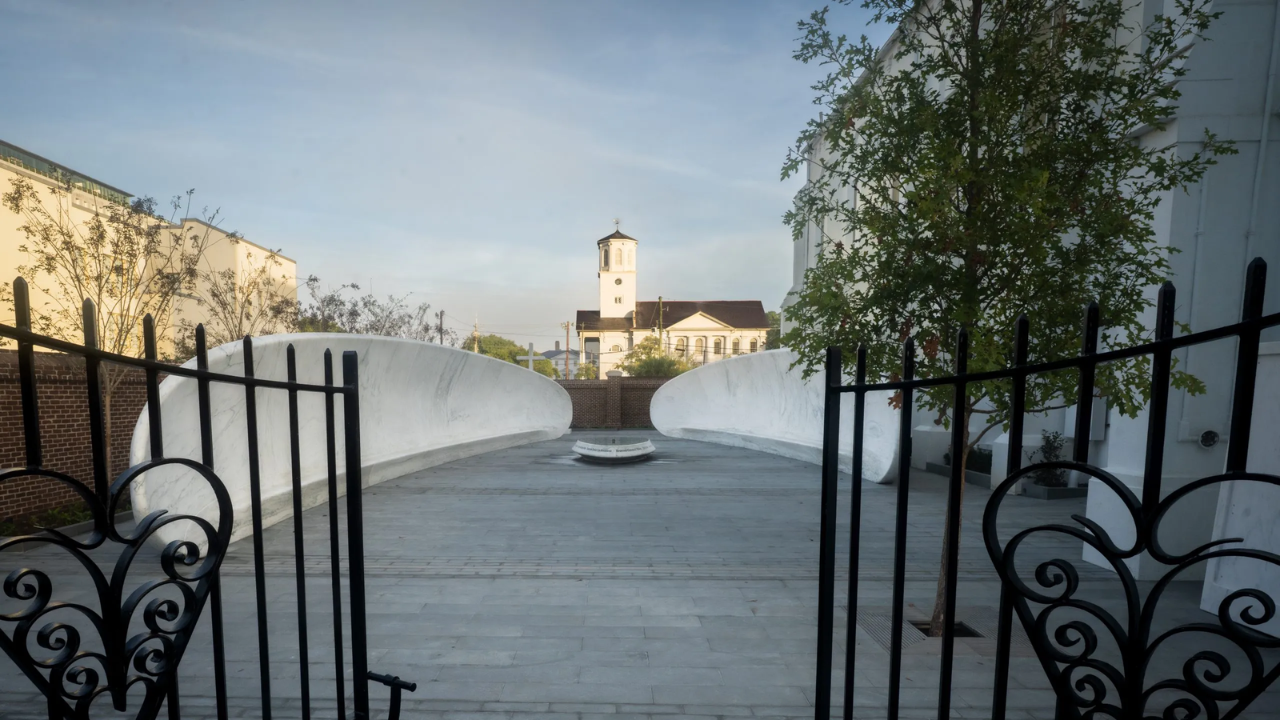
The layout relies on intimacy and quiet reflection rather than overwhelming scale. Two large, curved marble benches wrap around a central fountain. Inscribed in stone are the names of the nine victims whose lives were cut short that June evening: State Senator and Reverend Clementa Pinckney, Reverend Sharonda Coleman-Singleton, Cynthia Graham Hurd, Reverend Daniel Simmons, Reverend DePayne Middleton-Doctor, Myra Quarles Thompson, Ethel Lee Lance, Susie Jackson, and Tywanza Sanders.
Water flows past their names, creating a soundscape that muffles the relentless hum of downtown Charleston traffic. It invites you to sit down. It forces you to slow down. A planned Survivors' Garden will soon expand the grounds, adding another layer of living green space to a site designed around peace, reconciliation, and hope.
When you stand in the marble courtyard, the design directs your eyes upward and inward. It forces you to look at the people who died as human beings with families, dreams, and unfinished lives, rather than reducing them to statistics in a textbook about racial violence.
The Weight of Surviving
We talk endlessly about victims and perpetrators, but we rarely talk honestly about what happens to the families who survive targeted hate crimes.
During the dedication ceremony, William Dudley Hurd—whose sister Cynthia Graham Hurd was killed in the massacre—spoke with a clarity that cuts straight through institutional platitudes. He pointed out that the memorial is not merely about grief. It is about an unbreakable human resilience. The killer took nine precious lives, but he failed to extinguish the love shared by the families and the community.
That sentiment sounds like a greeting card until you look at what these families have built over the past eleven years. They didn't retreat into bitterness. They founded scholarships, wrote books, advocated for legislative reform, and poured their energy into youth mentorship programs.
Yet, resilience doesn't mean the pain vanishes. Grief doesn't check its watch when a decade passes. For families dealing with the sudden, violent loss of a loved one, holidays and anniversaries carry a dull, throbbing ache. Having a physical sanctuary like this new memorial acknowledges a harsh truth: society expects you to move on long before your heart has caught up.
Preserving the Legacy of Mother Emanuel
You cannot understand the weight of this memorial without understanding the bedrock it rests upon. Mother Emanuel AME Church is not just a building where a tragedy happened. Founded in 1818, it stands as one of the oldest Black congregations in the American South.
Its history is woven directly into the fabric of the civil rights movement. Decades before the 2015 shooting, figures like Reverend Martin Luther King Jr. stood at its pulpit to preach about equality and justice. The church has weathered arson, state suppression, and institutional racism for more than two centuries.
By placing the memorial right beside the church, the founders tied the modern struggle against white supremacy directly to a much deeper historical timeline. This site is destined to become an educational landmark. Thousands of students, tourists, and history buffs will visit Charleston to understand how a congregation rooted in faith and resistance absorbed an unimaginable blow and chose to stand tall.
What This Means for the Future of Public Memory
Public art and memorials are political battlegrounds today. Every monument erected or torn down sparks fierce debates about who gets to write history.
What makes the Emanuel Nine Memorial different is that its creation was driven from the ground up by the community and the families most affected. It wasn't commissioned by distant bureaucrats eager to polish their public relations image. It was willed into existence by people who needed a place to weep, remember, and demand better from society.
If you visit Charleston, go see it. Don't go just to snap a photo for social media. Sit on the curved marble bench. Read the names inscribed on the fountain. Let the water drown out your notifications for ten minutes.
We live in a culture obsessed with speed, instant fixes, and quick closure. The opening of this memorial reminds us that some wounds require permanent care. Honouring the past isn't about wallowing in sorrow. It is about building physical and spiritual spaces durable enough to hold our collective memory when everyone else has gone home.



