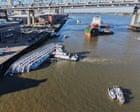
The phrase "miracle on the Mississippi" sounds like a neat headline hook until you remember how close New Orleans came to a full-scale catastrophe. When the asphalt tanker Atlantic Asphalt lost its steering mechanism and plowed straight into the docked paddlewheel cruise ship American Heritage, 191 passengers and crew members faced a terrifying scramble for survival as the vessel rolled onto its side. Everyone survived, which is a statistical relief. But now comes the messy part of maritime disasters: figuring out what went wrong in the minutes before the impact.
Federal investigators have officially recovered the voyage data recorder from the tanker. If you think of it like the black box of an airplane, you're on the right track. It holds bridge audio, speed metrics, and rudder command logs that will dictate where the legal and financial blame lands.
Inside the Voyage Data Recorder
National Transportation Safety Board officials confirmed that the recovery of the marine data unit is the primary breakthrough in understanding why the ship veered off course. Witnesses and initial reports pointed to a sudden steering failure roughly two minutes before the collision. Two minutes isn't much time. It is barely enough to realize a catastrophe is incoming, let alone reverse momentum on a massive commercial tanker laden with heavy asphalt and bitumen.
The audio captured on that bridge will tell a very specific story. Investigators want to hear the exact cadence of commands, check whether alarms were sounding, and determine how quickly the crew recognized their rudder was stuck. Mechanical failure defense lines are standard in these investigations, but proving when the failure happened and whether routine maintenance was ignored is where things get expensive.
Legal Fallout and Port Seizures
New Orleans officials didn't wait for the audio files to finish processing before taking aggressive action. The local port authority swiftly filed a million-dollar lawsuit and moved to seize the tanker. Because the vessel is tied to foreign corporate structures—specifically a subsidiary linked to Chinese ownership—securing the physical asset ensures that local stakeholders have leverage to recoup damages.
Meanwhile, attorneys representing the crew and passengers of the American Heritage are sharpening their arguments around gross negligence and operational fault. Operating heavy commercial traffic through the crowded bends of the lower Mississippi River requires absolute mechanical reliability. When a massive industrial ship loses directional control near a major metropolitan hub, the margin for error drops to zero.
The Broader Vulnerability of Inland Waterways
People look at river cruises as relaxed, low-risk vacations. They float down historic waterways, past scenic industrial ports, assuming the commercial traffic is tightly buffered. This crash shatters that illusion. The Atlantic Asphalt narrowly missed striking a heavily traveled bridge carrying tens of thousands of daily commuters.
If that tanker had hit structural pylons instead of a docked passenger vessel, the narrative would look entirely different. The NTSB expects its preliminary report to drop within thirty days, but a comprehensive final assessment could take up to two years. That timeline is standard for federal transport investigations, but it leaves local infrastructure vulnerable while operators wait for answers.
Expect tighter scrutiny on commercial vessel maintenance schedules and stricter maneuvering protocols in narrow river bends. The audio recovered from the bridge will ultimately decide whether this crash was an unavoidable mechanical ghost in the machine or the result of preventable oversight.



