History isn't usually written in permanent ink. Sometimes, it’s scribbled in blue pen on yellow legal pads late at night in a Washington hotel room, packed with crossed-out lines, anxious edits, and second thoughts.
For over sixty years, the only known handwritten final draft of Martin Luther King Jr.’s "I Have a Dream" speech sat tucked inside an ordinary desk drawer. Found among the belongings of Edward T. Clayton, a close speechwriter and public relations director for the Southern Christian Leadership Conference, the seven-page manuscript was preserved quietly by Clayton's widow, Xernona Clayton. Now, ahead of a high-stakes Christie's auction in January 2027 where it’s expected to clear $10 million, the document is finally seeing the light of day.
If you think you know the story behind America's most famous civil rights address, look closer. The paper tells a much rawier, more improvised story than the polished final audio suggests.
The Secret Desk Drawer Discovery
Edward Clayton passed away in 1966, leaving behind an archive of papers documenting the turbulent heart of the civil rights movement. In the late 1990s, Xernona Clayton opened an envelope marked simply "speech" and found the yellow pages. Knowing her husband held onto everything, she placed it back into the desk drawer, where it sat undisturbed until she looked inside again in 2024. For another perspective on this development, refer to the latest coverage from The New York Times.
When Christie's manuscript specialist Peter Klarnet first traveled to Atlanta to inspect the document, he expected a fragmented preliminary sketch. Instead, he found the complete final handwritten text King composed in the early morning hours of August 28, 1963, at the Willard Hotel before heading to the Lincoln Memorial.
Scholars from Stanford University and the National Center for Civil and Human Rights have since examined the manuscript. They didn't just find a piece of paper. They found a window into the mind of a leader under immense pressure.
The Phrase That Was Almost Left Out
The most striking detail about this newly public manuscript isn't what’s in it. It’s what’s missing.
The phrase "I have a dream" does not appear anywhere on those seven yellow pages.
King was a brilliant orator who often preferred speaking from the rhythm of the moment rather than reading rigidly from a script. While preparing his remarks alongside his team, advisers actually warned him against using the "dream" motif. They worried it was too cliché, too overdone, and too worn out for a national stage. King listened, set the thought aside, and stuck to his prepared economic and social critique on the legal pad.
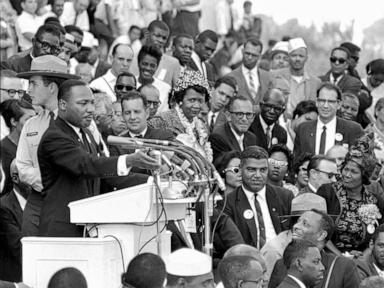
Then came the turning point on the steps of the Lincoln Memorial. As King spoke, gospel legend Mahalia Jackson shouted out from behind him, urging him to tell the crowd about the dream. Reading the energy of the massive audience, King pushed his notes aside and delivered the soaring refrain that defined a generation.
Seeing the unedited pages reminds us that history isn't predetermined. It's shaped by human choices, real-time adjustments, and the courage to listen to the room.
Where to See It Before the Auction
Before the manuscript goes up for sale on January 22, 2027, the public has a rare window to view it in person. The document is making a multi-city exhibition tour, starting with a week-long stint at the National Center for Civil and Human Rights in Atlanta, followed by stops in Chicago, and eventually landing at Christie’s in New York City on King's birthday.
Proceeds from the auction won't vanish into private accounts. They are earmarked for major philanthropic causes, including The King Center in Atlanta and the Xernona Clayton Foundation, ensuring that the legacy of the movement continues to fund future generations.
You can look at typed transcripts all day long, but seeing the physical ink scratches on yellow paper changes your perspective. It turns a marbleized myth back into a flesh-and-blood human being who stayed up until 4 AM working for change.



