Forget the joint statements. Ignore the podium speeches about peace, prosperity, and historical responsibility for a minute.
When three heavyweights like Xi Jinping, Donald Trump, and Vladimir Putin sit down in Shenzhen on the sidelines of the November 2026 APEC summit, the real story isn't in what gets read aloud to cameras. It's in who got a chair at the table, who stayed outside the room, and how small each circle got when the doors closed.
Diplomacy watchers love chasing grand bargains. I've spent years watching summit rosters across capitals, and I can tell you delegation lists rarely lie. A leader brings their lawyers when they expect a fight. They bring their dealmakers when they want leverage. And when they strip the room down to a handful of trusted aides over breakfast, they're either hiding real friction or trading favors nobody else is cleared to hear.
In Shenzhen, the three rosters told three very different stories—and together, they exposed where each capital's real priorities sit heading into 2027.
Why Shenzhen Summit Rosters Matter More Than Speeches
Most headlines treat a first-ever trilateral meeting between the leaders of China, the United States, and Russia as a dramatic turning point. In reality, high-level summits are theater layered on top of months of grinding staff work.
A seating chart shows power distribution inside each government. If a trade representative is seated front and center, tariffs and supply chains are active pressure points. If defense and foreign policy aides outnumber economic technocrats in the tightest breakout session, security and conflict management take precedence. If communications and protocol staff sit right inside the working orbit, message control and optics carry huge weight.
Shenzhen wasn't just an APEC stop. It was Trump's second trip to China in 2026 after his May visit to Beijing and Xi's September state visit to Washington, coming right after U.S. midterm losses and weeks before a key trade truce deadline on January 10, 2027. Against that backdrop, every name on the three delegation sheets had a job to do.
Beijing's Roster: Party Gatekeepers, Envoys, and Tight Control
Xi Jinping didn't leave much to chance on home turf at Kylin Villa in northwest Shenzhen. His bench combined top-tier party power with seasoned diplomatic and regional muscle.
Look at who stood beside him around the summit diplomacy:
- Cai Qi, Xi's chief of staff and Politburo Standing Committee member, who greeted Putin upon arrival and joined Xi at the airport welcome for Trump. Having Cai right in the mix signals that political discipline and the leader's inner command structure sit at the center of Beijing's playbook.
- Wang Yi, China's top diplomat, anchoring foreign policy continuity alongside Deputy Foreign Minister Ma Zhaoxu.
- Xie Feng and Zhang Hanhui, China's ambassadors to Washington and Moscow, respectively. Bringing both envoys together highlights how Beijing manages a balancing act: keeping a "constructive, strategic and stable" channel open with Washington while deepening strategic and military alignment with Moscow.
- Huang Kunming, Politburo member and Guangdong party secretary, tying the summit directly to the host province and the Greater Bay Area showcase.
Here's the catch with Beijing's approach, though. When Xi and Putin sat down for over two hours of talks on Wednesday—moving from a 13-a-side expanded session to a much tighter working breakfast with just two aides per leader—the real calibration moved away from big crowds. That pattern repeated when leaders narrowed down to small working circles. Big delegations signal breadth; tiny breakout rooms signal where sensitive trade-offs live.
Also, don't miss what Beijing emphasizes publicly versus privately. In public remarks around APEC, Xi leaned hard into defending open trade, supply chain stability, AI cooperation, and avoiding nuclear war while urging respect for each other's red lines. In practice, analysts point out that China is juggling competing pressures: defending export markets and rare earth or critical mineral leverage, avoiding getting dragged too deep into Moscow's war in Ukraine or Middle East escalations, and protecting its growing influence across the Global South.
Washington's Roster: Economic Heavyweights Plus a Tight White House Core
Trump's lineup in Shenzhen read like a mashup of trade negotiators, diplomatic principals, and fiercely loyal White House operators.
On the policy side, Washington brought heavy hitters tied directly to economic friction and statecraft:
- Marco Rubio, serving as Secretary of State and national security adviser, bridging traditional diplomacy, regional security, and crisis talks.
- Scott Bessent (Treasury Secretary), Howard Lutnick (Commerce Secretary), and Jamieson Greer (U.S. Trade Representative), flanked by U.S. ambassador to Beijing David Perdue.
Putting Bessent, Lutnick, and Greer on the roster makes total sense once you look at the calendar. Washington and Beijing have been wrangling over agricultural purchases, rare earth and critical mineral restrictions, semiconductor export controls, and a trade truce set to expire on January 10, 2027. Even ahead of APEC, Bessent and Greer had been pressing Chinese Vice Premier He Lifeng on following through on prior commitments, while Beijing pushed back on reciprocal tariff cuts.
At the same time, Washington's roster included a heavy concentration of senior White House staff and aides—names like Stephen Miller and Dan Scavino, alongside operations, communications, speechwriting, and protocol staff including Beau Harrison, Steven Cheung, Ben Moss, Ross Worthington, Walt Nauta, Alina Bulazel, Chris Ambrosini, Margo Martin, Natalie Harp, and Monica Crowley.
That mix reveals something important about how this White House operates abroad. Pairing heavyweight cabinet officials with an inner circle of trusted staffers keeps tight control over narrative, logistics, and presidential leverage. Yet it also creates a well-known tension in Washington diplomacy: when too many decisions stay tightly held inside a small presidential circle, career specialists and allies outside the room can end up guessing where policy is heading next.
Moscow's Roster: Security Veterans, Economic Technocrats, and Soft Outreach
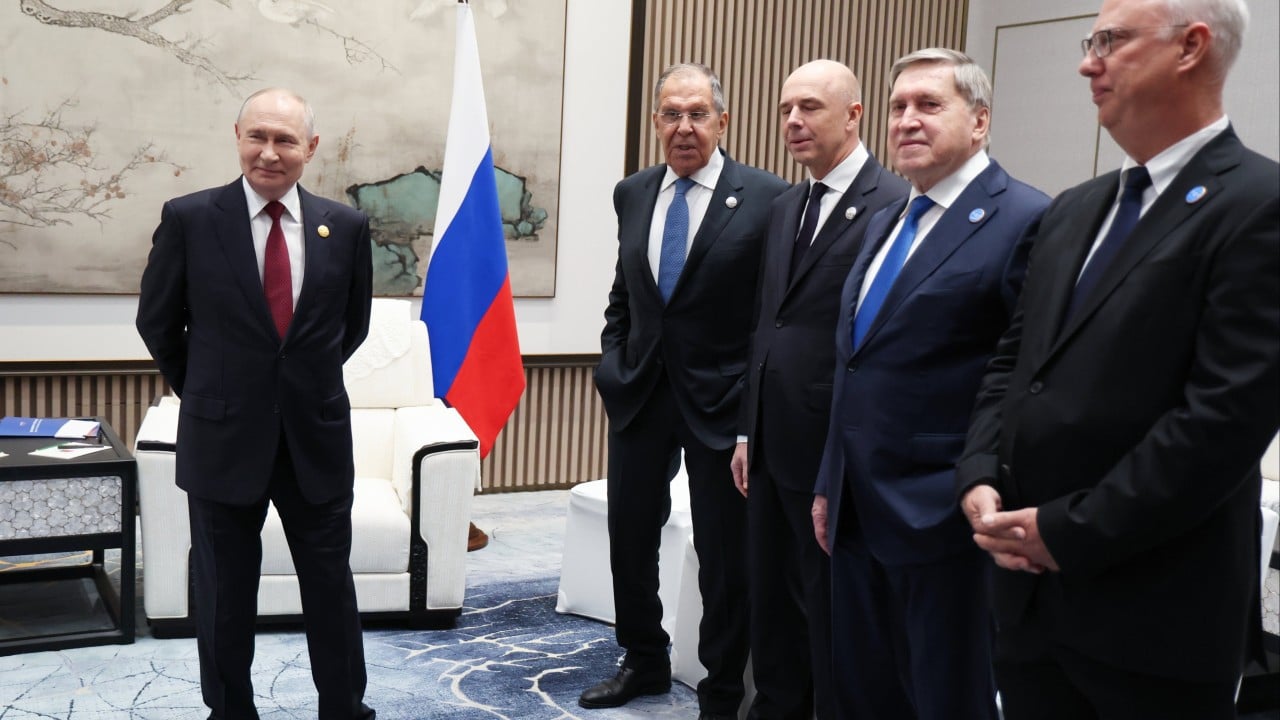
Vladimir Putin arrived in Shenzhen with a broad, multi-track delegation that blended hard security with economic survival and statecraft.
On the security and foreign policy side, Putin brought Sergey Lavrov, Defence Minister Andrey Belousov, and foreign policy aide Yury Ushakov. Given Russia's ongoing war in Ukraine—now more than four years in, with fresh strikes and diplomatic maneuvering swirling around any settlement—having defense and foreign policy veterans front and center is no surprise.
What stands out just as much is Moscow's economic and functional bench:
- Deputy prime ministers Tatyana Golikova, Dmitry Chernyshenko, and Anton Siluanov (who also serves as finance minister), joined by Economic Development Minister Maxim Reshetnikov and Energy Minister Sergey Tsivilev.
- Ministers covering health (Mikhail Murashko), science and higher education (Valery Falkov), and culture (Olga Lyubimova).
Why bring finance, energy, economic development, health, science, and culture into a summit setting? Because Moscow wants to project normalcy, resilience, and broad partnership rather than looking like a country defined solely by sanctions and war. Publicly, Putin claimed sanctions had lost their bite and framed the trilateral talks around shared responsibility for global stability and resolving conflicts, including Ukraine.
Still, numbers tell a sobering story beneath the tough talk. China accounts for roughly 40% of Russia's foreign trade, while Russia represents less than 4% of China's. Moscow can talk about multipolarity and shared interests all day long, yet the economic asymmetry in that partnership is hard to miss. And when Putin narrowed his circle down to Lavrov and Ushakov for tight working talks opposite senior Chinese figures like Cai Qi and Wang Yi, it underlined which levers Moscow treats as most sensitive.
What the Three Lineups Miss (and Where Skepticism Belongs)
A big summit roster can fool you into thinking a breakthrough is right around the corner. Honestly, it usually doesn't.
First, a trilateral photo-op doesn't erase deep structural disagreements. Data from the Stockholm International Peace Research Institute (SIPRI) in early 2026 put U.S. warheads around 5,042 and Russia's around 5,420, compared with roughly 620 for China. Talking broadly about preventing nuclear war or reducing stockpiles sounds historic in a soundbite, yet turning that into verifiable arms control agreements—especially when China has long resisted parity-style disarmament talks—is a massive lift.
Second, all three leaders have incentives to oversell optics while leaving hard details unresolved. Trump highlighted his willingness to discuss nuclear reductions and push for progress on conflicts like Iran and Ukraine, while brushing past thorny questions around high-end AI chips. Xi pitched stability, open trade, and AI cooperation while guarding Beijing's core red lines. Putin pushed for terms favorable to Moscow on Ukraine and talked up diplomatic engagement.
Third, we shouldn't treat every rumor or sideline report as gospel. Reports around high-stakes summits often mix verified protocol details with trial balloons, leaks, and posturing. Always separate confirmed delegation roles and official readouts from speculation about "secret deals" that haven't materialized.
Practical Next Steps for Tracking What Comes Next
If you're following how Shenzhen shapes global trade, tech, and security over the next few months, skip the victory laps and watch concrete markers instead:
- Watch the January 10, 2027 trade truce clock. Pay close attention to announcements from the U.S. Treasury, Commerce Department, USTR, and China's commerce and vice-premier channels on agricultural purchases, rare earth or critical mineral export rules, and tariff suspensions.
- Track AI and export-control enforcement. Look beyond speeches about "cooperation" to actual licensing rules, chip restrictions, and any working-level AI safety or incident channels between Washington and Beijing.
- Follow back-channel negotiators, not just podium quotes. Keep an eye on what figures like Rubio, Wang Yi, Lavrov, Ushakov, Bessent, Greer, and He Lifeng say and do in the weeks after Shenzhen—that's where real compromises or deadlocks show up first.
- Compare leader rhetoric against ally and market reactions. Watch how Asian partners, European capitals, and global markets respond to signals on Ukraine, Iran, regional security, and trade stability.
Rosters don't settle geopolitical rivalries. They just show you who each side trusts when the stakes go up.



