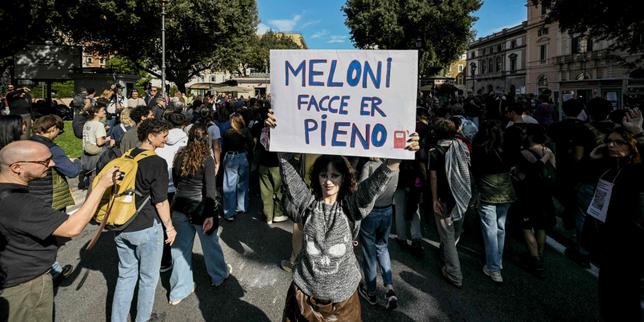
Young people in Italy are getting hit from two directions at once. Lawmakers in Rome keep rolling out tough security decrees that target street protests, juvenile offenses, and even teen screen time, while real wages and long-term career prospects barely budge.
Look at the math driving the politics. According to ISTAT demographic indicators, roughly a quarter of Italy's resident population is aged 65 or older—about 14.8 million people out of roughly 58.9 million—and the mean age reached 47.1 years at the start of 2026. With legislative elections scheduled for 2027, Prime Minister Giorgia Meloni's coalition has leaned heavily into visible "law and order" measures that play well with older voters anxious about street unrest and urban disorder.
Honestly, that trade-off makes political sense on paper, even if it feels infuriating if you're twenty-something trying to pay rent in Milan or Bologna. Older citizens vote in higher numbers and care deeply about public order. Young Italians? Plenty of them feel written off before they even land a permanent contract. Additional information into this topic are covered by Associated Press.
Why Italy security policies target young people first
When trouble flares up in Italian cities, Rome reaches for criminal law and police decrees first. Following serious clashes and property damage in downtown Milan in mid-October 2026, the cabinet adopted Decree-Law No. 190 of October 22, 2026 on urgent public security and juvenile crime.
That decree followed an already crowded sequence of security bills—from the 2022 anti-rave rules and 2023 Caivano decree to Law No. 80/2025 and Law No. 54/2026. Each wave has widened police powers, created new protest-related offenses, or toughened penalties for minors. Human rights groups, including FIDH and OMCT, warned in early November 2026 that the latest decree risks shrinking civic space and leaning too hard on detention for young people.
And security in Italy isn't just about tear gas and street barricades anymore. It's bleeding straight into digital life.
In mid-November 2026, coalition lawmakers tabled an amendment to the security decree aiming to ban children under 13 from social media outright, require parental linkage for ages 13 to 15, and let teens manage independent accounts starting at 16, as reported by Wanted in Rome. Protecting kids online is a real issue—parents everywhere worry about algorithms and harmful content—but bundling age limits into a security decree shows how quickly young people's everyday spaces become a law-and-order battleground.
The risk of treating symptoms instead of causes
Crackdowns look decisive on the evening news. They don't fix why a kid in a rough neighborhood or a frustrated university student ends up on a police blotter.
When governments treat youth friction mainly as a policing problem, they get fast headlines. What they don't get is trust. Heavy-handed rules can turn ordinary street grievances into a permanent standoff between young citizens and the state.
Economic blind spots hurting young Italians
If security is the loud part of the story, the quiet part is economic stagnation. You can pass ten security decrees a year and still leave young workers stuck with low pay, weak purchasing power, and thin career ladders.
According to the European Commission economic forecast for Italy published in November 2026, real GDP growth is projected at just 1.0% for 2026 and 0.7% for 2027, while inflation stays elevated around 3.4% in 2026 and 3.1% in 2027. Wage growth has been trailing inflation, meaning many households won't claw back lost purchasing power until closer to 2028.
For young adults entering the workforce, that squeeze hurts even more. Wages for under-30 workers in Italy have long lagged behind older cohorts and European peers, and entry-level jobs often come with precarious terms or slow progression. Even when headline youth unemployment dips—ISTAT data showed the youth unemployment rate hitting a multi-decade low of 17.7% in May 2026—a lower unemployment percentage doesn't automatically mean good pay or real upward mobility.
Brain drain and the quiet exit
When opportunities at home feel cramped, plenty of young Italians pack a bag instead of waiting around. A December 2025 report from CNEL found that 630,000 young people aged 18 to 34 emigrated from Italy between 2011 and 2024, carrying an estimated human capital value equal to 7.5% of GDP.
Think about the irony there. A country with one of the oldest populations in Europe—where births in 2025 fell to 355,000 against 652,000 deaths and fertility dropped to 1.14 children per woman—can't afford to lose its twenty- and thirty-somethings. Yet high living costs in booming hubs, low starting salaries, and slow bureaucracy keep pushing talented people toward London, Berlin, Zurich, or Madrid.
What economic policy gets right and where it falls short
To be fair, the Meloni government hasn't ignored the economy completely. Public investment tied to EU funds has supported infrastructure and works, and certain tax rules have favored self-employment. Supporters argue that fiscal restraint and political stability matter for keeping borrowing costs manageable in a high-debt country.
Still, critics and economists point out a glaring mismatch. Short-term stability isn't the same as generational renewal. A country that relies mostly on low-wage service jobs, small family firms, and temporary contracts struggles to keep educated young workers from feeling stuck.
There's also a legitimate debate over how to read the numbers. Some analysts note that total employment in Italy has held up better than pessimists expected over the past couple of years, and immigration has helped keep the overall population roughly flat despite low birth rates. Fair enough. Yet underemployment, stagnant real pay, and unaffordable housing in major cities remain stubborn realities for young people on the ground.
Practical steps for young Italians and policy watchers
If you're a young person navigating work or study in Italy—or following how the country's politics will shape 2027—waiting for a sweeping generational fix isn't a great strategy. Here are concrete moves you can take right now:
- Audit total compensation, not just gross salary. Compare net take-home pay against local rent, commuting costs, welfare/meal vouchers, and training benefits before accepting an entry-level offer or internship.
- Build cross-border skills early. Strengthen English or another major European language, get certifications recognized across the EU, and keep your CV adaptable whether your next step is in Milan, elsewhere in Italy, or abroad.
- Track parliamentary amendments, not just headlines. Security decrees and youth measures get revised fast during committee votes in Rome—check official gazettes or legal trackers if you organize, protest, or work with minors.
- Push local and regional institutions on concrete levers. Housing availability, technical training, and university-to-industry links are often decided at regional or municipal levels where turnout and pressure actually move the needle.



