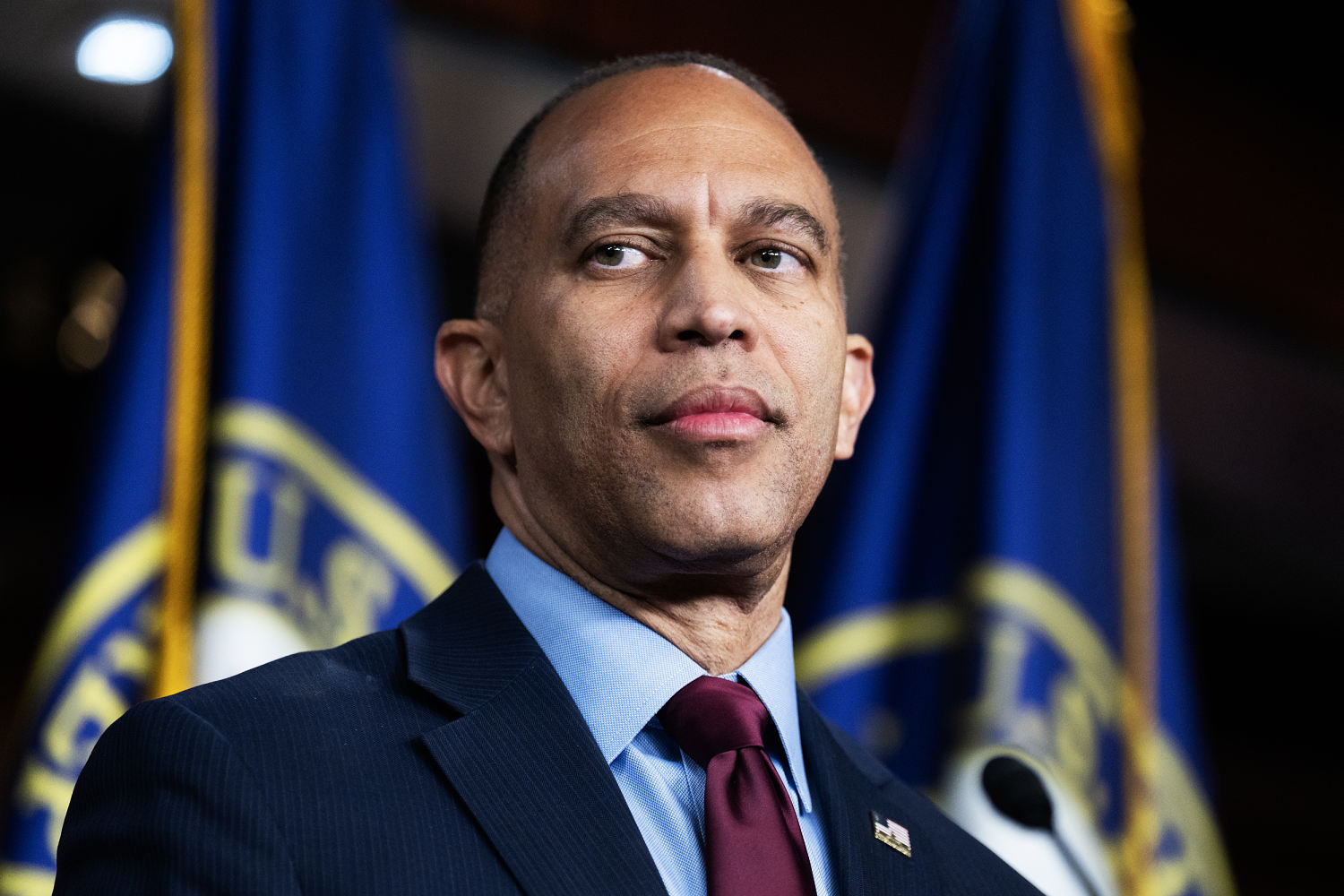
Winning a party nomination for House Speaker doesn't automatically hand you the gavel. It puts you in line for it.
When House Democrats formally nominated Representative Hakeem Jeffries of New York in January 2023—making him the first Black lawmaker in American history to lead a major party in either chamber of Congress—headlines immediately framed him as the future Speaker of the House. That framing missed the entire math of Capitol Hill. On January 3, 2023, Republicans held a narrow 222-to-212 majority in the House of Representatives, which meant Jeffries was entering a floor fight he was mathematically destined to lose, at least during that 118th Congress.
Yet treating his nomination as mere political theater is an even bigger mistake. Every single one of the 212 House Democrats voted for Jeffries on all 15 ballots during that chaotic January 2023 Speaker election, while Kevin McCarthy bled support from his own right flank and struggled for days to lock down the 218 votes he needed. That contrast told the real story of modern congressional power.
Why the Hakeem Jeffries Nomination Actually Shifted Power in Washington
For nearly two decades, House Democrats operated under a single, ironclad leadership trio. Nancy Pelosi, Steny Hoyer, and Jim Clyburn ran the caucus from 2003 until the end of 2022, creating a generational bottleneck that left younger members waiting years for a shot at top committee or leadership roles.
When Pelosi announced in November 2022 that she wouldn't seek reelection to leadership, she didn't just step aside. She cleared the runway for a complete generational overhaul. By November 30, 2022, House Democrats had already elected Jeffries by acclamation in a closed-door caucus meeting to serve as House Minority Leader, alongside Katherine Clark of Massachusetts as Minority Whip and Pete Aguilar of California as Caucus Chair.
The formal floor nomination on January 3, 2023—delivered in a fiery speech by Aguilar on the House floor—cemented that transition in the official Congressional Record. Aguilar pointed out that Jeffries didn't just inherit a seat at the table. He earned it by building trust across ideological factions that rarely agree on anything, from progressive firebrands in the Squad to moderate frontline Democrats representing districts Donald Trump won.
Here's what separates Jeffries from the leaders who came before him:
- Age and generational alignment: Born in 1970 in Brooklyn, Jeffries became the first member of Generation X to lead a party in Congress, replacing octogenarian leaders who were born during or just before World War II.
- Unbroken caucus unity: Across 15 consecutive Speaker votes in January 2023, not a single Democrat defected from Jeffries—a stark contrast to the 20 House Republicans who repeatedly blocked McCarthy.
- Institutional discipline: Rather than running a loud, cable-news-driven insurgency, Jeffries built his rise through committee work on the House Judiciary and Budget committees, plus a four-year stint as Democratic Caucus Chair starting in 2019.
That discipline matters because House leadership isn't about giving great speeches. It's about counting votes accurately so you never bring a bill to the floor unless you already know the outcome.
How a Speaker Nomination Works When Your Party Is in the Minority
If you've ever watched C-SPAN during the opening day of a new Congress, the ritual looks almost theatrical. Before the House can swear in new members, adopt rules, or pass a single piece of legislation, it has to elect a Speaker.
Under Article I, Section 2 of the U.S. Constitution, the House chooses its Speaker, and tradition dictates that both the majority and minority parties formally nominate their respective leaders on the floor. You don't actually have to be a sitting member of Congress to receive votes—people have cast protest votes for everyone from Colin Powell to Donald Trump—but the two party nominees are the only candidates with real institutional backing.
To win the gavel outright, a candidate needs an absolute majority of members present and voting for a specific person. When all 435 seats are filled and everyone votes, that magic number is 218. If members vote "present," the threshold drops, which is precisely how Kevin McCarthy finally squeaked through on the 15th ballot in the early morning hours of January 7, 2023, winning 216 votes after six Republican holdouts switched to "present."
Jeffries finished ahead of McCarthy on the first 11 ballots, pulling 212 votes every single time while McCarthy hovered between 201 and 203. Did Jeffries ever have a realistic path to 218 in January 2023? No. Six moderate Republicans would have had to commit political suicide by crossing the aisle to vote for a Brooklyn Democrat, and none of them were ever going to do that.
So why go through the motions 15 times? Because in the House of Representatives, the minority leader isn't just a symbolic runner-up. That person becomes the Speaker-in-waiting, the chief negotiator who holds the leverage whenever the majority party fractures. And during the 118th Congress, the Republican majority fractured constantly—first over the debt ceiling in spring 2023, then during the historic ouster of McCarthy in October 2023, and repeatedly during government funding deadlines under Speaker Mike Johnson.
From Crown Heights to Capitol Hill
To understand why Jeffries was able to keep 212 wildly different Democrats locked in formation, you have to look at his background before he ever stepped foot in Washington. He didn't come up through wealthy political dynasties or Ivy League donor circuits.
Raised in Crown Heights, Brooklyn, by a social worker mother and a state substance abuse counselor father, Jeffries attended public schools before earning his bachelor's degree from Binghamton University in 1992. He went on to earn a master's in public policy from Georgetown University and a law degree from New York University School of Law, where he served on the NYU Law Review. After clerking for U.S. District Judge Harold Baer Jr. and working as a corporate litigator at Paul, Weiss, Rifkind, Wharton & Garrison, he ran for the New York State Assembly.
He lost twice before finally winning a seat in 2006. Those early losses taught him something many rising stars never learn: how to organize block by block in neighborhoods where voters are skeptical of establishment promises.
After six years in Albany, Jeffries ran for Congress in 2012 to represent New York's 8th Congressional District, covering parts of Brooklyn and Queens. Once in Washington, he avoided the trap of picking unnecessary fights with party leadership while still carving out a distinct profile. He played a key role in passing the First Step Act of 2018, the bipartisan criminal justice reform bill signed into law by President Trump, proving he could negotiate across the aisle without alienating his base back home.
Later, during the first impeachment trial of Donald Trump in early 2020, Pelosi tapped Jeffries as one of the seven House impeachment managers. His methodical, prosecutor-style presentation on the Senate floor introduced him to millions of viewers outside New York and signaled that Pelosi viewed him as her heir apparent.
What Critics Get Wrong About His Leadership Style
Talk to political strategists in Washington, and you'll hear two completely contradictory critiques of Hakeem Jeffries. Progressive activists sometimes accuse him of being overly cautious, too cozy with Wall Street donors, and reluctant to publicly pressure moderate Democrats. Conservative commentators, meanwhile, paint him as a partisan hardliner who marches in lockstep with the progressive wing.
Both caricatures miss the mark.
Jeffries operates like a courtroom litigator, not an activist. He rarely improvises in front of microphones, favors rehearsed alliteration in his floor speeches, and keeps internal caucus disagreements behind closed doors whenever possible. Some critics find his public cadence overly scripted—he's famous for his "A to Z" alphabet speeches summarizing Democratic priorities—and argue it lacks the raw emotional punch of populist politicians.
Yet inside the Capitol, that predictability is exactly why colleagues trust him. When Jeffries tells a moderate from a swing district in California or New York that he won't force them to take a tough vote unless the Senate actually plans to pass the bill, he keeps his word. When he tells members of the Congressional Progressive Caucus that he'll defend core social safety net programs like Medicare and Social Security against spending cuts, he holds the line.
Look at how that played out in practice:
- The Fiscal Responsibility Act of 2023: When the U.S. government faced a catastrophic default in May 2023, Republicans held the majority, yet more Democrats (165) than Republicans (149) ultimately voted to pass the bipartisan debt ceiling deal, effectively rescuing McCarthy from his own hardline members.
- Government shutdown showdowns: Throughout late 2023 and 2024, whenever GOP leadership couldn't pass partisan spending bills on their own, Jeffries delivered Democratic votes to keep the federal government funded—extracting key policy concessions in exchange for bailing out the majority.
- The Speaker vacatur vote: When eight Republicans moved to oust McCarthy in October 2023, Jeffries unified every single Democrat to vote for removal after McCarthy refused to offer any power-sharing concessions or bipartisan guarantees.
You don't pull off those maneuvers by accident. They require complete discipline inside your own ranks.
How to Track House Leadership Moves Without Falling for Cable News Spin
If you follow congressional politics, it's easy to get distracted by daily cable news chatter and miss the structural shifts that actually determine who holds the gavel. Whenever a new Congress convenes or a party elects a new leader, pay attention to three concrete indicators instead of pundit predictions:
- Check the actual vote margins, not the party labels. A Speaker with a 30-seat cushion governs completely differently than a Speaker with a 4-seat margin. When margins shrink into single digits, the Minority Leader gains massive de facto power over what passes the House.
- Read the official floor nomination speeches in the Congressional Record. You can access every floor speech for free at Congress.gov. The person chosen to deliver a party's nominating speech—like Pete Aguilar for Jeffries in 2023—is almost always a key power broker whose faction the nominee is trying to signal unity with.
- Watch who controls the House Rules Committee and discharge petitions. Floor control in the House comes down to procedure. When a minority leader successfully uses a discharge petition to force a floor vote over the Speaker's objections, the majority party has effectively lost control of the chamber.
Hakeem Jeffries's formal nomination didn't immediately place a Black lawmaker in the Speaker's chair, because the math of the 2022 midterm elections put Republicans in the majority. What it did was shatter a two-century barrier at the top of congressional leadership and install a disciplined tactician who proved that even from the minority, a unified caucus can dictate the terms of survival in Washington.



