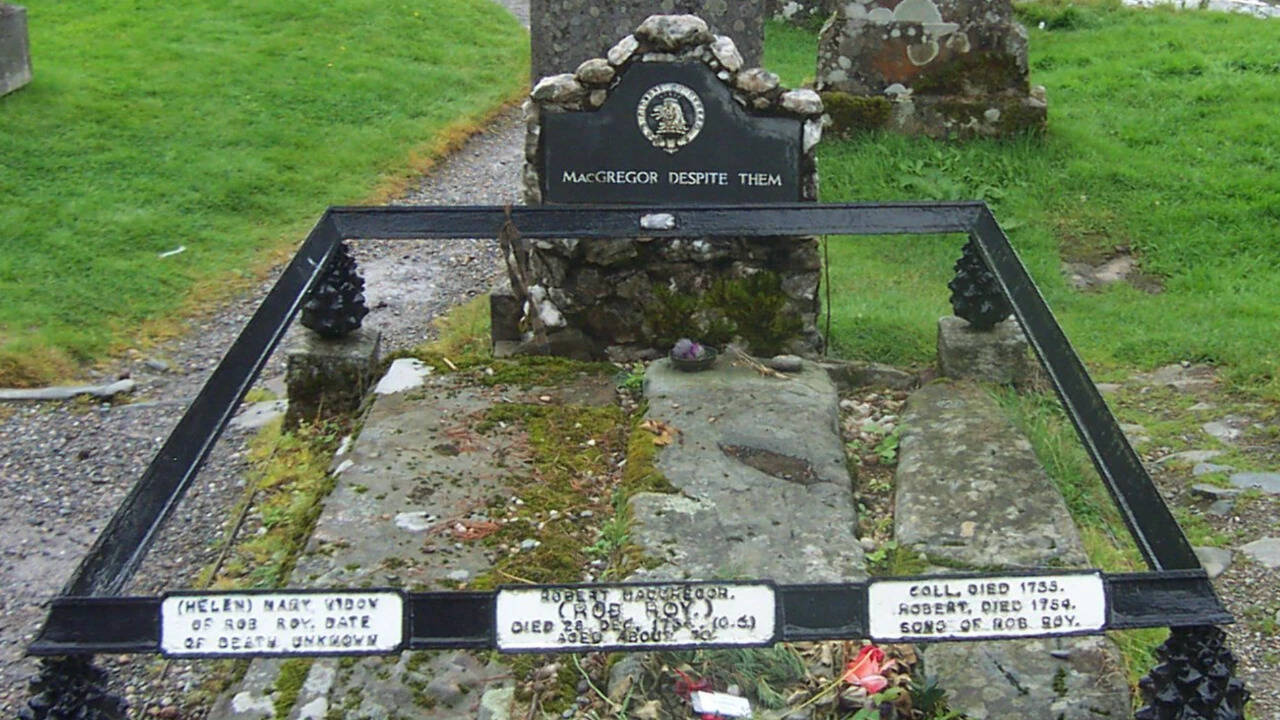
For nearly three centuries, tourists and history buffs have walked through the damp churchyard at Balquhidder in Scotland to stand before the grave of Rob Roy MacGregor. People assume the stone slab resting over the famous outlaw's bones was carved specifically for him when he died in 1734.
They are wrong.
Recent high-tech 3D imaging by the Balquhidder Graveyard Claymore Project tells a radically different story. The primary carvings on that famous stone weren't made during the eighteenth century. They were hammered into the rock roughly a thousand years before Rob Roy ever drew breath.
The Outlaw Myth Versus Physical Reality
Robert MacGregor wasn't just a Scottish folk hero. He was a cattle drover turned Jacobite rebel whose larger-than-life exploits inspired Sir Walter Scott's 1817 novel Rob Roy. When MacGregor passed away at the age of sixty-two, locals marked his burial spot with an elaborate medieval slab.
Historians long suspected the stone was recycled. Mediaeval grave markers were expensive and hard to come by in the rugged Scottish Highlands, so communities frequently repurposed older monuments. But nobody knew just how ancient the original canvas actually was until researchers started deploying photogrammetry tools to map every micro-crevice of the stone's surface.
What High-Resolution Photogrammetry Uncovered
Researchers working on the site discovered carvings that belong squarely in the early medieval period. Archaeologists spotted a distinct cross-like design near the top of the slab. This carving represents a flabellum, an ancient ceremonial fan used during early Catholic religious services.
Alongside the flabellum, the stone features two smaller crosses carved using a meticulous technique known as pocking and smoothing. This specific stonemasonry style is a hallmark of early Christian sculpture across Britain.
The presence of these early medieval religious symbols completely flips our understanding of the monument. Archaeologists now believe the heavy stone slab originally marked the final resting place of a high-ranking cleric or church official from the early medieval era, centuries before clan politics and cattle raids dominated the Balquhidder valley.
How Stone Was Recycled Across Centuries
Old monuments in Scotland didn't just sit untouched. They evolved through multiple generations of reuse.
The Balquhidder stone experienced at least two major phases of modification long before it became associated with Rob Roy. Sometime during the fifteenth or sixteenth centuries, other hands took chisel to rock. They added new images including a formidable broadsword, a pair of blacksmith tongs, and hunting motifs typical of late medieval Highland grave slabs.
Even the iconic figure often interpreted as Rob Roy himself—complete with a belted plaid and shield—might be an altered version of an older carving rather than a bespoke portrait commissioned after his death in 1734. The stone is basically a stone-carved palimpsest, where every era scraped away or built upon the layer left behind by the generation before.
Why This Discovery Matters For Scottish Archaeology
Reusing sacred stones reveals how medieval and early modern Highland communities viewed their landscape. They didn't treat history as a closed chapter. They recycled sacred spaces and ancestral markers to legitimize new power figures.
When you visit Balquhidder churchyard today, you aren't just looking at the grave of an eighteenth-century outlaw. You are staring at an ancient artifact that bridged the gap between early Christian clerics, late medieval clan warriors, and the Romantic myth-making of the Georgian era.
Modern digital archaeology allows us to peel back those hidden layers without damaging the physical stone. As projects continue mapping historic Scottish graveyards, expect more famous folk hero monuments to reveal surprisingly deep and unexpected roots.