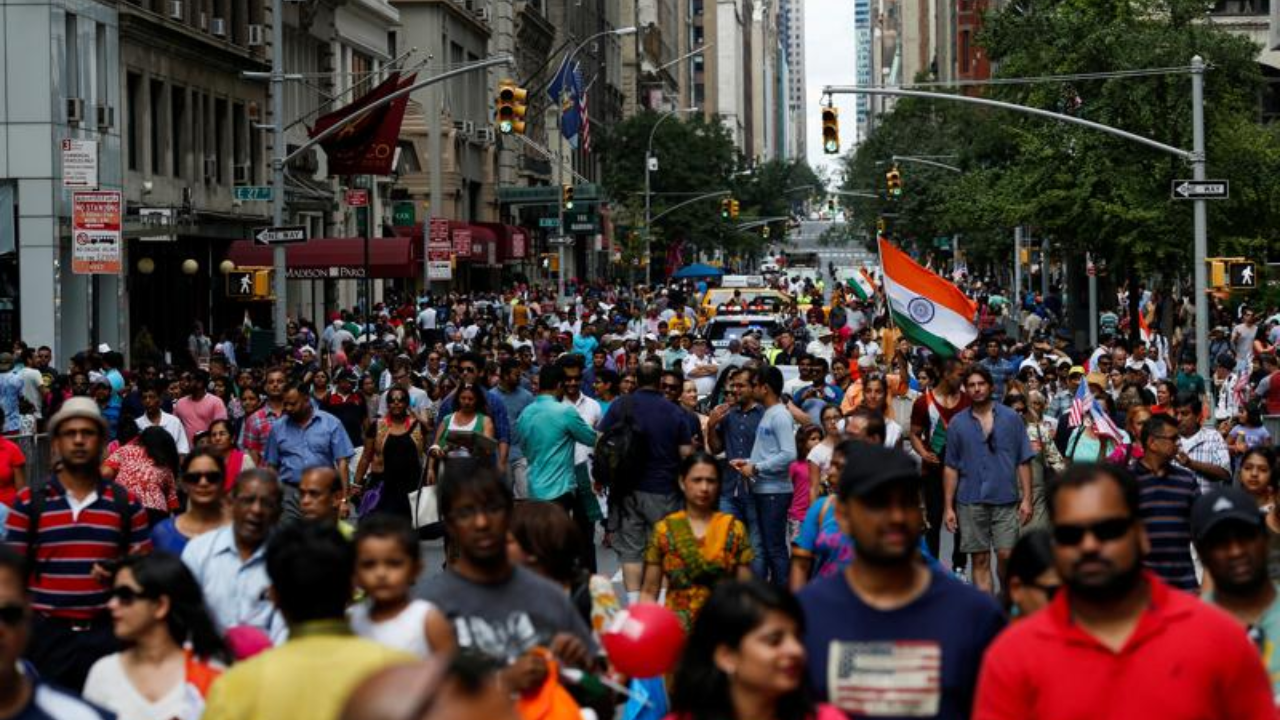
History has a funny way of looping back on itself. Take Forsyth County, Georgia. Decades ago, this patch of northern Georgia was synonymous with racial hostility and the total exclusion of non-White residents. Today, walk through its upscale neighborhoods, and you will hear Telugu and Hindi echoing down the suburban blocks. You will see sprawling multi-million-dollar homes, grocery aisles stocked with dosa batter, and a cultural footprint that is reshaping the American South in real time.
Roughly 52,000 Indian-Americans now call Forsyth County home, making up about 16 percent of the local population. They are engineers, entrepreneurs, doctors, and tech professionals drawn to top-tier schools and economic mobility. But moving into a region with a dark racial past brings a unique set of dynamics that most newcomers do not expect.
The Irony of the Soil
When families settle into newly constructed enclaves—like a neighborhood in Cumming where Indian homeowners occupy 45 out of 56 five-bedroom properties valued at roughly 1.5 million dollars each—few dwell on what happened here centuries ago.
Long before suburban cul-de-sacs and tech commutes, European settlers drove Indigenous Cherokee communities off these exact lands. Later, Forsyth earned a national reputation for racial cleansing, driving out its entire Black population in 1912 after decades of intimidation, and remaining virtually all-White for most of the twentieth century. It even served as a revived hub for the Ku Klux Klan.
Venu Challa, a long-time Georgia resident who relocated to Cumming, points out the stark generational and historical contrast. He notes that many immigrants arrive chasing the American dream without realizing the heavy historical baggage carried by the local soil. Understanding that past changes how you look at your neighbors, how you integrate, and how you build a community.
Commerce Culture and Community
The physical landscape of Forsyth has shifted dramatically to mirror its new demographic reality. Greater Atlanta now boasts around 100 Hindu temples, including massive spiritual centers like the BAPS Swaminarayan temple, which opened to crowds and celebratory elephant processions. Local festivals like Ganesh Chaturthi feature helicopter flower drops, turning suburban Georgia skies into scenes straight out of Mumbai or Hyderabad.
Step into regional grocery stores like Suvidha, and you realize this isn't just about housing developments. It is an entire ecosystem. Shelves are lined with fresh paneer, multiple varieties of atta, and sweets for Diwali.
Yet, this rapid clustering creates an insular bubble. Sociologists and community organizers point out that tight-knit ethnic networks make the initial migration transition smoother, but they can also stunt organic social interaction with long-term white residents. When communities live side-by-side rather than together, subtle friction points emerge—fueled further by broader national political currents like the MAGA movement, where rapid demographic changes frequently become flashpoints for anxiety over national identity.
The Next Generation Changes the Equation
Immigrant parents often lean on familiar cultural anchors for comfort, but their children view Forsyth County through an entirely different lens.
Second-generation Indian-Americans do not carry the psychological baggage of migration, nor do they stay confined within rigid regional or linguistic divisions imported from back home. They play American sports, run for local student office, and increasingly step into public life. Recent midterm elections highlighted a growing wave of second-generation political candidates and civic leaders across Georgia—a reality that would have been unthinkable during Forsyth's segregated past.
Integration is never a straight line. It requires mutual friction, shared schools, neighborhood barbecues, and time. Forsyth County proves that demographics are not static. A place once defined by rigid exclusion is now writing an unexpected chapter on modern American pluralism, driven by families who decided that a better future outweighed an ugly past.



