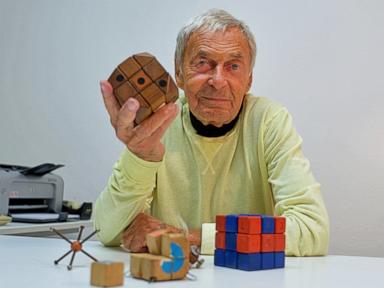
More than four decades after local manufacturing stopped, the legendary Rubik's Cube is once again being produced right where it started. A state-of-the-art, fully automated production line was recently launched at the Jász-Plasztik Kft. plastics processing plant in Jászberény, Hungary.
For inventor Ernő Rubik, now 82 years old, the moment brings his creation full circle. Standing at the factory opening, he noted that Hungary is the true home of the cube and where it was born. While hundreds of millions of these colorful puzzles have been churned out across the globe since the 1980s, the machinery that builds them has been absent from Hungarian soil for over forty years.
The Accidental Masterpiece That Conquered the World
Most people forget that the cube was never meant to be a toy. Back in 1974, Ernő Rubik worked as a professor of architecture and design at the Academy of Applied Arts in Budapest. He struggled to explain three-dimensional movement and spatial geometry to his students using textbooks or lectures.
He needed a physical model. Using 27 small wooden blocks, rubber bands, and paper clips, he built a prototype that could twist and turn without falling apart.
When he finally scrambled the colored blocks for the first time, he faced an unexpected problem. It took him an entire month to solve his own creation. What started as a university teaching aid turned out to be one of the most addictive puzzles in human history.
He patented the design in Hungary as the Bűvös Kocka, or Magic Cube. Local toy shops started stocking it in 1977 behind the Iron Curtain. By 1980, international distributors caught wind of the craze, rebranded it after its creator, and launched it onto the global stage.
Inside the New Hungarian Factory Line
The return of production to Hungary isn't just a nostalgic marketing stunt. It represents a serious manufacturing investment handled by Jász-Plasztik Kft., which serves as an official supplier utilizing advanced robotics and high-tech automation.
The facility aims to produce roughly one million cubes annually. To mark the inauguration of the plant, the very first cube off the assembly line won't hit retail shelves. Instead, organizers auctioned it off to raise funds for the local St. Elizabeth Hospital in Jászberény.
Building a modern Rubik's Cube requires precise engineering. The classic 3x3 puzzle consists of 26 individual moving pieces, or cubies, locked together in a mechanical mechanism that allows billions of possible configurations without jamming or flying apart. Rebuilding that manufacturing capacity in Hungary bridges a massive historical gap for a country deeply proud of its scientific and intellectual heritage.
Why the Cube Still Captivates Us
In an era dominated by screens, algorithms, and digital distractions, the tactile simplicity of a plastic puzzle remains astonishingly resilient. People still buy millions of them every year.
Speedcubers regularly solve the puzzle in under four seconds using complex algorithms and lightning-fast finger tricks. Yet, casual owners still find plenty of satisfaction in simply cracking the puzzle on their own, even if it takes them an hour or a week.
Ernő Rubik once remarked that when you create something, you have the chance to make something both meaningful and beautiful. Forty years after the original production lines moved away from Central Europe, that creation is once again rolling off factory floors in the country where it all began.
If you have an old cube gathering dust in a drawer somewhere, pull it out, scramble the colors, and remember that it all started with a wooden block and a frustrated design teacher in Budapest.



