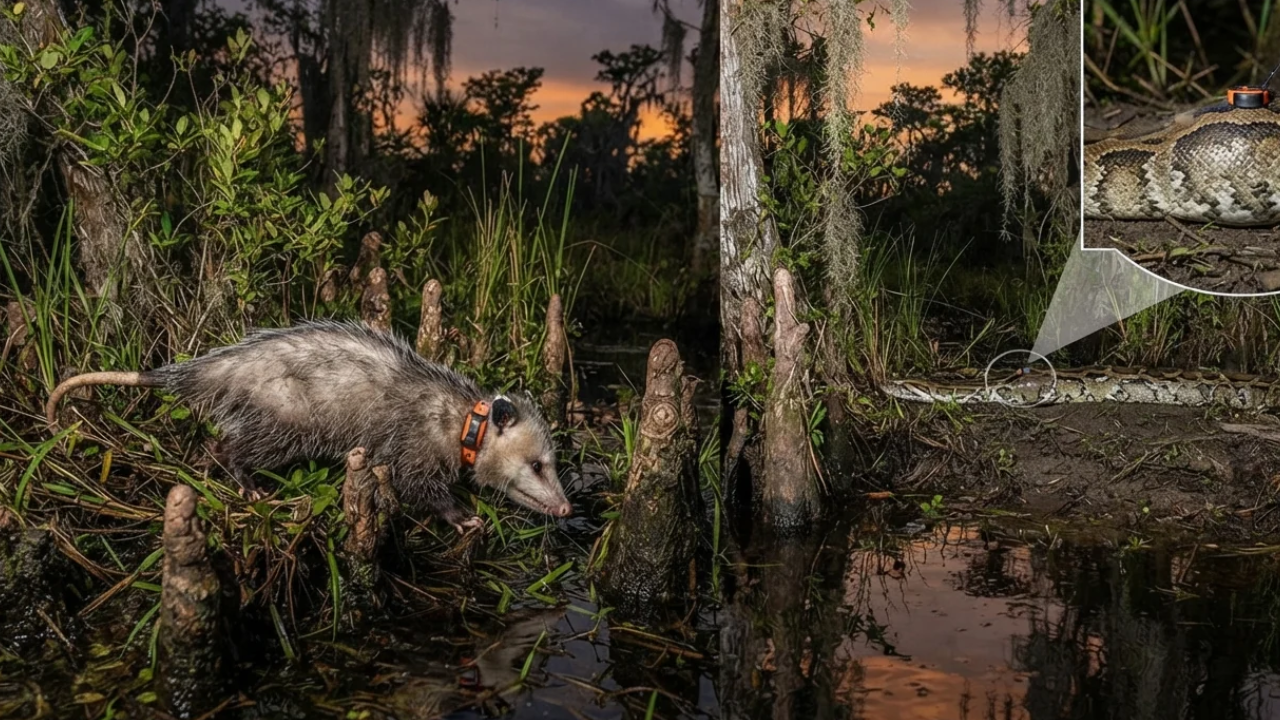
If you think catching an 18-foot python hiding in the Florida Everglades is difficult, you're right. These apex predators blend into dense swamp vegetation so well that finding them visually is mostly a matter of sheer luck. But wildlife biologists have recently found a clever workaround using an unlikely accomplice: the common opossum.
Instead of searching blindly through the sawgrass, researchers are now letting the prey do the work. By fitting small mammals with GPS tracking devices, scientists can monitor their movements remotely. When an opossum collar stays completely stationary for four hours and then suddenly starts moving again across the swamp, it usually means one thing. A Burmese python just swallowed the animal whole, tracking device and all.
The Accidental Discovery That Changed Python Tracking
Wildlife researchers originally placed GPS tags on opossums and raccoons in South Florida to study normal small mammal behavior and local habitat use. But the location data quickly revealed an unexpected trend.
Certain collars stopped transmitting movement for hours before suddenly shifting locations over considerable distances. It wasn't a malfunction or a signal glitch. The tracking equipment remained functional inside the digestive tracts of Burmese pythons. Because these massive snakes swallow their meals completely intact, the internal electronics continue broadcasting coordinates as the snake digests its meal and relocates.
Biologists working at the Crocodile Lake National Wildlife Refuge in Key Largo quickly realized they had stumbled onto a breakthrough. Instead of waiting to spot a snake by chance, they could wait for a motionless signal to wake up and start traveling.
Why Finding Burmese Pythons Is Such a Nightmare
Burmese pythons are native to Southeast Asia, but an established breeding population has taken over South Florida. First officially recorded in Everglades National Park in 1979, these non-native predators have grown into a massive ecological crisis.
They are notoriously difficult to control for several reasons:
- Exceptional camouflage in thick marshlands.
- Massive physical size, with specimens frequently exceeding 15 to 19 feet in length.
- Low detection rates during standard nocturnal or daytime visual surveys.
Their unchecked proliferation has devastated local wildlife. Historic mammal surveys in Everglades National Park documented a staggering 98.9% decline in opossum sightings and a 99.3% drop in raccoon observations between the pre-2000 period and the early 2010s. The spread of pythons directly correlates with these crashing populations, disrupting the entire regional food web.
Scaling Up the Tracking Operation
When the project first started, the specialized GPS equipment carried a heavy price tag of roughly $1,500 per collar. That high cost limited how many animals researchers could monitor at once.
Prices have since dropped to around $190 per device, allowing the team to expand the initiative significantly. Biologists have already fitted 32 opossums with collars and are scaling up the program.
Critics have occasionally questioned whether using prey animals as passive tracking beacons puts wildlife at unnecessary risk. However, researchers point out a fundamental reality of the Everglades ecosystem. Opossums live in an environment where Burmese pythons hunt them naturally every single day. The scientific team isn't introducing a brand-new threat into the habitat; they're simply documenting an existing predator-prey interaction and using the data to remove an invasive apex predator.
When a tagged collar signals that a snake has consumed an opossum, field teams use the coordinates to track down the reptile. Once they locate the python, they euthanize it to protect native species, retrieve the tracking collar, clean it off, and deploy it on another animal.
It's a practical, real-world strategy born out of necessity. As long as invasive pythons continue reshaping Florida's landscape, unexpected tracking methods will remain one of the best tools conservationists have left.